EXPORT CONTROLS MANUAL

PREPARED BY:
Office of General Counsel
The California State University
SEPTEMBER 2012
Table of Contents
I. INTRODUCTION .........................................................................................................
1
II. HISTORY OF EXPORT CONTROLS ......................................................................
1
III. CURRENT EXPORT REGULATORY FRAMEWORK ..........................................
2
A. The Department of Commerce and the Bureau of Industry Security ......................
2
B. The State Department and the Directorate of Defense Trade Controls ...................
2
C. The Department of Treasury and the Office of Foreign Asset Control (OFAC) ....
2
D. Other Federal Agencies That Regulate Exports ......................................................
2
IV. WHAT IS AN EXPORT? ..............................................................................................
3
V. EXPORT LICENSE ......................................................................................................
3
VI. CONTENT ......................................................................................................................
4
A. What is being exported? ..........................................................................................
4
B. How it can be used...................................................................................................
4
VII. DESTINATION .............................................................................................................
4
A. Where is it going? ....................................................................................................
4
B. End User Certification .............................................................................................
5
VIII. EXPORT LICENSE EXEMPTIONS ..........................................................................
5
A. Educational Information Exemption .......................................................................
5
B. Fundamental Research Exemption ..........................................................................
5
C. Public Domain .........................................................................................................
5
IX. DEEMED EXPORTS ....................................................................................................
6
X NON-IMMIGRANT APPLICATIONS AND “DEEMED EXPORTS” ................... 6
XI. CONCLUSION .............................................................................................................
6
RESOURCES .............................................................................................................................
6
APPENDIX
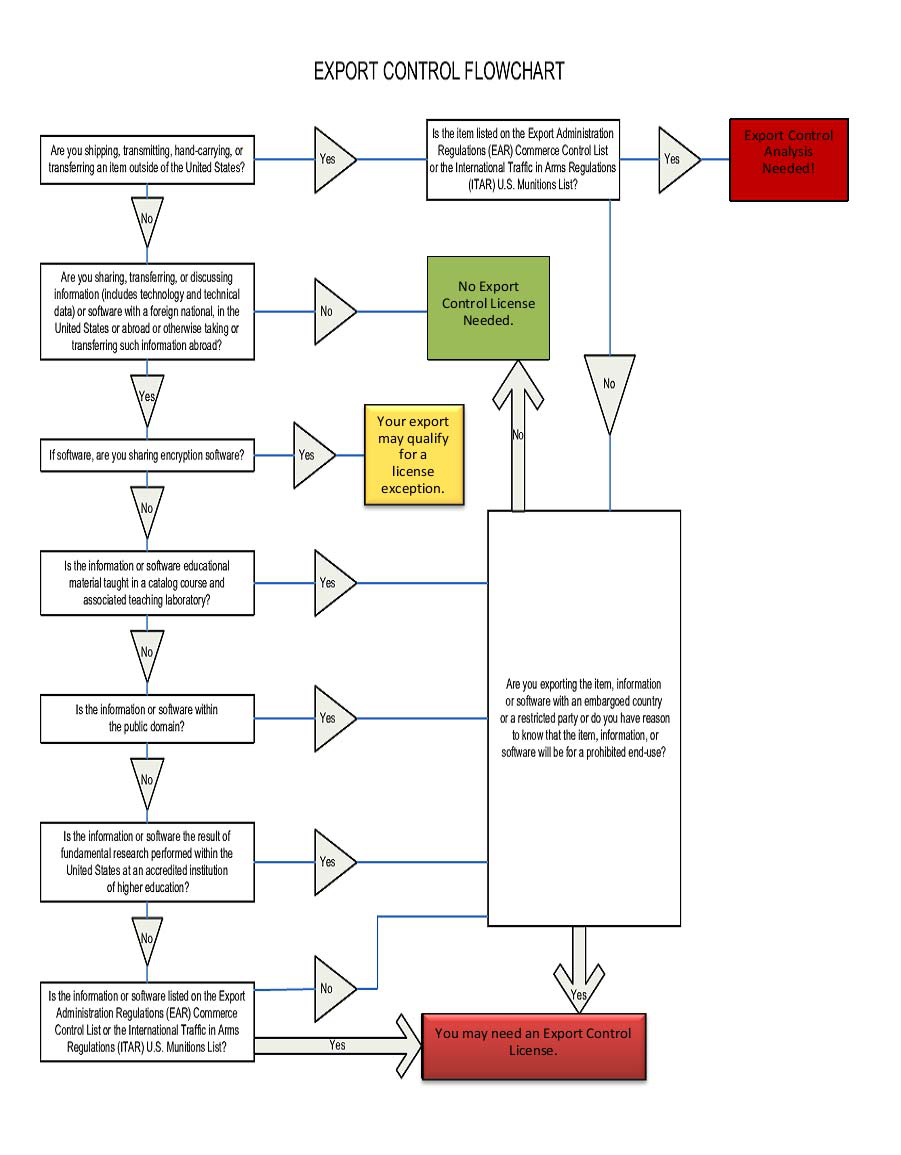
Export Control Flow Chart .........................................................................................................
7
I. INTRODUCTION
Certain types of equipment, software and technology are regulated by the U.S. government
and this may impact the university and its employees’ ability to host international
visitors, participate in international conferences, and conduct research in a completely
open environment. While the CSU remains dedicated to academic freedom and openness
in research, it must comply with the various laws and regulations known as export
controls. Non-compliance with export controls may subject the university and individuals
involved to civil and criminal penalties.
“Export Controls” covers a much broader array of activities than the term suggests.
Export controls can apply to international faculty (faculty who are not U.S. citizens
or permanent residents), international students and international visitors, as well
as faculty and staff who travel outside the U.S. “Exporting” can occur through international
shipments and physically carrying products and technology outside the U.S. (physical
exports), or through “deemed” exports, which can include the domestic transfer of
technology, or providing technical and/or financial assistance and training to foreign
nationals in the United States.
The Office of General Counsel has prepared this manual to give you a general overview
of a complex subject. Please consult OGC on a case-by-case basis as the need arises.
II. HISTORY OF EXPORT CONTROLS
In 1775, the Continental Congress outlawed the export of goods to Great Britain, thus
establishing the first American export control. Since then, the United States has
imposed export controls for a variety of reasons through legislation such as the Embargo
Act, Trading with the Enemy Act, the Neutrality Act, and the Export Control Act.
The Export Control Act of 1949 gave the U.S. Department of Commerce primary responsibility
for administering and enforcing export controls on “dual-use” items (i.e., those items
that have both commercial and military applications), and for the first time defined
three reasons for the imposition of these controls: national security, foreign policy,
and commodities in short supply. The Export Administration Act of 1979 provides the
basic framework for export controls currently in place and has since been amended
several times. While the Act itself actually expired in 1994 and again in 2001, the
Export Administration Regulations remain in effect and the Department of Commerce
is currently acting under the authority conferred by Executive Order No. 12924, signed
on August 19, 1994. In that Executive Order, the President invoked his authority,
including authority under the International Emergency Economic Powers Act, to continue
in effect the system of controls that the United States had maintained under the Export
Administration Act. Controls also are maintained for purposes of nuclear non-proliferation
under the Nuclear Non-Proliferation Act of 1978.
III. CURRENT EXPORT REGULATORY FRAMEWORK
Currently, the three agencies that have adopted regulations that are likely to have the most impact on university activities are:
A. The Department of Commerce and the Bureau of Industry Security
Export Administration Regulations (EAR) - The Department of Commerce has responsibility to regulate the export of “dual use” commodities (those that may have both a commercial and a military application), software and technology. These items are listed on the Commerce Control List and are administered through the U.S. Department of Commerce’s Bureau of Industry and Security. (Export Administration Regulations, 15 C.F.R. Sections 730-744)
B. The State Department and the Directorate of Defense Trade Controls
International Traffic in Arms (ITAR) – The State Department has responsibility for the export of defense articles and defense services identified on the U.S. Munitions List. (22 C.F.R. Sections 120-130)
C. The Department of Treasury and the Office of Foreign Asset Control
The Department of Treasury regulates commerce with a specified list of embargoed countries and with certain “specially designated nationals”. These regulations are subject to change because of the statutory powers given the President to protect U.S. foreign policy or national security. (31 C.F. R. Sections 500 et seq.; Executive Order 13224)
D. Other Federal Agencies That Regulate Exports:
- The Nuclear Regulatory Commission licenses the export of nuclear materials and equipment;
- The Department of Energy regulates the export of natural gas and electrical power, as well as nuclear technology and technical data for nuclear power;
- The Drug Enforcement Administration regulates the export of controlled substance and precursor chemicals;
- The Food and Drug Administration regulates food, drugs and cosmetics safety; and
- The Department of Agriculture guides exporters in meat, poultry and egg products, plants and pests.
Not all federal agency export regulations are the same. While this Manual identifies some of the major definitions and exemptions, specific agency regulations must be reviewed for each exported item.
IV. WHAT IS AN EXPORT?
Any tangible or intangible item that is sent from the U.S. to a foreign destination
is an export subject to regulation. “Items” include commodities, software or technology,
clothing, building materials, circuit boards, automotive parts, blue prints, design
plans, retail software packages and technical information.
It does not matter how the item is transported. It can be sent by regular mail, hand-carried
on an airplane, sent by facsimile to a foreign destination, uploaded to or downloaded
from an internet site, transmitted via e-mail, or even sent through a telephone conversation.
Regardless of the method used for the transfer, the transaction is considered an export.
An item is considered an export even if it is leaving the United States temporarily,
is not for sale, is being transshipped through the U.S., or is being returned from
the U.S. to its foreign country of origin.
A release of technology or source code to a foreign national physically present in
the U.S. is “deemed” to be an export to the home country of that foreign national
under export control regulations.
It is considered an “export” of technology when a faculty member leaves the U.S. with
a laptop containing computer programs or technical data. A “deemed” export may occur
when a foreign national visits a campus laboratory or a consultant is hired. The sending
of emails, faxes or even telephone conversations involving technical information may
be considered an “export”.
V. EXPORT LICENSE
A license is the method by which the U.S. government grants permission for an item
to be exported that otherwise would be subject to export controls. While a relatively
small percentage of total U.S. exports require a license, the main criteria for determining
if a license is required are 1) the content or the technical characteristics of the
item and its ultimate use, and 2) the destination of the item, including the country of the ultimate end user.
When an export license is required, most applications are made to the Bureau of Industry
and Security of the Department of Commerce (BIS), including export items regulated
by other federal agencies. The application must be approved and the license issued
before the goods or technology may be exported. A license may be issued with certain
conditions attached, such as limiting the capability of the export product, restricting
the item to civilian use and prohibiting its use for military or intelligence gathering
purposes, or prohibiting the resale of the item to another country.
VI. CONTENT
A. What is being exported?
The Bureau of Industry and Security of the Department of Commerce maintains the Commerce Control List (CCL). This list includes all items subject to export controls, except for those under the control of another branch of the government. The Department of State has responsibility for regulating all munitions, defense articles and defense services. The list of items controlled by the Department of State can be found in the ITAR regulations. These two agencies and lists cover the most commonly required export licenses. Other government agencies regulate the specific items described above, but the majority of regulated exports are contained in the CCL or ITAR lists.
B. How can it be used?
In general, the Export Administration Act and the BIS regulate items designated as “dual use”. This designation means that an item may have a commercial use, but also may have a military or defense purpose. The designation of “dual use” is a convenient way to describe items that are regulated by the BIS, regardless of whether it actually has a military or defense purpose. The more likely an export is to have a military or defense purpose, the more likely it is to be regulated and need a license for export.
VII. DESTINATION
A. Where is it going?
The destination of the item or technology is the second factor that is considered
when determining if government permission is needed for export (export license.) Certain
countries, organizations and individuals are subject to trade sanctions, embargoes
and other restriction under U.S. law. These restrictions apply to both domestic and
foreign transactions.
The Office of Foreign Assets Control of the Department of Treasury maintains the lists
of countries that have been designated “comprehensively embargoed”. At the time of
preparing this Manual, these countries are Cuba, Syria and Iran. Comprehensive embargoes
prohibit virtually all exports and other transactions without a license or other U.S.
government authorization. The countries that are subject to targeted sanctions, where
specific types of transactions are prohibited, include Libya, Sudan, North Korea,
Myanmar (formerly Burma), Liberia, Iraq, Zimbabwe, Balkans, and the Cote D’Ivoire
(formerly Ivory Coast.)
Countries that are restricted by the Export Administration Act can be found in the Commerce Country Chart, 15 C.F.R. Part 738, Supplement No. 1.
B. End User Certification
Both ITAR and EAR regulations require the campus to certify the ultimate end user of the item or technology. It is the responsibility of the campus to know who the ultimate end user will be and to take steps to ensure that this is actually the case. If an item or technology ends up in the control of a person in a country that would require a license, the campus and/or employee will be held to have violated U.S. law and will be subject to civil and criminal penalties.
VIII. Export License Exemptions
An export license is not required if the item or technology falls within one of the following exemptions. While these exemptions are found in most federal agency export regulations, a review of specific regulations must be made for individual circumstances:
A. Educational Information Exemption
Educational information may be exported or “deemed” exported without an export license during instruction in courses regularly offered by universities. This exemption includes instruction in science, math and engineering concepts taught in courses listed in the university’s catalogue and associated teaching laboratories, even if the information concerns export controlled commodities or items. (EAR 15 C.F.R. 734.3(b)(3)(iii), 734.9; ITAR 22 C.F.R. 120.10(5))
B. Fundamental Research Exemption
As used in the export control regulations, the fundamental research exemption includes basic or applied research in science and/or engineering at an accredited institution of higher learning in the U.S. where the resulting information is ordinarily published and shared broadly in the scientific community. Research will not be considered “fundamental research” if the campus accepts any restrictions on the publication of the information resulting from the research, or the research is federally funded and specific access and dissemination controls have been accept. (EAR 15 C.F.R. 734.8(a), (b); ITAR 22 C.F.R. 120.11(a)(8))
C. Public Domain
Information that is published and generally accessible or available to the public through sales at bookstores or newsstands, subscriptions, libraries, patents available at any patent office, conferences, meetings, seminars or trade shows, or through fundamental research. (EAR 15 C.F.R. 734.3(b)(3), 734.7-734.10; ITAR 22 C.F.R. 120.10(a)(5), 120.11, 125.1(b), 125.4)
There are also some special exceptions to the export license regulations. These include shipments of limited value, gifts and humanitarian donations. (15 C.F.R. 740)
IX. DEEMED EXPORTS
The export regulations include the concept that the release of controlled information or data to a foreign national visitor, employee or student within the U.S. is “deemed” to be an export to that visitor, employee or student’s home country. This means that an export license may be required for information or technology that never physically leaves the U.S.
X. NON-IMMIGRANT APPLICATIONS AND “DEEMED EXPORTS”
The United States Citizenship and Immigration Services requires a “deemed export” certification in the visa application process for nonimmigrant workers. The Form I-129 “Petition for a Nonimmigrant Worker” requires prospective employers to declare, under penalty of perjury, that they have reviewed the Export Administration Regulations and the International Traffic in Arms Regulations, and that with respect to the technology or technical data the employer will be releasing to the employee, either a license is not required, or if it is, the campus will prevent access to the controlled technology or technical data until the required license is received. This means that campuses facilitating an application for an H or O visa for an employee must be familiar with export control regulations.
XI. CONCLUSION
Export control regulations are complex, but the consequences of violating these regulations are significant. This Manual is necessarily general in nature. The Office of the General Counsel is available to respond to any export control questions.
RESOURCES
Commerce Control List (contains the official list of controlled technology, commodities, and software):
http://www.access.gpo.gov/bis/ear/ear_data.html
U.S. Munitions List (Lists regulated defense articles and associated controlled data): http://www.pmddtc.state.gov/regulations_laws/documents/official_itar/ITAR_Part_121.pdf
Office of Foreign Assets Control (OFAC restricts transactions with foreign countries that have sanctions in place
as well as the ability to transact with certain entities or individuals): http://www.treasury.gov/about/organizational-structure/offices/Pages/Office-of-Foreign-Assets-
Export Control Flow Chart
This PDF is provided as a print-only reference document and may not be fully accessible to users of assistive technology. For more information, please visit Title II Rule on Digital Accessibility page.