Post-COVID Task Force
Preliminary Report and Recommendations to the Academic Senate
5/2/22
Post-COVID Task Force
Preliminary Report and Recommendations to the Academic Senate
Monday May 2, 2022
Membership of Task Force
Faculty
• Katie Dyer (COSS, Chairs Council) – Chair
• Katy Tarrant (JCAST) – Vice Chair
• Jim Mullooly (COSS) - Secretary
• Marcus Crawford (CHHS)
• Lizhu Davis (CSB)
• Amanda Dinscore (HML)
• Ray Hall (Senate)
• Zoulikha Mouffak (LCOE)
• Karl Oswald (CSM)
• Lorin Lachs (CSM, president appointee)
• Virginia Patterson (CAH)
• Kathleen Rindahl (CHHS)
• Yuleinys Castillo (KSOEHD)
Students
• D’Aungelique Jackson
• Caroline Alvarez
• Kalyan Madoori
• Anou Vang
Staff Assembly
• Deb Reba
• Belinda Munoz
Administrators
• Jim Schmidtke (Faculty Affairs)
• Bernadette Muscat (Dean of Undergrad Studies)
• Honora Chapman (Dean of CAH, provost appointee)
• Bryan Berrett (IDEAS)
The Charge:
• To what extent does our accreditor, the Western Association of State Colleges, require
us to teach in person versus online teaching?
• To what extent do students want largely online courses and office hours (with little
in-person contact with faculty)?
• Should students be permitted to pursue degrees that are entirely (or almost entirely)
online?
• To what extent can course content and effective teaching be done without in-person
contact with students?
• Are there inequalities in workload that might develop among faculty if some faculty
rarely (if ever) come to campus?
To what extent does WASC require us to teach in person versus online teaching?
• WASC has changed its “counting” system, so that all of GE is now “distance education”
which means, by default, that every single Fresno State degree is, essentially, a
“distance education degree program.”
• All of our programs will soon be approved as distance education programs. Therefore,
there is no longer an accreditation barrier.
• (But we may need a new mechanism for the Senate to review proposals for fully online
programs.)
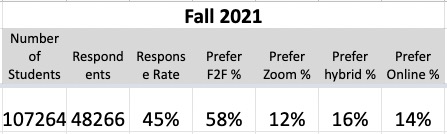
To what extent do students want online courses and office hours?
Office Hours: We have no data directly on the question. But students have a clear
preference (demonstrated through scheduling) for academic advising online. Only 4%
of advising meetings F2F in Fall 2021.
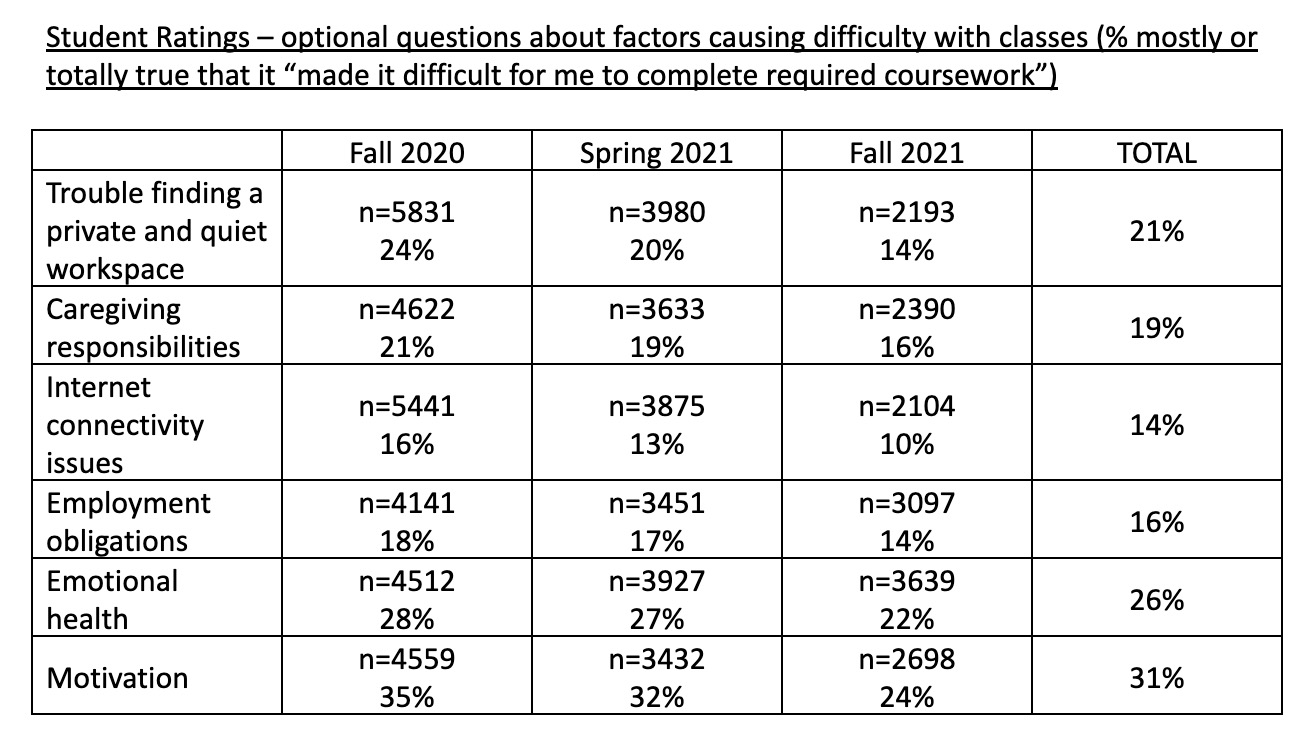
Student Ratings Data
Should students be permitted to pursue degree that are entirely ( or almost entirely)
online?
No.
14/15 Task Force members agreed to this statement:
While students may benefit from flexibility in course modality and effective online
coursework is possible in some classes, the education of a student at a comprehensive
regional campus must also involve participation and inclusion in the building of a
vibrant and diverse campus culture, which requires students to be physically present
on campus and in the local community for a meaningful fraction of their coursework.
Should students be permitted to pursue degrees that are entirely (or almost entirely)
online?
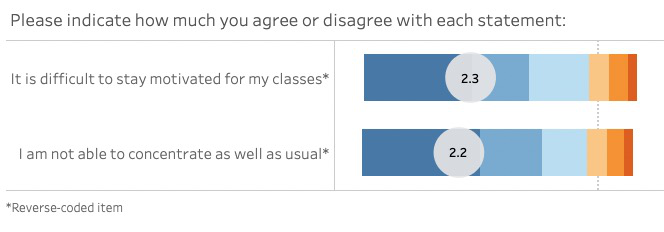
Rapid Response Surveys
– Sept, Oct, & Nov 2020
The ”fully online” experience was very difficult for most students And was not successful
for our most vulnerable students
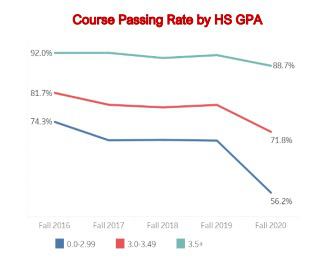
To what extent can effective teaching be done without in-person contact with students?
Conclusions:
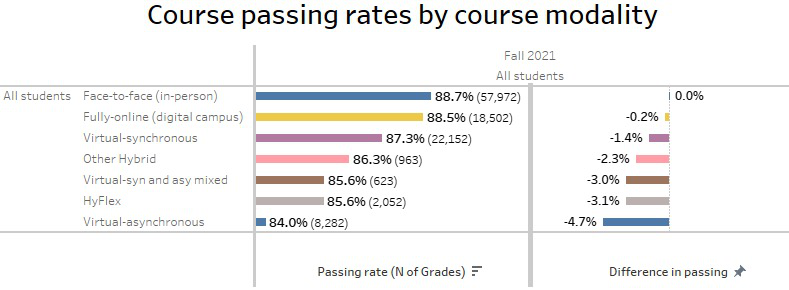
For 80%(ish) of students, it works fine. (Especially when their instructors are well-trained
and experienced with online teaching.)
For 20%(ish), it is deeply problematic.
For 3%(ish) it is not effective.
We need to continue to explore how to make it work better.
Are there inequalities in workload that might develop if some faculty rarely (if ever)
come to campus?
• Yes.
• 14/15 Task Force members agreed to this statement:
While teaching and committee work can sometimes be achieved remotely, tenured and
tenure-track faculty bear primary responsibility for creating and maintaining the
intellectual community of the campus, and they can only do that if they are physically
present on campus and in the local community for a meaningful fraction of their workload.
Primary Recommendation:
Majority Position
• A new university-wide policy is required whereby faculty (not admin) will establish
limits on class modality assignments.
1. Full-time tenure-track faculty may only teach x% of their instructional WTUs in
a distance modality. (To create an on-campus requirement for TT faculty, to protect
workload equity.)
2. Departments may only offer y% of their instructional WTUs in a distance modality.
(To prevent us from drifting too far toward online degrees.)
3. A class may only be offered in a distance modality if it is also available F2F.
(To protect the students who may not have the resources to succeed in them.)
• All departments must maintain a list of courses that may or may not be taught online.
At least 2/3 approval by members of Task Force
Alternative Recommendation:
Minority Position
• Departments must each create their own policy to establish limits (or not) on class
modality assignments.
• Limits on individual faculty members
• Limits on department offerings
• Limits on courses
Other Recommendations
• We support the MCJ recommendation to match office hours to the modality of the class
(APM 338).
• We support policies that would allow remote work for staff for those offices where
this makes sense, rather than a one-size-fits-all plan.
• We request that the Bulldog Test Center be allowed to resume providing services
to instructors of online classes.
At least 2/3 approval by members of Task Force
What Next?
• We have only clarified some questions, and put some evidence on the table regarding
each one.
• Our final report will include a list of specific policies that need consideration
with some suggestions. Senate committees now need to craft and debate policies.
• Some major remaining “post-COVID” issues are not necessarily policy ones.
• How we as a campus might address the collective trauma of the past two years?
• What we have learned that will change how we do business in the future. How we teach,
hold meetings, conduct searches, manage offices, etc.?
This HTML version was generated with AI assistance and may contain errors or omissions. The original approved PDF remains the official document of record. An alternative accessible format is available upon request from the document creator in accordance with Title II of the ADA.