Fresno State Surveys During COVID-19 Pandemic
Kathleen Dyer & Matt Zivot
January 2022
Fresno State’s Office of Institutional Effectiveness (OIE), under the guidance of Matt Zivot, has conducted a faculty survey and multiple student surveys during the pandemic in order to get a sense of the opinions and experiences of members of the campus community. The results are available in Tableau, but some highlights are summarized here.
Fall 2021 Faculty Repopulation Surveys
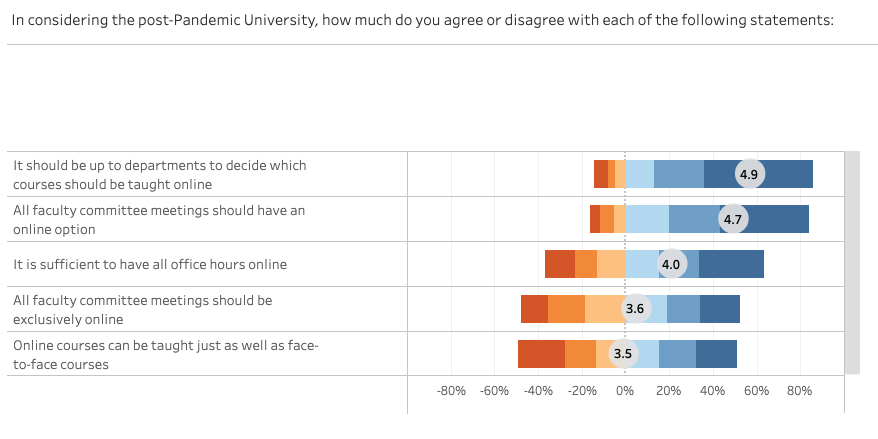
First, they conducted a faculty survey in March and April 2021 about the Fall 2021 repopulation of campus with responses from 679 faculty members, a response rate of 44%. While many of the questions refer only to campus operations in fall 2021, one set of questions specifically asked about the post-pandemic university.
Note the incredibly strong support for the statement that decisions about online teaching
should be made at the department level, and for an online option for all faculty meetings.
Also note that faculty support online office hours by a slim majority, but they are
split right down the middle on whether online courses can be taught as well as face-to-face
courses.
Rapid Response Student Surveys
Secondly, OIE has conducted a series of Rapid Response Student Surveys since the beginning of the pandemic. It has been administered Sept, Oct, and Nov 2020, as well as Feb, March, Sept, Oct, and Nov 2021. Each survey invites a random selection of Fresno State students to participate. Response rates are low (about 10%). In total, 3,009 students have participated.
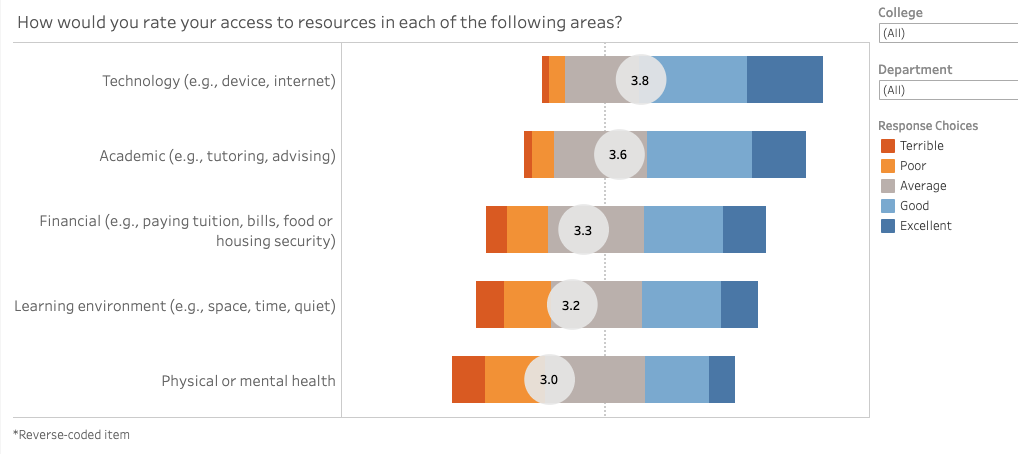
Overall, most students report good access to technology (8.5% report poor or terrible
access). But many more students struggle with learning environment (39% report poor
or terrible) and health (35% report poor or terrible).
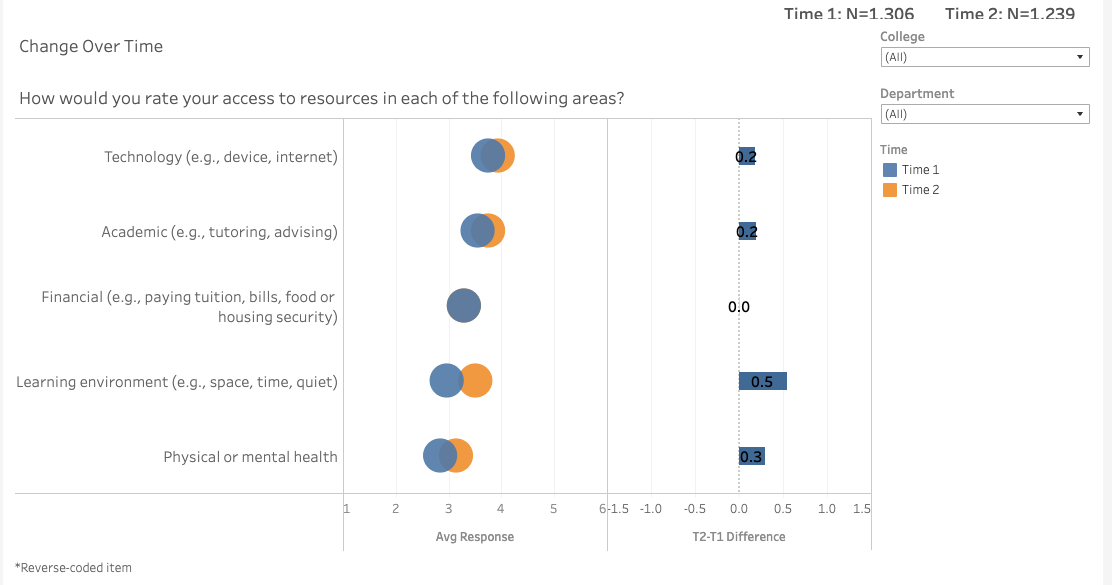
But all three of these indicators have improved marginally at least over the past
year.
Fresno State:
Matt Zivot: OIE Surveys - overall, about 15% of students had connectivity issues at
the beginning of the pandemic, it is now (Fall 2021) down to less than 10%
- 4/20, We surveyed all students in four of the colleges. When asked, “To what extent have access to reliable internet/service been a challenge for you since the transition to remote learning?”, 7% answered Extremely Challenging and 9% answered Very Challenging.
- 9/20 - We sampled 9000 students across the university. When asked, “Do you have access to adequate internet service to complete your coursework and participate in virtual instruction (e.g., Zoom)?” 7% answered No. Of the small subset (11% of the respondents) who said that they received a hotspot from the university, 9% said that it was not sufficient for them to complete their coursework.
- 9/20-11/21 - We have conducted our Rapid Response survey 8 times during this period, asking a sample of students to, “rate your access to Technology (e.g., device, internet). There has been small change over time. Combining the Fall 2020 responses, 3% of students responded Terrible and 7% responded Poor. Combining the Fall 2021 responses, 2% responded Terrible and 4% responded Poor.
Student Ratings – optional questions about factors causing difficulty with classes (% mostly or totally true that it “made it difficult for me to complete required coursework”)
| Fall 2020 | Spring 2021 | Fall 2021 | TOTAL | |
|---|---|---|---|---|
| Trouble finding a private and quiet workspace | n=5831 24% | n=3980 20% | n=2193 14% | 21% |
| Caregiving responsibilities | n=4622 21% | n=3633 19% | n=2390 16% | 19% |
| Internet connectivity issues | n=5441 16% | n=3875 13% | n=2104 10% | 14% |
| Employment obligations | n=4141 18% | n=3451 17% | n=3097 14% | 16% |
| Emotional health | n=4512 28% | n=3927 27% | n=3639 22% | 26% |
| Motivation | n=4559 35% | n=3432 32% | n=2698 24% | 31% |
February 26, 2021
RESOLUTION
Expressing the view of the Department of Media, Communications and Journalism regarding faculty office hours.
WHEREAS office hours are an essential tool for students to communicate with faculty;
WHEREAS digital technology offers unprecedented opportunities for faculty to interact
with students outside normal business hours;
WHEREAS the vast majority of classes have been offered entirely online during the
COVID-19 pandemic, necessitating that faculty communicate with students using only
remote means for that period;
WHEREAS faculty will have the option to continue offering classes online following
the public health emergency;
WHEREAS students taking online classes require a reliable method to communicate with
their professors, necessitating flexibility in how office hours are offered;
WHEREAS nearly all other California State Universities allow the modality of office
hours to match that of the course being offered, meaning that entirely online classes
offer entirely online office hours;
WHEREAS the principles of academic freedom are predicated on the idea that faculty
are experts in their field and are the most knowledgeable about how to teach and interact
with their students;
WHEREAS APM 338, which is entitled “Policy on Office and Consultation Hours,” was
last approved by the Academic Senate on April 25, 2011 and approved by the President
on July 15, 2011;
WHEREAS digital technology has improved dramatically since 2011 and students now expect
faculty to be available to engage with them using digital methods, often outside of
normal business hours;
WHEREAS faculty spend many hours a week responding to email and engaging in other
forms of electronic communication with students that did not exist in previous decades
when office hour policies were originally framed;
WHEREAS a body of research contained as an Appendix to this Resolution increasingly
suggests that students are more comfortable engaging with their instructors using
digital means;
WHEREAS some students have legitimate difficulties or concerns about traveling to
campus to meet with their instructors in a face-to-face setting;
Resolved, that the Department of Media, Communications and Journalism:
- Finds that:
- Faculty should have an option to offer office hours entirely online;
- The modality of office hours should adhere to that of the course being offered, meaning that entirely online classes should offer entirely online office hours unless the instructor believes otherwise; and —
- Faculty should be given the flexibility to interact with students using the means of their choosing, consistent with their status as experts in their fields, which is in turn established by their faculty appointments.
- Calls on the Academic Senate to amend APM 338 at the earliest possible date to reflect the above findings and allow faculty to conduct office hours entirely online.
- Calls on the university administration to honor the spirit and principles of academic freedom by allowing faculty to teach and interact with students in the manner their expert judgement leads them to conclude is best.
- Sends a copy of this Resolution to the Interim President, the Interim Provost, the Chair of the Academic Senate, the Vice Chair of the Academic Senate, the Dean of the College of Arts & Humanities, the Associate Dean of the College of Arts & Humanities, and the Chair of Chairs.
Appendices
The Department submits the below Appendices as supplements to the Resolution.
Appendix A: Survey of all CSU Office Hour Campus Policies, page 3
Appendix B: Research about student engagement in office hours, page 7
APPENDIX A TO OFFICE HOURS RESOLUTION
OFFICE HOURS POLICIES – CSU CAMPUSES
From university websites, February 12, 2021
SUMMARY:
• 18 campuses with alternative requirements for office hours (mostly matching modality
of teaching)
• 3 campuses requiring face-to-face with alternatives by permission
• 1 campus unclear of on-campus requirement
• 2 campuses requiring on-campus office hours
Campuses with Alternative Requirements for Office Hours
- CSU Channel Islands
Programs may opt to create residency requirements for faculty in regards to the number of courses and sections that may be taught off-campus and/or online; in regards to physical/virtual office hours; in regards to service.
- CSU Chico
If an instructor is teaching a class to students in remote locations or a class that is substantially online, online or remote office hours are permitted with the approval of the Appropriate Administrator. In order to best promote the objectives of a course, the instructor determines the format of online office hours. For online students desiring to meet face-to-face, instructional faculty will provide reasonable opportunity for consultation.
- CSU Dominguez Hills
The site for holding office hours may be either on campus, in the field, online, or a combination thereof.
- CSU East Bay
The way in which office hours are held should be congruent with the mode(s) of instruction. For example, faculty teaching online courses may hold office hours online.
- CSU Fullerton
Office hours are held in the instructor’s office or virtually at a time that is likely to be accessible to the students. Office hours shall be outside of scheduled class time
- CSU Humboldt
Instructors of online courses will schedule office hours accessible to their online students, or as determined by department policy.
- CSU Long Beach
Office hours can take the form of face-to-face meetings, phone conversations, and electronic communication. Because the way in which office hours are held should be consistent with the mode(s) of instruction, faculty teaching online, hybrid or field courses may schedule some or all of their office hours as determined in consultation with the department chair/school director.
- CSU LA
Faculty members shall schedule office hours consistent with the mode of instruction e.g., face-to-face, online, hybrid, or field-based modes.
- CSU Maritime
A faculty member may offer office hours electronically after consultation with and approval of the department chair and dean. The promptness and level of student interaction should be comparable to face-to-face office hours.
- CSU Monterey Bay
Instructors of online courses will schedule office hours accessible to their online
students, or as determined by department policy.
For faculty teaching fully face-to-face courses, synchronous office hours shall be
a physical presence in one’s designated office space on campus or other place on campus
that is convenient for students. In courses where the instruction is exclusively or
primarily online, faculty shall have discretion in determining appropriate places
and times for conducting the synchronous office hour(s).
- CSU Northridge
Faculty who teach online courses must hold and report office hours via a chat room or other technology that facilitates faculty/student interaction.
- CSU Sacramento
The methods of holding office hours shall be determined by department policy..
- CSU San Bernardino
Types of Office Hours
2.1. Face-to-face office hours, typically held on campus
2.2. Office hours by appointment, usually held on campus
2.3. Virtual office hours, e.g. communication between the faculty and students in
an online chat room, instant messaging, phone calls, email, or videoconferencing.
In this type of office hours, the physical presence of the faculty on campus is not
required.
- CSU San Francisco
All faculty - tenured, tenure-track and lecturers - are urged to consult with their departments and to establish the time, frequency and manner of office hours appropriate to their teaching and advising schedule.
- CSU San Jose
Allows departments to develop departmental guidelines for office hours that differ
from this policy, to best meet the needs of their faculty and students.
Modes of student-faculty communication have expanded to include various forms of electronic
communication including email, chat, and videoconference. Such technology is effective
and expedient in responding to student needs. The Faculty Office Hours Policy is being
made more flexible to allow faculty to communicate with students using the entire
range of types of communication rather than being overly reliant on scheduled, in-person
office hours.
- San Luis Obispo
For normal classroom instruction, scheduled office hours should be held in person in the faculty member’s office. For online courses, scheduled office hours should be conducted in a synchronous online mode suited to the nature of the engagement with the enrolled students. Hybrid courses may warrant an appropriate combination of in-person and synchronous online office hours.
- CSU San Marcos
The methods and frequency of office hours, virtual or in-person, will be clearly communicated to students. Faculty teaching a fully online course section must have a regularly scheduled office hour during which they are available through an on-online technology appropriate to the course (on-line discussion group, telephone, web chat, skype, etc.) and/or be available by appointment.
- CSU Stanislaus
Aside from the CBA, it states: “Program faculty have responsibility for delivering
advising services to students within their respective departments on matters related
to the major degree programs of their departments.”
No other mention of policies on office hours.
Campuses Requiring Face-to-Face Office Hours
- CSU Bakersfield (may vary with permission from Chair/Dean)
Full-time teaching faculty shall schedule office hours so they are on campus and available to their students and colleagues at least five hours per week, and for at least one hour per day at least three (3) days each week of the academic term, including finals week. Deviations from this policy that would result in fewer days and/or hours per week require the formal written approval of the department chair and the appropriate school dean.
- Fresno State (Must meet on campus weekly)
Full-Time Faculty - All full-time faculty members, regardless of teaching modality, shall maintain an average of at least five office and consultation hours per week during which faculty members are available to either meet personally in their offices (office hours) or communicate electronically (consultation hours) with students.
- CSU Pomona (Two hours on campus weekly)
Tenured and tenure-track faculty shall maintain a minimum of four office hours per week. Two of the hours must be face to face and conducted over at least two days
- CSU San Diego (Unclear about on-campus requirement)
All faculty members are required to have regularly scheduled office hours as part of their assigned direct instructional workload. A schedule of office hours and office phone number should be posted next to your office door, with a copy provided to the department/school.
- CSU Sonoma (May be altered from on campus)
The required availability will typically be posted, on-campus, in-person office hours (either drop-in or by appointment). An alternative mode for such availability, when appropriate to meet student or curricular needs, may be provided.
APPENDIX B
Background Research about Office Hours and Student Engagement
February 12, 2021
Summary:
• Students rarely attend traditional office hours due to work, schedules, inconvenience
• This is especially true with Latina and other students of color
• Students prefer to interact with professors over computer-mediated modes (email,
Canvas, etc.) far more than strictly-scheduled, in person timeframes
• Office hour mandates are being revised due to COVID-19 lessons learned
Colleges and universities require faculty members to hold office hours and how they are held vary. Some require face-to-face, while others state that office hours should align with the modality of instruction. Because of COVID, instruction and office hours moved entirely online and has subsequently prompted many colleges and universities to question if traditional office hours (face-to-face) are becoming extinct or if they should at least be revised.
Office hours are considered an important tool to help foster communication and build faculty and student connections. However, research shows that students rarely attend office hours (Nadler and Nadler, 2000; Bippus, Kerney, Plax and Brooks, 2003). Some reasons why students are reluctant to attend faculty office hours include: conflicts in schedules, work, fear and that there are easier ways to contact the professor other than attending in-person office hours (Abdul-Wahab, Salem, Yetilmezsoy, and Fadlallah, 2019). As Brinkley (2020) stated, “in general, my students underutilize scheduled, traditional office hours.” Moreover, findings from a recent study revealed that “Latina participants had extensive reasons as to why they chose not to attend faculty office hours, emphasizing feelings of confusion and uneasiness” (Aragon, 2019, p. 34).
Even before COVID, faculty frequently found themselves interacting with students through email or other computer-mediated communication tools far more than in person. Interactions between faculty and students through email don’t just occur a scheduled “office hour” times, but throughout days/nights and even weekends. Meyers, Bishop, Sayee and Kelly (2004) found that computer-mediated technology are often students’ preferable means of interacting with professors. Some faculty now state that office hours conducted over Zoom are better attended than face-to-face office hours. “Virtual meetings can be much shorter and the professor can
accommodate large groups when necessary” (Reed, 2020). Virtual office hours give both students and faculty more flexibility, privacy and provide more access (Reed, 2020). In addition, it may provide universities with better use of space. As Reed (2020) states, “far more students have shown up to faculty office hours through Zoom” and this is the point of office hours—interaction between faculty and students. If more students are interacting with faculty through computer-mediated tools, why wouldn’t we consider alternative modes of conducting office hours? In addition, if a faculty member is teaching only online courses, wouldn’t it stand to reason that he/she would meet with students virtually?
There are many advantages to virtual office hours. (Connect4Education):
- Virtual office hours benefit students whose work and/or school schedules conflict with the instructor’s availability.
- Asynchronous methods (e.g., discussion forums) offer archival features making it possible for all students to benefit from conversations between faculty and students.
- Shy students may feel less apprehensive when communicating with their instructors online. Discussion posts give them the opportunity to think about their questions before posting and avoid the face-to-face interaction that might increase their anxiety.
- Synchronous methods provide the benefit of a timely response, and when online meetings occur in groups, instructors can avoid the task of replying to multiple emails from students asking the same questions.
- Virtual hours allow instructors to enact more flexibility by making themselves available later in the evening (or even on weekends) when many students are actually working on course assignments.










This HTML version was generated with AI assistance and may contain errors or omissions. The original approved PDF remains the official document of record. An alternative accessible format is available upon request from the document creator in accordance with Title II of the ADA.