Special Commission Report on Academic Quality and Campus Life
TO:
DATE: November 4,1996
MEMORANDUM
Melanie Bloom, Chair
Academic Senate
q-J (P
FROM: David Chair
Special Commission
RE: FINAL REPORT ON ACADEMIC QUALITY, RESOURCES AND
SUPPORT FOR ACADEMICS, AND THE QUALITY OF LIFE ON
CAMPUS
Enclosed is the Final Report of the Special Commission appointed by the Academic
Senate. As called for in the Senate's charge of March L8,1996, the Special Commission
held three publicly arìnounced open hearings on faculty and staff concerns--though
it
should be noted that students and administrators also participated. The required
preliminary report was submitted to the Academic Senate in May 1996.
The charge additionally directed the Special Commission to issue "recommendations
for future actions" including "recommending a planning process." Accordingly, the
Special Commission (1) requests the Academic Senate formally receive its Fina1
Report, and (2) submits for adoption two formal recommendations on planning and
funding.
:gs
Enclosure
Final Report on Academic Quality, Resources and Support for Academics,
and the Quality of Life on Campus
by
The Special Commission
Appointed by the Academic Senate
November 4,1996
California State University, Fresno
Members of the Special Commission
David Provost, Chairman
Vonda Epperson
Warren Kessler
Robert Merrill
Beth Newell
George Raney
John Shietds
Fred Sclueiber
Ephraim Smirh
Introduction
On March 18,1996 the Academic Senate adopted a resolution creating two special committees;
one, an
"Ad Hoc Administrative Accountabilþ Committee" to answer a mnge of questions which
had emerged
about administrative expenditures, appoinfrnents, etc.; the second, a ''Specih Commission
to Address Issues
of Academic Quality, Campus Priorities and the Qualrty of Life on Campus." While this
action was an
immediate response to controversial e-mail messages widely distributed on campus,
it is clear that for a
long time faculty and staffhave had serious concerns about academic quality, distribution
of resources,
administrative priorities, morale and the quality of life on campus.
Complaints have beþn expressed in recent years with regard to the quality of education
provided by
California State University, Fresno (CSU). A number of students complain that teachers
spend too
much time teaching at a low level and that grading practices are often subjective
and erratic- A growing
number of facuþ members express concern about thé presence of under-qualified students
in their
classrooms. And employers have been heard to say that CSUF graduates lack expected
competencies.
The Commission believes the growing anger and frustration and the declining morale
are partly the
result of a reduction in support, by all segments of the campus community, for high
academic quality.
Contributing causes include the widespread perception that l) there is an inadequate
share of state and
non-state fi.rnds spent on instruction, 2) there is a decline in the number of students
prepared to do
university level work, 3) the administration, Academic Senate and schools are not
providing suff,rcient
leadership in ter¡ns of academics, 4) the administration is disproportionately allocating
resources to itself
rather than to the entire campus community, and 5) many faculty members have lowered
their academic
standards and expectations oÌ student perfàrmance. Furtherïnore, current problems
will be compounded
in the future by a dramatic increase in the number of eligible students and growing
c'ompetition from
other colleges and universities
Though the focus of this report is on problem areas the Commission identified, its
members wish to
make it clear that many dedicated faculty, staq and administrators are working hard
to provide students at
CSUF with a high quality education. Moreover, the Commission recognizes several adminishative
initiatives to address academic quality. It is in this spirit that the Commission
notes deficiencies and makes
suggestions.
This report focuses on concerns of and related suggestions made by students, staffand
faculty about:
1) academic qualþ and support for academics; and 2) campus morale and quality of life.
History
In the last five to six years economic problems in California caused a drastic state
budget reduction in
support for the CSU system. Allocations to schools, deparfnents, library, plant operations
and virtually
every office were cut. Facuþ and staffreceived layoffnotices. Actual layoffs, bumping
and fear of layoff
caused serious demoralization throughout the university. As of Lgg5-g6the facuþ was
approxim ately L20
tenure track positions short of what it had been in 1991. Twenty-five tenure hack
facuþ were hired and
several senior fa"ulty retired last year. Since 1991 class sizes and average student-facuþ
ratios are up by
14.5 percent. Library acquisitions are down. Defened maintenance has a backlog in
the millions of dollars.
The pervasive sense that academic quality is deteriorating has been mirrored by a
serious deterioration of
campus facilities, including classrooms and labs.
In March 1993 the adminisfation asked the Academic Senate to do an appraisal of the
academic
program to determine if resources could be reallocated and certain progfams could
be eliminated. This
procedure began a proc€ss of confronting scarcþ in ways that threatened jobs and the
very eústence of
prog*. and departnents. As things turned ou! the progam reductions were few but nonetheless
heavily
felt. The anguish during and after this process furttrer demoralized facuþ and staff.
Four years ago, President Welty developed a Planfor the 90s with input from a variety
of sources.
T|¡e Plan laid out an ambitioils set of objectives centered around a mission statement
and a vision statement
which were approved by the Academic Senate on April 26, 1993 . This plan created:a
framework for
identifring university priorities for some years to come.
The adminisfration obtained a grant from the Pew Foundation for the purpose of shategic
planning. A
Pew Roundtable consisting of facuþ adminishators, and staffmet tlr¡oughout the year
discussing
challenges to the university such as: changes in society, funding sources, new technologies,
demographic
changes, and the future educational needs of our region. ' It made a number of suggestions
for changes to
improve the university and position ourselves for challenging circumstances that may
come.
In June 1995 anumber of facuþ found themselves drawn together by common concerns about
academic qualþ issues on c4mpus. Designating themselves "The Group for Quality Education,"
this body
attracted about fiffy members and several more interested parties. It held an open
forum with the Vice
President for Academic Affairs in October 1995. In March of 1996the "Group" published
a detailed draft
repor\ A Quest þr Academic Excellence, on such issues as admission policies and practices,
academic
standards, acadefnic freedom, grade inflation, the importance of administrators teaching,
and a number of
other issues that are of concern to the campus community.
Finally, in the context of current controversies, the California Facuþ Association
(CFA) submitted to
President Welty and the Senate a paper entitled CFA Positiorzs covering eighteen areas
in which
improvements were suggested. It was expected that the administration and the Academic
Senate would
deliberate these positions.
Methodology
In order to determine ofhcial commitment to excellence in academics and dedication
to high quality
programs, the commission reviewdd universþ publications from various administrative
ofFtces. These
documents included, but were not limited to, the President's Plønþr the 1990s (June,
1993), Universþ
Outreach Services'California State University,rp¡æno informational brochure, andthe
Generøl Catalog,
t995-96.
In order to better understand efforts in achieving and/or sustaining high quality
educational
standards and a campus dedicated to academics, documents from a number of groups were
studied.
These documents included several memoranda from the California Facuþ Association Fresno
Chapter,
the Group for Quality Education's A Questfor Academic Excellence, and the report from
the Quality
Teaching and Scholarship/Learning Subcommittee offhe Roundt¿ble on the University
Future 1994195.
Additionally, Commission members informally interviewed students, staff, faculty and
administrators on
ideas about academic quality and campus morale issues. :
The final procedure for gathering information was mandated by the Academic Senate's
resolution of
March 18,1996 which required public hearings. Three open hearings to address issues
of academic
quality and campus morale were held on April 25, April2g and October g,1996. At the
beginning of the
hearings, an information sheet with ground rules andpossible categories for discussion
**iirt iù'ut"¿-
This sheet also had space for written comments, which could be returned to any member
of the
Commission. Sessions were tape recorded so that summaries of oral statements could
be made. Notes
on st¿ted concerns and suggestions were written in condensed form for selective incorporation
into this
report. Within the limited time frame and resources of the Commission it should be
nôted that a formal
comprehensive survey could not be undertaken. Commission members are confidenl however,
that the
major concerns of students, staffand faculty have been identified. Subgroups of the
Quafity Commission took responsibility for writing sections of this the report rut¡eót
to final editing and
approval by all members.
Concerns
On paper CSUF is clearly committed to quality and excellence, but the Commission found
that
relatively little is being accomplished towards these ends. There were many, different
concerns expressed
about the quality of the education being provided at this campus. Some weie widely
mentioned whereas
others were noted by only a few individuals. What follows is a brief listing of ideniified
concernr. Th;r"
considered more significant by the commission members are in bold type.
About Academic Quality and Support for Academics
- Faculty objected to a lack of prerequisite checking and deþed completion of General Education core requirements such as the requirements in English and mathematics.
- Many professors and several students expressed the belief that there are too many students who are unprepâred for college level instruction. This is corroborated by the data on EpT and ELM fail rates. In addition mâny students are unready for class or simply fail to attend.
- There was nearly universal complaint among those attending the hearíngs that tibrary resources are inadequate. Students and faculty alike deplored the shortage of current periodÍcaþnd boo¡s. Restrictions on library hours are also of substantial concern.
- Several complaints were made involving either insufficient access to computen¡ or computers that were obsolescent None have CD-ROM capability yet our own facuþ arã developing Co-nOU teaching technolory. Much of the older, still usablg equipment is not maintaineúand open hours of labs are ÍnsuflicienL This is at the same time the administration is urging increased use of Ínstructional technology
- Several faculty and staff expressed the perception that funding for fundamental academic programs had been allowed to languish, while non-state funds seemed readily available for administrative perks and non-academic enterprises. This perception is widespread and appearc to be a major source of demoralized feelings
- Several faculty members complained of a deterioration of deportrnent among a small but disruptive segment ofstudents, a lack ofrespect for professors, and a need that has arisen in recent years to assert authority over talking in class, the reading of unrelated materials and early unannounced and disruptive departures from class.
- Some professors expressed concern that large classes where personal contact with students was minimal create an environment where learning was less likely to occur. Mechanically scored tests, which have replaced essays and other writing in some upper division courses, may further reduce learning. This issue is of special concern given the changing demographics of our student body. .
- There is widespread acknowledgment that heavy work schedules, economic hardships, and family burdens contribute to poor academic performance for many students.
- A related conceri, expressed by facuþ and students, was variable grading practices and/or course work r<iuirements amgng facuþ. A student said, "Some sections of the same course require mæ<imum effort for a C; others minimum effort for an ,A'." :
- I There was a feeling on the part of many that grade inflation was rampant. Repeated inquires about grade inflation suggest a deeper concern regarding the integrity of grading practices on campus.
- There were assertions that cheating and plagiarism are extensive. A faculty member reported being told by a high level administrator to "let it go" since it was easier for the university to ignore such happenings than it was to pursue them.
- Several students complained that advising was either nonexistent or haphazard, leading them to the conclusion that facuþ did not care about their students
- Several professors expressed a belief that students are allowed to withdraw from classes too easily, thereby removing one impetus for good performance.
- Students complained of a lack of classes especially required courses in their majors. One summed it up this way: "The fees are increased for decreased value."
- Several faculty members raised questions about student evaluations of instructors as an adequate measure of teaching efifectiveness. It was indicated that there has not recently been a determination of reliability or validity of the forms used on this campus.
- A related concern raised questions over the relationship between student evaluations and grade inflation. It was feared that overemphasis on the results of student evaluations during the tenure, promotior¡ tenure review and PSSI processes may lead some facuþ members to "dumb down" courses in order to secure favorable evaluations.
About Morale and Qualitv of Life
- The academic core of the university feels as if it has been Ieft out of the important planning processes. Decisions are'rhanded down from on high" with little or no input from staff, students or faculfy.
- Enrollment planning and related recruitment has opted for the "any warm body" approach rather than the 'rqualified and motivated student" approach. Even in the short run the latter will improve morale and quality of life for all concerned.
- Several who spoke believe that the administration has been less than forthright in answering questions posed by the faculty and staff. This has sened to c¿st suspicion in the minds of many membe¡s of the campus community who now find it diffrcult to bèlieve that the highmt administrators are focused on the best interests of the campus âs a whole.
- Faculty and staff have become angered and demoralized by the failure of the state to keep abreast of inflation and pay rates of comparable universities. This anger and demoralization is more focused when faculty and staff view the ever-widening gap between their salaries and those of the administration.
- Faculty and staffexpressed concern that both the adminishation and peer committees are using personnel decisions such as tenure, promotion and pay for performance to increase workload demands. Many also thought that there are inequities in the handling of these personnel decisions.
- Quantity and diploma-factory tactics have overshadowed the on-paper commitnent to high quality. "The focus of this educational instifution often seems far away from education."
- Many of our employees are in desperate need of ergonomic furniture because of work related injuries and have not had the necessary furniture purchased for them by CSUF. Several have either retiied on disability or are in the process of retiring in the near future. Certain campus areas border on being unsafe or unhealthy. At least one campus building has been identified *ã "ri*k building,, due to its numerous ventilation problems.
- In many instances inshuctional facilities and equipment at CSUF are worse than at local high schools.
- Racial relations remain fuoubling on our campus.
- Concern was expressed that many tasks and responsibilities have been added to the facuþ workload without c¡mmensurate work reductions in other areas. Thus one competitive advantage over other institutions, greater facuþ contact with students, has been undennined. This probtem"is tnu¿" *or serious by the fact that the normal CSU teaching load of 12 units is one-third trigtrer t¡an national average for comprehensive state universities. Moreover, on our campus average class sizes have increased by more than 14 percent since 1991.
- Faculty and staffmembers alike reported that they a¡e disheartened by the fact that some colleagues have "given up."
Suggestions
It is widely recognized that there are extensive problems on this campus both in the areas of the qualþ of education and the quality of life. The following suggestions relating to academic and morale issues are presented as the beginnings of potential solutions for gtave problems. As with the concerns above those believed to be of paramount priority by the Commission are in bold face type.
ulet's høtte ø Red Waueþr Academics'"
- Establish a set of goals for campus academics like Athletics did in preparation for joining the WAC.,Then do the planning to reach those higher academic goals.
- The administration must work to insure that the academic programs of the university receive an adequate level of funding from both state and non state sources. There should also be a balanced distribution of the funds that flow to this campus.
- Provide additional funds for the library with faculty and student voices in their allocation.
- Set and enforce minimum standards and requirements for student performance at the department, school and university level. Do this within GE and within each major and/or department. Articulate these standards to students both in writing and in personal advising. There should be consistency in the minimum amount of work required of students for comparable courses.
- Faculty should be reminded of the important role of student advising as part of their responsibilities and as part of the educational process. The increasing percentage of at-risk students demands that the faculty involved in the mentoring process take this role seriously.
- Establish a focused and well-planned recruiting effort that has as its goal not only a diverse student body but also one that is qualified and motivated.
- Establish an Honors Program with a higher set of performance standards for all involved.
- The universþ must address and prepare itself for maintaining the qualþ, standards and integrþ of the educational process in the face of projected growth in student numbers’ánd the proposed alternate delivery mechanisms such as distance learning. ln order to have good morale on this campus, such standa¡ds need to be fairly but effectively monitored by administrators, department chairs and facuþ members themselves.
- Faculty and administators must guard against increasing work load demands in the way personnel decisions such as promotions and pay for performance salary increases are implemented. Steps must be taken to assure equity in these decisions.
- Establish a focus group to address the issue of improving the quality of education for a student body that is largely one of commuters. How do we as faculty, who are largely products of residential campuses, engender a better sense in our students of what an education is and why it should be . valued?
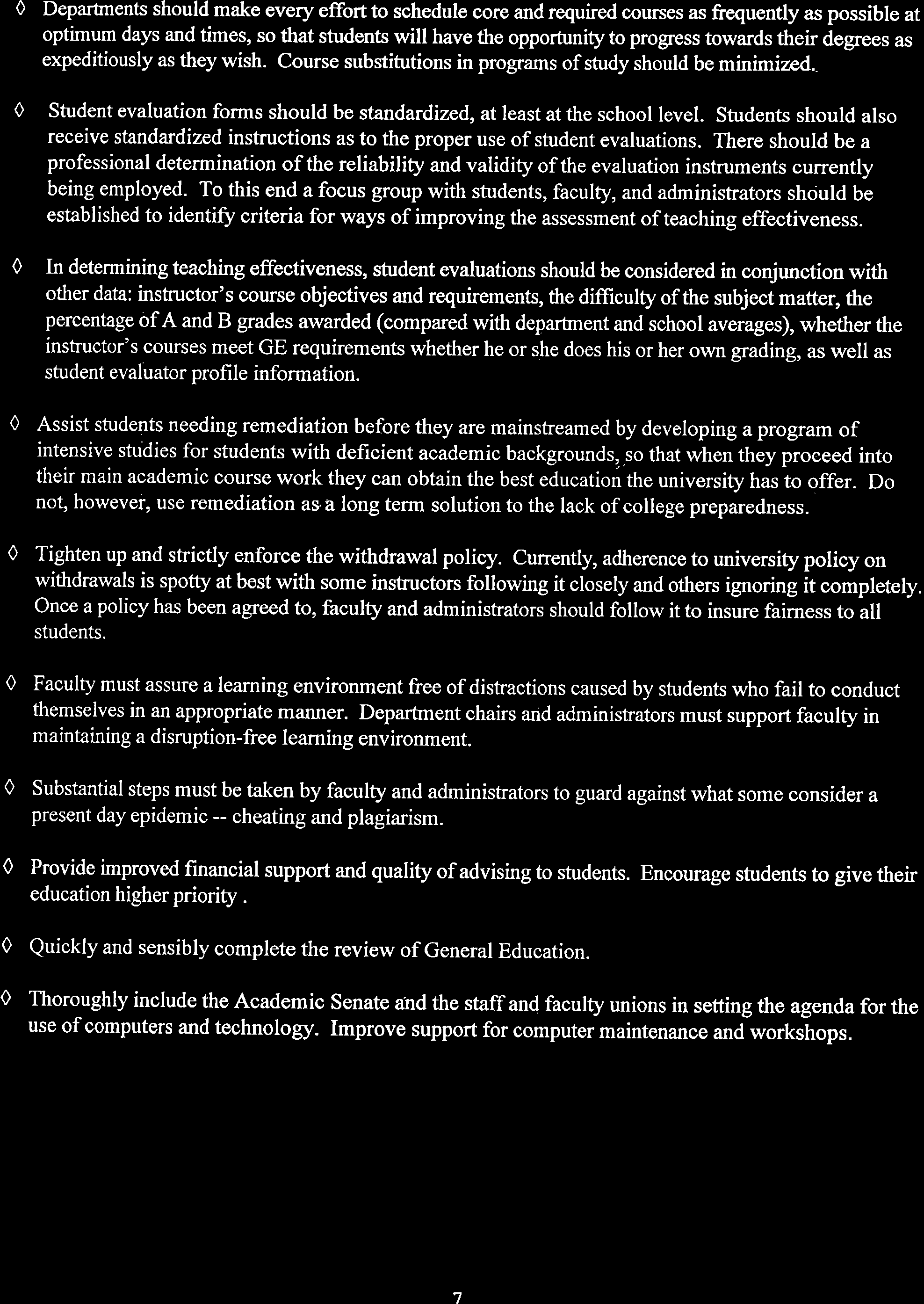
- Deparünents should make every effort to schedule core and required courses as frequentþ as possible at optimum days and times, so that students will have the opportunity to progress towards their degrees as expeditiously as they wish. Course substitutions in programs of study should be minimized.
- Student evaluation forms should be standardized, at least at the school level. Students should also receive standardized instructions as to the proper use of student evaluations. There should be a professional determination of the reliability and validity of the evaluation instruments currently being employed. To this end a focus group with students, faculty, and administrators should be established to identifu criteria for ways of improving the assessment of teaching eftectiveness.
- In determining teaching effectiveness, student evaluations should be considered in conjunction witlr other data: instructor's course objectives and requirements, the diffrculty of the subject matter, the percentage of A and B grades awarded (compared with deparûnent and school averages), whether the ínstructor's courses meet GE requirements whether he or she does his or her own grading, as well as student evaluator profile information.
- Assist students needing remediation before they are mainstreamed by developing a program of intensive studies for students with deficient academic backgrounds,.so that when they proeeed into their main academic course work they can obtain the best education the university has to offer. Do no! however, use remediation as.a long term solution to the lack of college prepãredness.
- Tighten up and shictly enforce the withdrawal policy. Cunently, adherence to university policy on withdrawals is spotty at best with some instructors following it closely and others ignoring it completely. Once a policy has been agreed to, faculty and adminishators should follow it to insure fairness to àll students.
- Faculty must assure a learning environment free of distractions caused by students who fail to conduct themselves in an appropriate manner. Department chairs and administrators must support faculty in maintaining a disruption-free learning environment.
- Substantial steps must be taken by facuþ and adminishators to guard against what some consider a present day epidemic - cheating and plagiarism.
- Provide improved financial support and quality of advising to students. Encourage students to give their education higher priority .
- Quickly and sensibly complete the review of General Education.
- Thoroughly include the Academic Senate and the staff and faculty unions in setting the agenda for the use of computers and technology. Improve support for computer maintenance andworkrhopr.
For Improving Morale/Quality of Life “Quality not Quantity!”
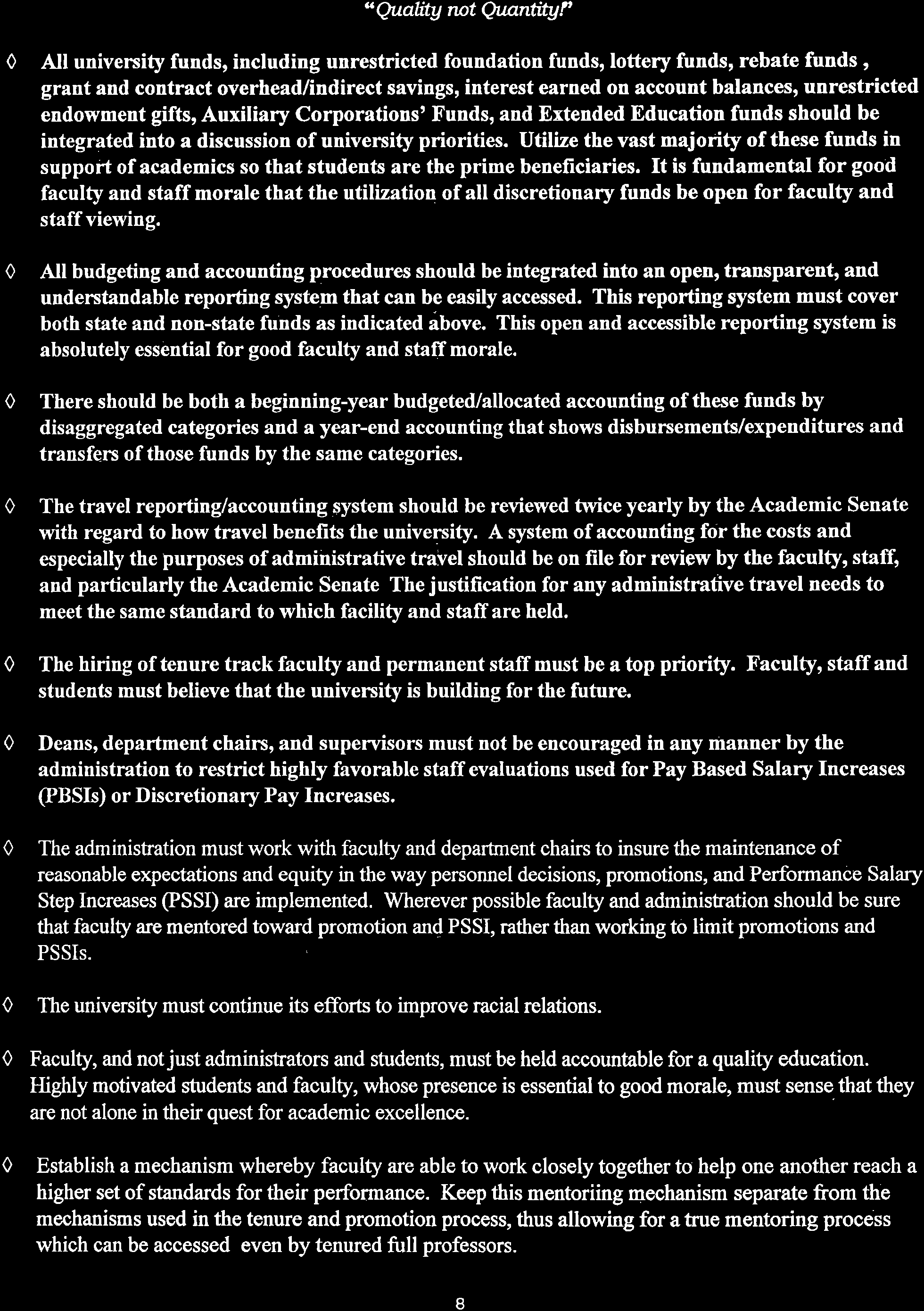
- All university funds, including unrestricted foundation funds, lottery funds, rebate funds , grant and contract overhead/indirect savings, interest earned on account balances, unrestricted endowment gifts, Auxiliary Corporations’ Funds, and Extended Education funds should be integrated into a discussion of university priorities. Utilize the vast majority of these funds in support of academics so that students are the prime beneficiaries. It is fundament¿l for good faculty and staff morale that the utilization of all discretionary funds be open for faculty and staff viewing.
- Atl budgeting and accounting procedures should be integrated into an open, transparentt and understandable reporting system that can be easily accessed. This reporting system must cover both state and non-state funds as indicated ábove. This open and accessible reporting system is absolutely essential for good faculty and staff morale.
- There should be both a beginning-year budgeted/allocated accounting ofthese funds by disaggregated categories and a year-end accounting that shows disbursements/expenditures and transfers of those funds by the same categories.
- The travel reporting/accounting system should be reviewed twice yearþ by the Academic Senate with regard to how travel benefits the university. A system of accounting for the costs and especially the purposes of administrative trayel should be on file for review by the faculty, staff, and particularly the Academic Senate The justification for any administrative travel needs to meet the same standard to which facility and staffare held.
- The hiring of tenure track faculty and permanent staff must be a top priority. Faculty, staff and students must believe that the university is building for the future.
- Deans, department chairu, and supervisors must not be encouraged in any manner by the administration to restrict highly favorable staffevaluations used for Pay Based Salary Increases (PBSIS) or Discretionary Pay Increases.
- The administration must work with facuþ and deparfrnent chairs to insure the maintenance of reasonable expectations and equity in the way personnel decisions, promotions, and Performance Salary Step Increases (PSSI) are implemented. Wherever possible facuþ and adminisfration should be sure that faculty are mentored toward promotion and PSSI, rather than working to limit promotions and PSSIs.
- The university must continue its efforts to improve racial relations.
- Faculty, and not just administrators and students, must be held accountable for a quality education. Highly motivated students and facuþ, whose presence is essential to good morale, must sense.that they are not alone in their quest for academic excellence.
- Establish a mechanism whereby facuþ are able to work closely together to help one another reach a higher set of st¿ndards for their performance. Keep this mentoriing mechanism separate from the mechanisms used in the tenure and promotion process, thus allowing for a true mentoring process which can be accessed even by tenured full professors.
- Encourage facultyparticipation at deparhnenlschool conferences andworkshops forthe exchange of ideas and scholarship. The administration should expand on-campus efforts, outside of the promotion, PSSI and PBSI processes, to recognize and reward faculty and staffwho contribute to a climate of excellence.
- There is a need to improve communication, understanding and trust between the administration, faculty and staffand to maintain a level of civility in our dialogue.
- Administators should take steps to understand what goes on in the educational process, including teaching their own courses where feasible, visiting classes þreferably at the invitation of faculty) and talking with students, staffand facuþ about courses, advising, etc. Adminisfiators teaching in the classroom build a commonality with faculty and send a clear message that our academic offerings are a priority on the campus.
- The wide disparþ in grading practices and the disproportionate number of A's and Bls across the : campus is demoralizing to the facuþ and students alike. The Academic Senate, working with the administration, needs to address the problem of grade inflation.
- Whenever possible, faculty should do their own grading. This demonstrates to students and to faculty that instructors do indeed care about what happens in the classroom.
- The university should concentrate its focus on quality rather than quantþ.
Conclusion
While there is plenty of room to criticize the administrations past and present, it
is primarily the
responsibility of the faculty to assert the academic needs of the university, to build
and maintain a culture
of excellence, and to defend the quality of education and service we provide to students
and the
community. A climate of academic excellence and quality of life on campus will reflect
our highest
aspirations and assure that the integrþ of our institution is assured no maffer who
is in university
administrative roles and no matter what elected and appointed state officials do.
The administration has a responsibility to exercise leadership in support of faculty
and staff in
achieving those goals. The administration should seek a level of financial support
to provide the
resources necessary for the university to fulfill its mission. Working within the
principles of shared
governance, with respect for the academic expertise of faculty and the legal requirements
of collective
bargaining, the administration has a responsibility to assure fairness and high standards
in personnel
matters. The administration has the ultimate legal authority for the operation of
the university; however,
academic exeellence, quality service and good morale are best maintained when the
administration works
honestly and cooperatively with faculty and staffth¡ough academic governance and collective
bargaining. Shaightforward communication and shared decision making are pivotal to
good morale and
good performance.
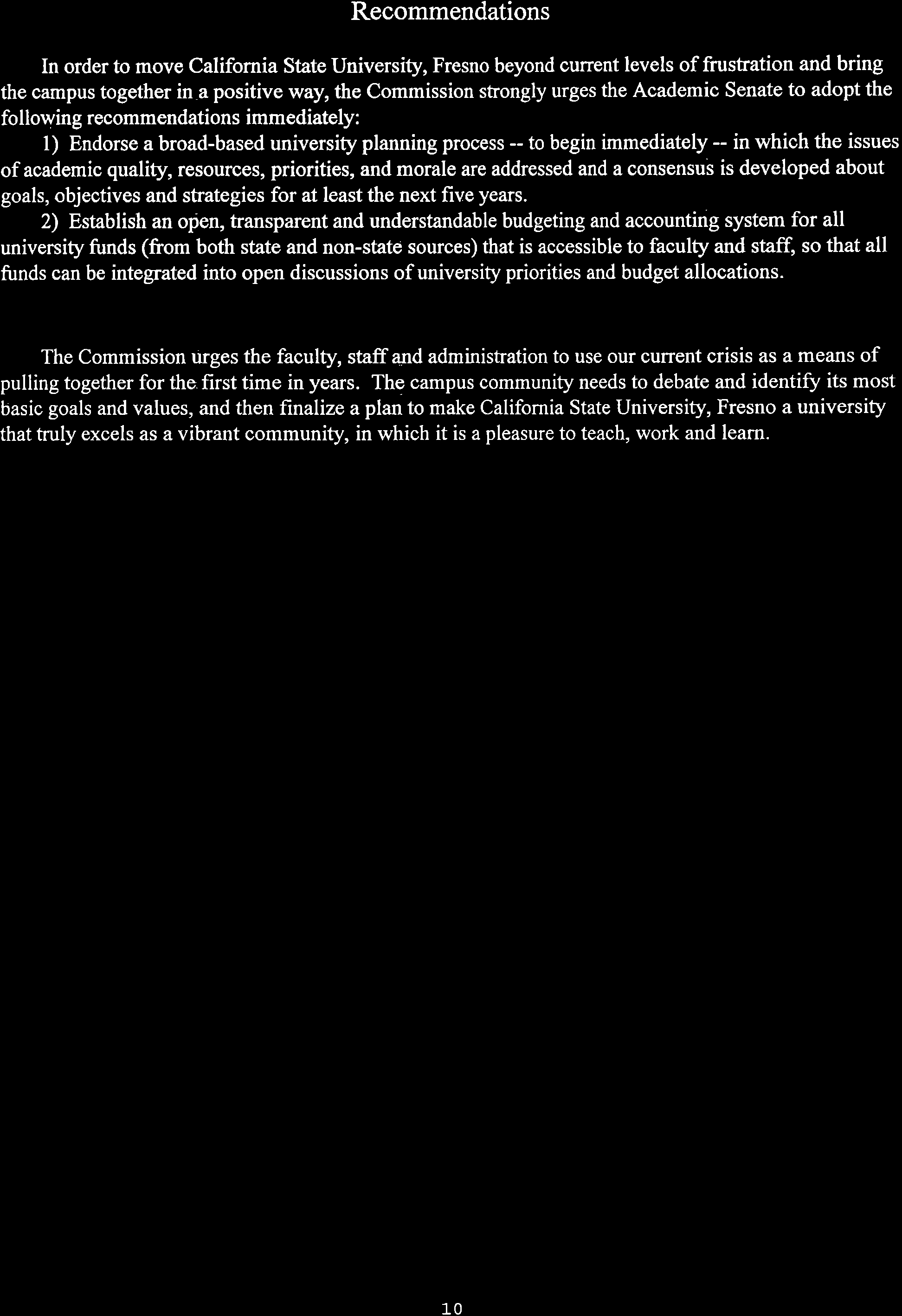
Recommendations
In order to move California State Universþ, Fresno beyond current levels of frushation
and bring
the campus together in a positive way, the Commission strongly urges the Academic
Senate to adopt the
following recommendations immediately:
1) Endorse a broad-based university planning process - to begin immediately - in which
the issues
of academic quality, resources, priorities, and morale are addressed and a consensus
is developed about
goals, objectives and strategies for at least the next five years.
2) Establish an oþen, transparent and understandable budgeting and accounting system
for all
university funds (from both st¿te and non-state sources) that is accessible to facuþ
and staff, so that all
funds can be integrated into open discussions of university priorities and budget
allocations.
The Commission urges the faculty, staffand administration to use our current crisis
as a means of
pulling together for the first time in years. The campus communþ needs to debate and
identifu its most
basic goals and values, and then finalize a plan to make California State University,
Fresno a university
that truly excels as a vibrant communþ, in which it is a pleasure to teach, work and
learn.
This HTML version was generated with AI assistance and may contain errors or omissions. The original approved PDF remains the official document of record. An alternative accessible format is available upon request from the document creator in accordance with Title II of the ADA.