Web based Cert Catalog Statement Rev Request
GRADUATE PROGRAM
(master's degree, doctoral degree, certificate of advanced study, credential requiring graduate-level course work)
CATALOG STATEMENT REVISION REQUEST
Return original to:
Division of Graduate Studies
Harold H. Haak Administrative Center
4th Floor, Henry Madden Library
Mail Stop ML51
Graduate Program: Certificate for Advanced Studies in CRP
Department: Geography & City & Regional Planning
Contact Person: Segun Ogunjemiyo
Phone: 278-6897
E-mail: sogunjemiyo@csufresno.edu
Catalog pg. #
PURPOSE OF FORM: To propose revision of a graduate program catalog statement (program description and/or requirements) as it appears in the University Catalog. The proposed program changes if approved will be binding on students who are advanced to candidacy under the new catalog statement. NOTE: Revisions in graduate courses and proposals for new graduate courses are submitted on separate forms available through the Division of Graduate Studies, phone 8-2448.
INSTRUCTIONS: Use attachments to this sheet to indicate the changes that you propose. Make changes as space allows directly on a 8.5" x 11" xerographic copy of the entire page(s) of your graduate program statement (description/requirements) as it appears in the most recent University Catalog, including page numbers. Use "mock-up" style: cross out wording to be deleted; type new language in margins. If there is not sufficient space in the margins to type lengthy additions, designate inserts (a, b, c, etc.). Attach fully typed language for each insert on additional sheets. Address questions on these instructions to the Dean, phone 8-2448.
Routine proposals for graduate program changes are reviewed by the Graduate Curriculum Subcommittee. Extensive, substantive changes are reviewed by the University Graduate Committee.
Those planning to propose a new or extensively revised graduate program (master's, doctoral, or certificate of advanced study), including a proposal for a revised or an additional option under an existing graduate degree, should schedule a meeting with the Graduate Dean.
JUSTIFICATION: Explain why the proposed changes in the graduate program are needed. Attach additional pages as necessary. Special justification and approval are required for proposals to increase master's degree program units above 30 units in academic fields, and 60 units in professional fields. Such justification must include comparative information concerning similar programs at representative universities, and outline adherence to accreditation standards if applicable. Document the impact of the proposed change and/or any increased program units on program students and department resources.
CONSULTING SIGNATURES (if required)
In an effort to avoid misunderstandings, signatures must be obtained from those departments potentially affected by proposed change(s).
I have read the catalog statement revision request and support the proposed change(s).
Yes [ ] No [ ]
If no, please explain your concern(s):
Department Chair (of department being consulted)
Department: Department
Department Chair (typed name) Department Chair (typed name)
Department Chair Signature Department Chair Signature
Date Date
REQUIRED SCHOOL SIGNATURES (verifies proposal has been approved)
Graduate Program Coordinator
Hongwei Dong Lee — [signature]
Typed Name Signature Date
Department Chair
Segun Ogunjemiyo
Typed Name Signature Date
School Curriculum (or Credential) Dean (if applicable)
Typed Name Signature Date
School Dean
Luz Gonzalez
Typed Name Signature Date
For committee use only
UNIVERSITY GRADUATE COMMITTEE/GRADUATE CURRICULUM
SUBCOMMITTEE REVIEW RECOMMENDATION:
Request Approved
[ ] Request Denied
[ ] Request Deferred
Explanation:
Date of Action
Recommendation approved by:
Dean, Division of Graduate Studies/or designee
Typed Name Signature Date
Provost/Vice President for Academic Affairs/or designee
Typed Name Signature Date
Rev. 12/11
Geography
College of Social Sciences
Department of Geography
Aribilola S. Omolayo, Chair
Paulette Morrow,
Administrative Support Coordinator
Science Building, Room 182
559.278.2797
B.A. in Geography
Minor in Geography
Minor in Meteorology
Minor in Urban Studies
Subject Matter Preparation for
Single Subject Teaching Credential
in Social Sciences
Certificate in Geographic
Information Systems (GIS)
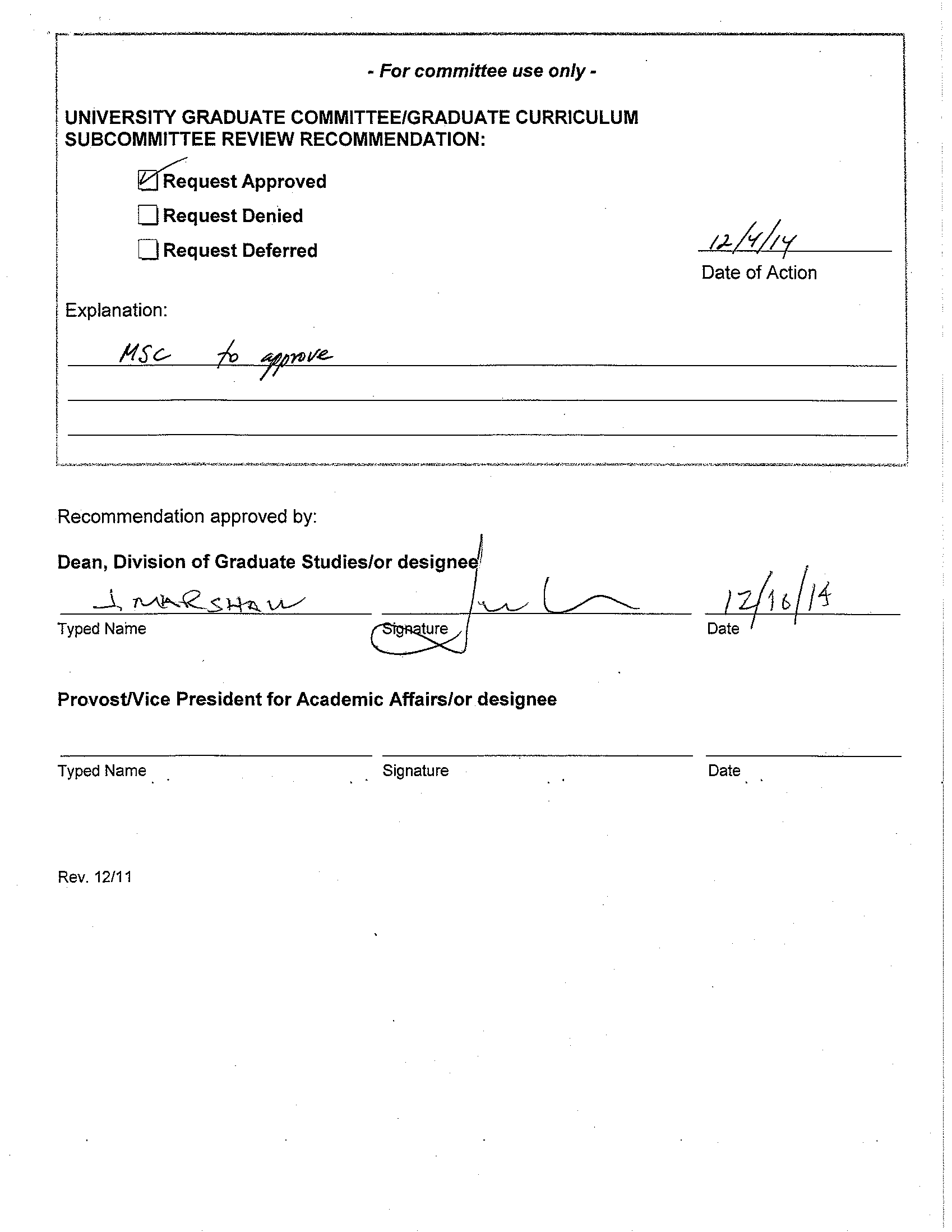
Geography
Geography in the 21st century is a place of complex interactions among the people who make us, the world of diverse cultures on it, and the environment. Geography seeks to provide students with the ability to “see the big picture” and be uniquely tuned to fully understand these interactions of the environment through the many cultures of humankind.
The Geography Department offers a Bachelor of Arts degree in geography, a minor in geography, a minor in meteorology, and an interdisciplinary minor in urban studies. Geography course offerings support graduate preparation for careers in teaching, weather, and urban planning, and preparation for geographic inquiry.
Geographic inquiry is concerned with human occupancy of the earth, the character of human environment, and the interrelationships that link humans to the world. In sum, geography seeks to provide a broad understanding of human beings, people, and their problems.
Geography provides applied specialized technical skills that can be used to address economic, social, and environmental issues at scales that range from local to global. Employing a spatial framework for purposes analogous to the biological framework employed in biology, geography integrates much information from physical and social sciences. Because of the diversity of subject matter, geography obtains data, offers a broad understanding, and is applicable to many fields.
The department offers a variety of courses that allow students to address different objectives. First, we provide, for both majors and non-majors, a greater understanding of the world as an element of a liberal education that has become an increasingly important component of a complete university education. Second, we provide courses that assure a depth of knowledge in geography. Third, we serve those students in related disciplines who wish to strengthen programs of study through a selection of courses in geography.
Although there are no options in the degree program, students may select courses that focus on various areas of study.
Examples of such focused study areas could include the following.
Geographic Studies: Course work for the student interested in the world and its spatial patterns. Traditional study which may lead to graduate work and a career in higher education, or with local, state, and federal agencies utilizing geographic analysis, including the use of geographic information systems (GIS).
Environmental Studies: Course work for the student interested in developing competence in environmental techniques with particular emphasis on such topics as meteorology, pollution, environmental impact analysis, geographic information systems (GIS), and human-environment relationships. This may lead to graduate work in geography, or employment in various state and federal agencies dealing with environmental problems.
Urban and Regional Planning: Course work for the student interested in the study of how to create communities that balance new development and essential environmental systems. Topics may include planning, environmental planning, environmental quality, urban and regional planning, environmental planning, and climate change and global governance.
Students must regularly consult with their academic adviser to facilitate course selection and enable the student to develop a program consistent with individual interests and needs.
Faculty and Facilities
Instruction at introductory and advanced levels is conducted by a faculty whose teaching and research interests are diverse. All major facets of the discipline are represented, including geography, economics, medical geography, political geography, urban revitalization, resource management, environmental monitoring using remote sensing, urban air quality, urban and regional planning, environmental planning, and climate change and global governance.
A laboratory facility is available for student use. The Urban Planning and Environmental Research Laboratory is a 32-station, state-of-the-art, computer laboratory used for instruction and research in urban planning, geographic information systems (GIS), environmental studies, remote sensing, and a variety of other applications.
Career Opportunities
Geographers are employed in government and the private sector. Their knowledge and skills have applications in a variety of fields including teaching, planning, cartography, GIS, locational analysis, intelligence and security, land and resource management, policy research, transportation, and industrial development.
Agencies of federal, state, and local governments are major employers of geographers. At the federal level many agencies employ geographers. At state and local levels most geographers are involved in planning, land and resource management, and community development. Because many businesses and industries have important geographical dimensions to their operations, there is demand for geographers in the private sector. Geographers are employed in banking, transportation, international trade, utilities, wholesaling and retailing, and a number of other fields. Finally, teaching is a major occupation for individuals with training in geography. The department welcomes inquiries about career opportunities.
Faculty
Aribilola S. Omolayo, Chair
Michelle Calvarese
Mohan B. Dangi
Hong Chi? Leung
Stuart K. McFeeters
Segun O. Ogunjemiyo
Bachelor of Arts
Degree Requirements
Geography Major
The Bachelor of Arts degree with a major in geography requires the completion of 120 units, at least 42 of which shall be in geography.
Units
Major requirements ................................ 42
Core courses ........................................ (12)
GEOG 4, 5, 7, 30
Areas of Concentration ........................ (18)
Majors should complete 3 units in each area.
Atmospheric Sciences:
GEOG 111, 112, 114, 115, 118
Environmental Studies:
GEOG 127, 128, 135, 139T
Geographic Information Systems (GIS) and Remote Sensing:
GEOG 140, 141, 142, 143, 149, 150, 151, 152
International Development Studies:
GEOG 160, 161, 162, 163, 164, 165, 166, 167
Global and Regional Studies:
GEOG 170T, 171T, 173, 174, 175T, 177T, 178, 179
Urban and Regional Planning:
GEOG 181, 184, 187T
Approved geography electives ................................ 12
Additional requirements:
12 units of upper-division courses
3 units from one of the following:
IS 52 (with 52L), SOC 172
General Education requirements ............................ 51
Electives and remaining degree requirements .......... 24
Total ................................................................. 120
(See Degree Requirements); may be used toward a double major or minor.
*This total reflects the use of GEOG 4 in G.E.
Advising Notes
No General Education Integration or Breadth D3. Consult the department chair or faculty
adviser for additional details.
No more than 3 units of GEOG 195 may be applied to the geography major.
Multicultural/International course offered by the Department of Geography may be used
to satisfy the General Education requirements for geography majors.
CR/NC grading is not permitted in the geography major with the exception of GEOG 192
and 195.
General Education and elective units may be applied to a second major or a minor (see
Double Major or departmental minor). Consult the appropriate department chair, program
coordinator, or faculty adviser for further information.
Students must complete 40 upper-division units as part of the requirements to earn
a B.A.
It is strongly recommended that students interested in professional careers in geography
select the emphasis in Geographic Information Systems and Remote Sensing and complete
a minor in a related field.
Students must regularly consult with their academic adviser. Such consultation will
facilitate course selection and enable the student to develop a program consistent
with individual interests and needs.
The selection of electives within the major should be strongly influenced by career
goals, interests in graduate study, and related matters. Whether one’s interest focuses
on environmental protection, planning, cartography, GIS, locational analysis, or any
one of a wide array of geographic competencies, the department can provide current
applicable information. Inquiries are welcomed.
Geography Minor
Select from upper-division courses.
Total: [OCR unclear]
No more than 3 units earned in GEOG 195 may be applied to the minor. Students completing a minor in geography are encouraged to seek advice relative to course selection and program.
Meteorology Minor
The Meteorology Minor requires the successful completion of four meteorology/climatology courses within the Geography Department and three other elective courses that are drawn from Chemistry, Computer Science, Engineering, Environmental Sciences, Geography, and Physics departments.
With the approval of a program adviser, elect 9 units from the following list of courses:
CHEM 3A, CSCI 40, EES 100B, EES 125, EES 167, GEOG 118, PHYS 2A.
Total: [OCR unclear]
*All courses must be passed with a grade of C or better to count toward the undergraduate minor in Meteorology.
Urban Studies Minor
The interdisciplinary Urban Studies minor provides exposure to the analysis of urban and regional problems and serves as an excellent supplement to other degree programs offered through the university. A special major in urban studies may be designed to meet the needs of students with an interest in this field. Special Major, page 82-83.
Coordinator: Consult department.
Faculty Advisers: Undergraduate advisers in the Geography Department, Department of Political Science, and Sociology Department.
Required Courses
Concepts and Issues:
GEOG 160, or SOC [OCR unclear]
PLSI 181
GEOG 181
Methods and Techniques:
Select from the following courses:
GEOG 30, 142, [OCR unclear], SOC 175
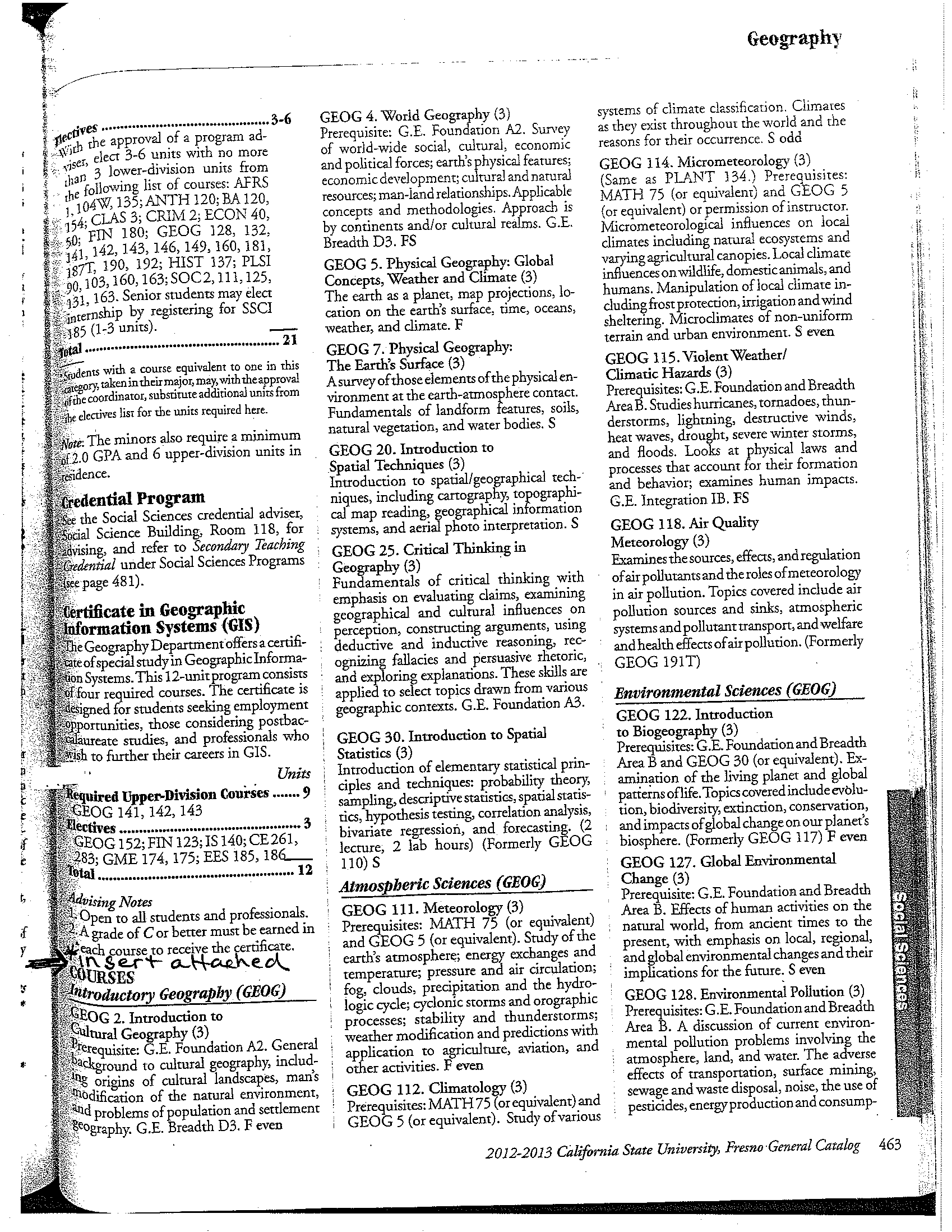
With the approval of a program adviser, students may elect 3-6 units with no more than 3 lower-division units from the following list of courses:
AFRS 120, ANTH 120, BA 120, CLAS 3, CRIM 2, ECON 40, FIN 180, GEOG 128, 132, 141, 142, 143, 146, 149, 160, 181, 187, 190, 192; HIST 137; PLSI 160, 163; SOC 2, 111, 125.
Senior students may elect to register for SSCI [OCR unclear].
Students with a course equivalent to one in this category, taken in their major, may, with the approval of the coordinator, substitute additional units from the electives list for the units required here.
The minors also require a minimum 2.0 GPA and 6 upper-division units in residence.
Credential Program
Contact the Social Sciences credential adviser, Social Science Building, Room 118, for information on the Single Subject Teaching Credential under Social Sciences Programs (page 481).
Certificate in Geographic Information Systems (GIS)
The Geography Department offers a certificate of special study in Geographic Information Systems. This 12-unit program consists of four required courses. The certificate is for students seeking employment opportunities, those considering postbaccalaureate studies, and professionals who wish to further their careers in GIS.
Required Upper-Division Courses ........ 9
GEOG 141, 142, 143
Electives ............................................ 3
Total .................................................. 12
Advising Notes
Open to all students and professionals.
Students must pass each course to receive the certificate.
COURSES
Introductory Geography (GEOG)
GEOG 2. Introduction to Cultural Geography (3)
Prerequisite: G.E. Foundation A2. General background to cultural geography, including origins of cultural landscapes, man's modification of the natural environment, population and settlement. G.E. Breadth D3. F even
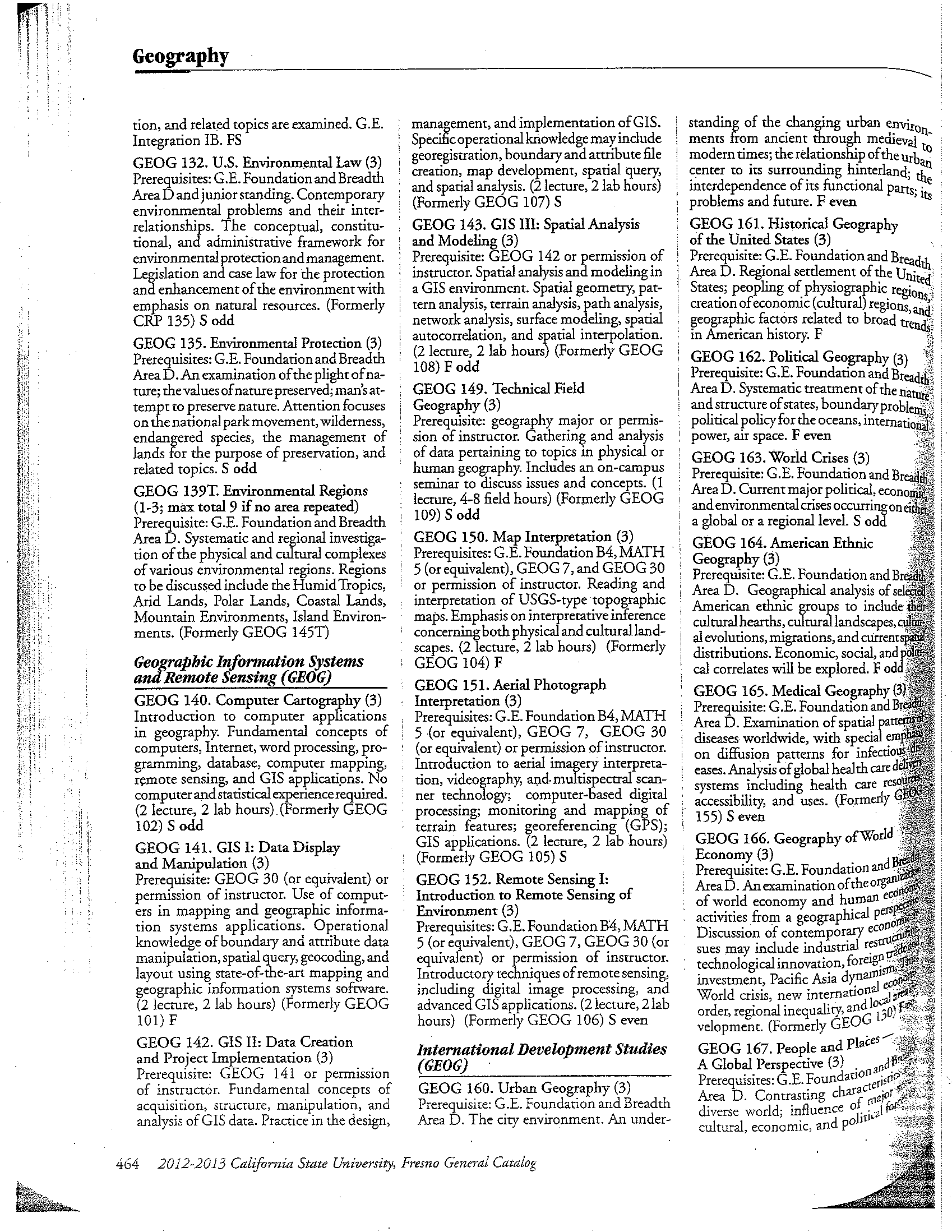
GEOG 4. World Geography (3)
Prerequisite: G.E. Foundation A2. Survey of world-wide social, cultural, economic and political forces; earth's physical features; economic development; cultural and natural resources; man-land relationships. Applicable concepts and methodologies. Approach is by continents and/or cultural realms. G.E. Breadth D3. FS
GEOG 5. Physical Geography: Global Concepts, Weather and Climate (3)
The earth as a planet, map projections, location on the earth's surface, time, oceans, weather, and climate. F
GEOG 7. Physical Geography: The Earth's Surface (3)
A survey of those elements of the physical environment at the earth-atmosphere contact. Fundamentals of landform features, soils, natural vegetation, and water bodies. S
GEOG 20. Introduction to Spatial Techniques (3)
Introduction to spatial/geographical techniques, including cartography, topographical map reading, geographical information systems, and aerial photo interpretation. S
GEOG 25. Critical Thinking in Geography (3)
Fundamentals of critical thinking with emphasis on evaluating claims, examining geographical and cultural influences on perception, constructing arguments, using deductive and inductive reasoning, recognizing fallacies and persuasive rhetoric, and exploring explanations. These skills are applied to select topics drawn from various geographic contexts. G.E. Foundation A3.
GEOG 30. Introduction to Spatial Statistics (3)
Introduction of elementary statistical principles and techniques: probability theory, sampling, descriptive statistics, spatial statistics, hypothesis testing, correlation analysis, bivariate regression, and forecasting. (2 lecture, 2 lab hours) (Formerly GEOG 110) S
Atmospheric Sciences (GEOG)
GEOG 111. Meteorology (3)
Prerequisites: MATH 75 (or equivalent) and GEOG 5 (or equivalent). A grade of C or better must be earned in MATH 75 (or equivalent). Study of the earth's atmosphere; energy exchanges and temperature; pressure and air circulation; fog, clouds, precipitation and the hydrologic cycle; cyclonic storms and orographic processes; stability and thunderstorms; weather modification and predictions with application to agriculture, aviation, and other activities. F even
GEOG 112. Climatology (3)
Prerequisites: MATH 75 (or equivalent) and GEOG 5 (or equivalent). Study of various systems of climate classification. Climates as they exist throughout the world and the reasons for their occurrence. S odd
GEOG 114. Micrometeorology (3)
(Same as PLANT 134.) Prerequisites: MATH 75 (or equivalent) and GEOG 5 (or equivalent) or permission of instructor. Micrometeorological influences on local climates including natural ecosystems and varying agricultural canopies. Local climate influences on wildlife, domestic animals, and humans. Manipulation of local climate including frost protection, irrigation and wind sheltering. Microclimates of non-uniform terrain and urban environment. S even
GEOG 115. Violent Weather/Climatic Hazards (3)
Prerequisites: G.E. Foundation and Breadth Area B. Studies hurricanes, tornadoes, thunderstorms, lightning, destructive winds, heat waves, drought, severe winter storms, and floods. Looks at physical laws and processes that account for their formation and behavior; examines human impacts. G.E. Integration IB. FS
GEOG 118. Air Quality Meteorology (3)
Examines the sources, effects, and regulation of air pollutants and the roles of meteorology in air pollution. Topics covered include air pollution sources and sinks, atmospheric systems and pollutant transport, and welfare and health effects of air pollution. (Formerly GEOG 191T).
Environmental Sciences (GEOG)
GEOG 122. Introduction to Biogeography (3)
Prerequisites: G.E. Foundation and Breadth Area B and GEOG 30 (or equivalent). Examination of the living planet and global patterns of life. Topics covered include evolution, biodiversity, extinction, conservation, and impacts of global change on our planet's biosphere. (Formerly GEOG 117) F even
GEOG 127. Global Environmental Change (3)
Prerequisite: G.E. Foundation and Breadth Area B. Effects of human activities on the natural world, from ancient times to the present, with emphasis on local, regional, and global environmental changes and their implications for the future. S even
GEOG 128. Environmental Pollution (3)
Prerequisites: G.E. Foundation and Breadth Area B. A discussion of current environmental pollution problems involving the atmosphere, land, and water. The adverse effects of transportation, surface mining, sewage and waste disposal, noise, the use of pesticides, energy production, and related topics are examined. G.E. Integration IB, FS
GEOG 132. U.S. Environmental Law (3)
Prerequisites: G.E. Foundation and Breadth Area D and junior standing. Contemporary environmental problems and their interrelationships. The conceptual, constitutional, and administrative framework for environmental protection and management. Legislation and case law for the protection and enhancement of the environment with emphasis on natural resources. (Formerly CRP 135) S odd
GEOG 135. Environmental Protection (3)
Prerequisites: G.E. Foundation and Breadth Area D. An examination of the plight of nature; the values of nature preserved; man's attempt to preserve nature. Attention focuses on the national park movement, wilderness, endangered species, the management of lands for the purpose of preservation, and related topics. S odd
GEOG 139T. Environmental Regions (1-3; max total 9 if no area repeated)
Prerequisite: G.E. Foundation and Breadth Area D. Systematic and regional investigation of the physical and cultural complexes of various environmental regions. Regions to be discussed include the Humid Tropics, Arid Lands, Polar Lands, Coastal Lands, Mountain Environments, Island Environments. (Formerly GEOG 145T)
Geographic Information Systems and Remote Sensing (GEOG)
GEOG 140. Computer Cartography (3)
Introduction to computer applications in geography. Fundamental concepts of computers, Internet, word processing, programming, database, computer mapping, remote sensing, and GIS applications. No computer and statistical experience required. (2 lecture, 2 lab hours) (Formerly GEOG 102) S odd
GEOG 141. GIS I: Data Display and Manipulation (3)
Prerequisite: GEOG 30 (or equivalent) or permission of instructor. Use of computers in mapping and geographic information systems applications. Operational knowledge of boundary and attribute data manipulation, spatial query, geocoding, and layout using state-of-the-art mapping and geographic information systems software. (2 lecture, 2 lab hours) (Formerly GEOG 101) F
GEOG 142. GIS II: Data Creation and Project Implementation (3)
Prerequisite: GEOG 141 or permission of instructor. Fundamental concepts of acquisition, structure, manipulation, and analysis of GIS data. Practice in the design, management and implementation of GIS.
Specific operational knowledge may include georegistration, boundary and attribute file creation, map development, spatial query, and spatial analysis. (2 lecture, 2 lab hours) (Formerly GEOG 107) S
GEOG 143. GIS III: Spatial Analysis and Modeling (3)
Prerequisite: GEOG 142 or permission of instructor. Spatial analysis and modeling in a GIS environment. Spatial geometry, pattern analysis, terrain analysis, path analysis, network analysis, surface modeling, spatial autocorrelation, and spatial interpolation. (2 lecture, 2 lab hours) (Formerly GEOG 108) F odd
GEOG 149. Technical Field Geography (3)
Prerequisite: geography major or permission of instructor. Gathering and analysis of data pertaining to topics in physical or human geography. Includes an on-campus seminar to discuss issues and concepts. (1 lecture, 4-8 field hours) (Formerly GEOG 109) S odd
GEOG 150. Map Interpretation (3)
Prerequisites: G.E. Foundation B4, MATH 5 (or equivalent), GEOG 7, and GEOG 30 or permission of instructor. Reading and interpretation of USGS-type topographic maps. Emphasis on interpretative inference concerning both physical and cultural landscapes. (2 lecture, 2 lab hours) (Formerly GEOG 104) F
GEOG 151. Aerial Photograph Interpretation (3)
Prerequisites: G.E. Foundation B4, MATH 5 (or equivalent), GEOG 7, GEOG 30 (or equivalent) or permission of instructor. Introduction to aerial imagery interpretation, videography, and multispectral scanner technology; computer-based digital processing; monitoring and mapping of terrain features; georeferencing (GPS); GIS applications. (2 lecture, 2 lab hours) (Formerly GEOG 105) S
GEOG 152. Remote Sensing I: Introduction to Remote Sensing of Environment (3)
Prerequisites: G.E. Foundation B4, MATH 5 (or equivalent), GEOG 7, GEOG 30 (or equivalent) or permission of instructor. Introductory techniques of remote sensing, including digital image processing, and advanced GIS applications. (2 lecture, 2 lab hours) (Formerly GEOG 106) S even
International Development Studies (GEOG)
GEOG 160. Urban Geography (3)
Prerequisite: G.E. Foundation and Breadth Area D. The city environment. An understanding of the changing urban environments from ancient through medieval to modern times; the relationship of the urban center to its surrounding hinterland; interdependence of its functional parts, problems and future. F even
GEOG 161. Historical Geography of the United States (3)
Prerequisite: G.E. Foundation and Breadth Area D. Regional settlement of the United States; peopling of physiographic regions and geographic factors related to broad trends in American history. F
GEOG 162. Political Geography (3)
Prerequisite: G.E. Foundation and Breadth Area D. Systematic treatment of the nature and creation of economic (cultural) and structure of states, boundary problems, political policy for the oceans, international relations, power, air space. F even
GEOG 163. World Crises (3)
Prerequisite: G.E. Foundation and Breadth Area D. Current major political, economic, and environmental crises occurring on a global or a regional level. S odd
GEOG 164. American Ethnic Geography (3)
Prerequisite: G.E. Foundation and Breadth Area D. Geographical analysis of selected American ethnic groups to include cultural hearths, cultural landscapes, cultural evolutions, migrations, and current distributions. Economic, social, and political correlates will be explored. F odd
GEOG 165. Medical Geography (3)
Prerequisite: G.E. Foundation and Breadth Area D. Examination of spatial patterns of diseases worldwide, with special emphasis on diffusion patterns for infectious diseases. Analysis of global health care systems including health care resources, accessibility, and uses. (Formerly GEOG 155) S even
GEOG 166. Geography of World Economy (3)
Prerequisite: G.E. Foundation and Breadth Area D. An examination of theories of world economy and human economic activities from a geographical perspective, including technological innovation, foreign investment, Pacific Asia dynamics, world crisis, new international economic order, regional inequality, and underdevelopment. (Formerly GEOG 154)
GEOG 167. People and Places: A Global Perspective (3)
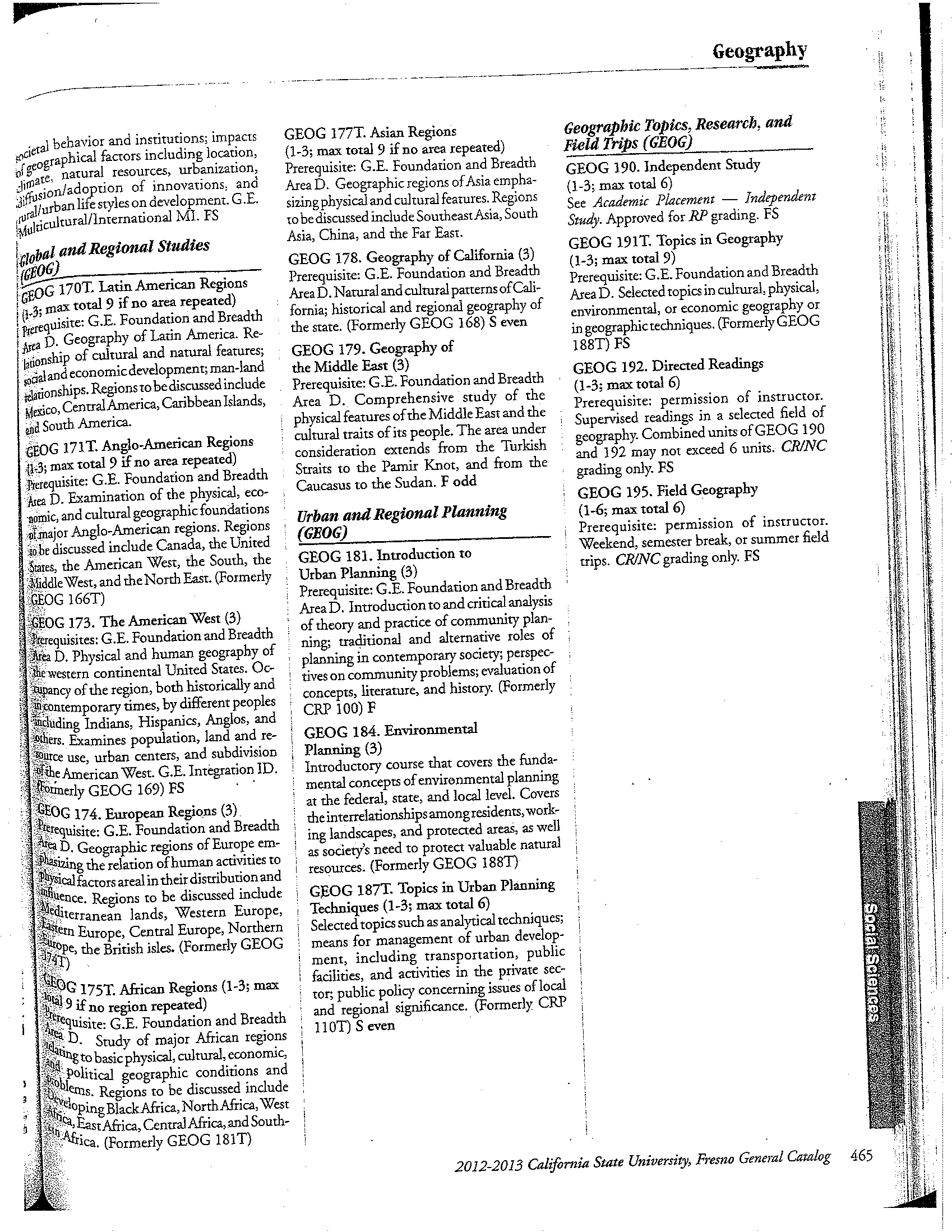
Prerequisites: G.E. Foundation and Breadth Area D. Contrasting characteristics of a diverse world; influence of location, natural resources, urbanization, diffusion/adoption of innovations, and suburban life styles on development. G.E. Multicultural/International M1. FS
Global and Regional Studies (GEOG)
GEOG 170T. Latin American Regions
(1-3; max total 9 if no area repeated)
Prerequisite: G.E. Foundation and Breadth Area D. Geography of Latin America. Relationship of cultural and natural features; social and economic development; man-land relationships. Regions to be discussed include Mexico, Central America, Caribbean Islands, and South America.
GEOG 171T. Anglo-American Regions
(1-3; max total 9 if no area repeated)
Prerequisite: G.E. Foundation and Breadth Area D. Examination of the physical, economic, and cultural geographic foundations of major Anglo-American regions. Regions to be discussed include Canada, the United States, the American West, the South, the Middle West, and the Northeast. (Formerly GEOG 166T)
GEOG 173. The American West (3)
Prerequisites: G.E. Foundation and Breadth Area D. Physical and human geography of the western continental United States. Occupancy of the region, both historically and in contemporary times, by different peoples including Indians, Hispanics, Anglos, and Asians. Examines population, land and resource use, urban centers, and subdivision of the American West. G.E. Integration ID. (Formerly GEOG 169) FS
GEOG 174. European Regions (3)
Prerequisite: G.E. Foundation and Breadth Area D. Geographic regions of Europe emphasizing the relation of human activities to physical factors areal in their distribution and existence. Regions to be discussed include Mediterranean lands, Western Europe, Southern Europe, Central Europe, Northern Europe, the British Isles. (Formerly GEOG 170)
GEOG 175T. African Regions
(1-3; max total 9 if no region repeated)
Prerequisite: G.E. Foundation and Breadth Area D. Study of major African regions with emphasis on basic physical, cultural, economic, and political geographic conditions and problems. Regions to be discussed include Developing Black Africa, North Africa, West Africa, East Africa, Central Africa, and Southern Africa. (Formerly GEOG 181T)
GEOG 177T. Asian Regions
(1-3; max total 9 if no area repeated)
Prerequisite: G.E. Foundation and Breadth Area D. Geographic regions of Asia emphasizing physical and cultural features. Regions to be discussed include Southeast Asia, South Asia, China, and the Far East.
GEOG 178. Geography of California (3)
Prerequisite: G.E. Foundation and Breadth Area D. Natural and cultural patterns of California; historical and regional geography of the state. (Formerly GEOG 168) S even
GEOG 179. Geography of the Middle East (3)
Prerequisite: G.E. Foundation and Breadth Area D. Comprehensive study of the physical features of the Middle East and the cultural traits of its people. The area under consideration extends from the Turkish Straits to the Pamir Knot, and from the Caucasus to the Sudan. F odd
Urban and Regional Planning (GEOG)
GEOG 181. Introduction to Urban Planning (3)
Prerequisite: G.E. Foundation and Breadth Area D. Introduction to and critical analysis of theory and practice of community planning; traditional and alternative roles of planning in contemporary society; perspectives on community problems; evaluation of concepts, literature, and history. (Formerly CRP 100) F
GEOG 184. Environmental Planning (3)
Introductory course that covers the fundamental concepts of environmental planning at the federal, state, and local level. Covers the interrelationships among residents, working landscapes, and protected areas, as well as society's need to protect valuable natural resources. (Formerly GEOG 188T)
GEOG 187T. Topics in Urban Planning Techniques
(1-3; max total 6)
Selected topics such as analytical techniques; means for management of urban development, including transportation, public facilities, and activities in the private sector; public policy concerning issues of local and regional significance. (Formerly CRP 110T) S even
Geographic Topics, Research, and Field Trips (GEOG)
GEOG 190. Independent Study
(1-3; max total 6)
See Academic Placement — Independent Study. Approved for RP grading. FS
GEOG 191T. Topics in Geography
(1-3; max total 9)
Prerequisite: G.E. Foundation and Breadth Area D. Selected topics in cultural, physical, environmental, or economic geography or in geographic techniques. (Formerly GEOG 188T) FS
GEOG 192. Directed Readings
(1-3; max total 6)
Prerequisite: permission of instructor. Supervised readings in a selected field of geography. Combined units of GEOG 190 and 192 may not exceed 6 units. CR/NC grading only. FS
GEOG 195. Field Geography
(1-6; max total 6)
Prerequisite: permission of instructor. Weekend, semester break, or summer field trips. CR/NC grading only. FS
2012-2013 California State University, Fresno General Catalog 465
Certificate in Advanced Studies in Community and Regional Planning
The Geography Department offers a Certificate of Advanced Study in Community and Regional Planning. This 15 graduate unit program consists of five courses. The Certificate Program is designed for various types of students. The targeted audience may include current graduate-level students who plan to obtain their master's degree in a land use planning-related field, such as Real Estate, Public Administration, Civil Engineering, Public Health, and Architecture. It also includes planning-related practicing professionals, such as architects, engineers, planners, elected and appointed public officials, and non-profit community service providers.
Admission Criteria
Interested candidates shall meet at least one of the following criteria for admission. Applicants must
1. be currently enrolled in a master's degree program at an accredited institution of higher education, or
2. have already earned a master's degree from an accredited institution of higher education, or
3. have earned an undergraduate degree.
A GRE test is not required for admission. Students currently enrolled in a graduate degree program at Fresno State must submit an "Add or Change Graduate Degree or Advanced Certificate Objective" form to the Division of Graduate Studies office.
Admission Process
Students shall submit a program application to the Program Coordinator and Fresno State University. The application can be found on the Program website. Besides the application, students shall also submit three letters of recommendation to the Program Coordinator. Student must apply for admission to the university through CSU Mentor.
Computer Requirements and Support
Participants must have access to a computer. All students will need to activate a Fresno State email account. Software requirements can be accessed by clicking on the following link: https://help.fresnostate.edu/content/software.php. Visit the Digital Campus website at http://www.fresnostate.edu/academics/tilt/to learn more about how to be successful with online learning. Students have access to online tutorials and frequently asked questions at the following website: http://www.fresnostate.edu/academics/blackboard/students/index.html
Exit from Program
The Certificate in Community and Regional Planning shall be issued upon completion of all coursework with a GPA of 3.0 or higher. Program is cohort based. Students are expected to progress and graduate within their matriculated cohort. Exceptions are considered on a case-bycase basis in accordance with university policy and accreditation standards. To be awarded the certificate, students must first submit a Proposed Program for the Certificate of Advanced Studies, and then file the Application for the Award of the Certificate of Advanced Study in the Division of Graduate Studies within the first two weeks of the term in which all courses and requirements are expected to be completed. A minimum of 9 program units must be used solely for certificate course requirements, and not toward any other degree or certificate program.
Program Length and Schedule
The five required courses are distributed in Fall and Spring semesters in each academic year. In each Fall semester, courses GEOG 201, 202, and 203 are offered sequentially, with each course finished within 4-5 weeks. GEOG 204 and 205 are available in each Spring semester sequentially with each finished within 6-7 weeks. A full online delivery mode will be utilized to accommodate participants' work schedules.
Required Graduate Courses Units
1) GEOG 201 Foundations in Urban Planning 3
2) GEOG 202 Land Use Regulation, Law and Ethics 3
3) GEOG 203 Community Planning 3
4) GEOG 204 Environmental Planning 3
5) GEOG 205 Transportation Planning 3
Total 15
Advising Notes
1. Open to all post-baccalaureate students and professionals
2. A grade of B or better must be earned in each course to receive the certificate.
This HTML version was generated with AI assistance and may contain errors or omissions. The original approved PDF remains the official document of record. An alternative accessible format is available upon request from the document creator in accordance with Title II of the ADA.