Institutional Report for the WSCUC Thematic Pathway for Reaffirmation
CALIFORNIA STATE UNIVERSITY, FRESNO
Institutional Report for the WSCUC Thematic Pathway for Reaffirmation
July 30, 2025 • Site Visit October 8-10, 2025

Table of Contents
Section 1: Introduction – Institutional Context and Response to Previous Commission
Actions 2
Fresno State’s Vision 3
Meeting Challenges 7
Response to 2015 WSCUC Reaccreditation Report 9
Introduction of our Theme: Flagship of the Central Valley 11
Section 2: Essays on Fresno State’s Theme, “Flagship of the Central Valley” 12
Nurturing Our Next Generation Of Leaders 12
Social Mobility (CFR 1.1, 1.2, 2.10, 2.11, 2.13, 2.14, 4.1, and 4.2) 12
Table 2.1. Fresno State Affordability Rankings in the CSU System 15
Table 2.2 First-Year Retention Rates 16
Table 2.3 Second-Year Retention Rates 16
Table 2.4. Six-Year Graduation Rates 16
Table 2.5. Four-Year Graduation Rates 17
Table 2.6. Median Annual Earnings for Fresno State Graduates 18
Table 2.7. Alumni Passing Earnings Threshold by Ethnicity 18
High Impact Practices and Experiential Learning (CFR 1.2, 2.13, 4.1, 4.2, and 4.5)
20
Table 2.8 HIP Participants, F2021-Sp2023 20
Table 2.9. HIP Participants by Gender 21
Table 2.10. HIP Participants by Historically Underrepresented Group Status 21
Table 2.11. HIP Participants by First Generation Status 21
Table 2.12 Impact of High Impact Practices for Career Preparation 22
Table 2.13. Alumni Satisfaction with Primary Graduation Occupation 24
Career Satisfaction (CFR 1.2, 2.11, 2.14, and 4.5) 24
Table 2.16. Alumni Satisfaction with Primary Post Graduation Occupation by Historically
Underrepresented Group Status 25
Table 2.14. Alumni Satisfaction with Primary Post Graduation Occupation by First Generation
Status 25
Table 2.15. Alumni Satisfaction with Primary Post Graduation Occupation by Gender
25
Table 2.17. Primary Motivation for Finishing Their Recently Completed Degree 26
Table 2.18. Helpfulness of Degrees for Each Primary Motivating Factor 26
Cultivating Service, Leadership, And Research 28
Economic Impact in the Region (CFR 1.1, 4.1, and 4. 8) 28
Impact of Research and Service (CFR 1.2, 2.8, 2.13, 2.14, 4.1, and 4.8) 31
Table 2.19. Impact of collaboration on organization’s mission 36
Table 2.20. Organization’s satisfaction with collaboration 36
Fresno State Graduates in Regional Workforce (CFR 1.7, 2.9, 2.11, 2.14, 4.1, and 4.8)
38
Table 2.21 Regional Job Openings and Fresno State Graduates 39
Section 3: Reflections – Synthesis of Insights as a Result of the Reaffirmation Process
42
Summary of Findings from the Self-Study 42
Opportunities for Improvement 44
How Our Momentum Will be Sustained 46
Final Thoughts on the TPR Process 47


Section 1: Introduction – Institutional Context and Response to Previous Commission Actions
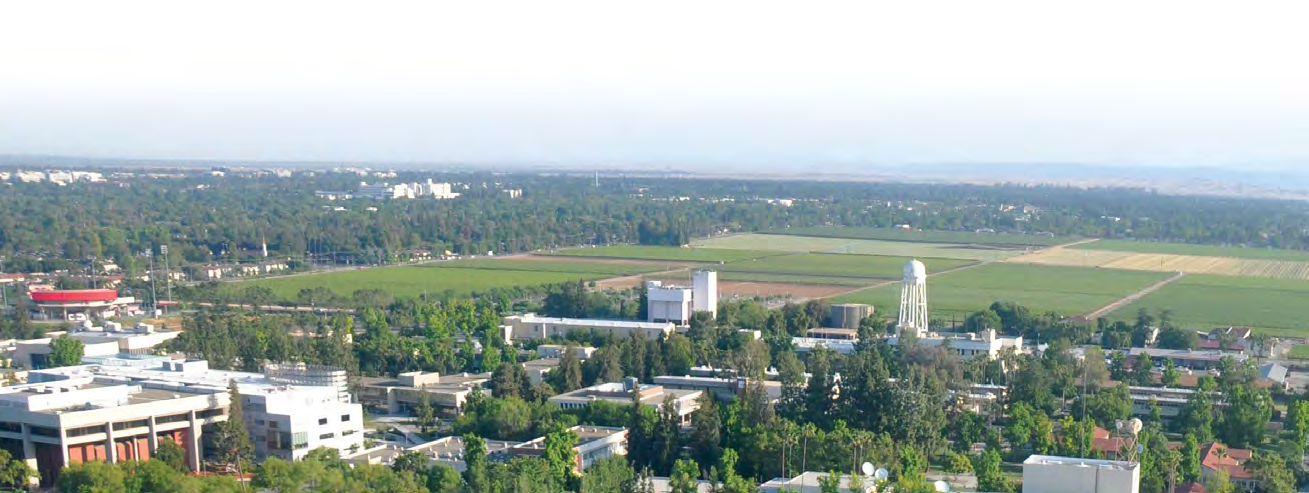
California State University, Fresno (Fresno State) is in California’s fifth largest city, in a state with the fourth largest economy in the world. The Fresno State campus sits in the midst of the San Joaquin Valley, a valley rich in the traditions and representation of Native American peoples and cultures. We are grateful to be in the traditional homelands of the Yokuts and Mono peoples, whose diverse tribal communities share stewardship over this land. The region is critical to the Nation’s food supply as about 25% of all the food comes from the valley. If we take out the grains from the Midwest, approximately 45% of all our nation’s fruits and vegetables are grown in the Central Valley’s fertile soil. Hence, the region is essential to the security of the United States of America. Yosemite, Sequoia, Kings Canyon, and Pinnacle National Parks are situated to the north, east, and west of Fresno.
Fresno State is the only public four-year institution in our service area (Fresno, Madera, Kings, and Tulare counties), a region with 1.8 million people—it’s more populous than 12 U.S. states and geographically larger than nine U.S. states. Fresno State is the only public university within a 66 mile radius and it offers more undergraduate and graduate programs than any university in a 100 mile radius. Our campus is thus a focal point for the region, and the economic, cultural, and social futures of our community and the university are inextricably intertwined. The Spring/Summer 2023 issue of Fresno State Magazine posited the question of what our region would look like without Fresno State. If the university did not exist, the Central Valley would lose a highly significant source of talent, innovation, and economic activity. Our region has entrusted Fresno State with a mission to provide a transformative education for our students, conduct research to address regional and global challenges, and foster an ethos of community service through example. Our university is proud to engage in this mission and its students, faculty, staff, and administration work hard to achieve these goals. Our self-study focused on our theme, Flagship of the Central Valley, and analyzed the role of Fresno State as an institution that both uplifts the lives of its residents and reshapes every facet of the region through transformative education, research, service, and leadership.
Fresno State was founded in 1911 as the Fresno State Normal School, becoming a four-year degree granting institution in 1934, and joining the system that would become the California State University (CSU) in 1961. The campus began awarding master’s degrees in 1949, and in 2005, became the first CSU to award doctorates. Fresno State is a comprehensive university, and in fall 2024, the university offered degrees in 74 undergraduate, 49 post baccalaureate, and three doctoral programs of study. The range of major offerings is diverse, giving students a wide variety of options for their field of study. These degree programs are housed in eight schools and colleges, along with the Division of Continuing and Global Education. 24,310 Fresno State students enrolled in fall 2024 The university had 24,310 students enrolled in fall 2024, including 21,852 undergraduate students and 2,458 post-baccalaureate students. Fresno State had 1,503 faculty members, including 596 tenured/tenure track professors, all holding a doctoral or other terminal degree in their area of study. The student/faculty ratio was 19:1. The university also had 997 administrative and staff employees. 19:1 Student to faculty ratio
California State University, Fresno | 2
Fresno State’s Vision
In 2023, the Fresno State community developed a new strategic plan to establish goals and strategies to guide the university over the next five years (online source: Fresno State Strategic Plan 2023-29). This process actively involved the participation of over 1,100 students, faculty, and staff. The vision of this plan is for Fresno State to be recognized as a model for advancing social, economic, and environmental progress regionally, nationally, and globally by providing an accessible, transformative education, conducting research on critical issues, and producing a generation of diverse leaders. We are proud to state that the strategic plan is both aspirational as well as measurable. The following goals are especially important elements of this vision and Fresno State works hard to achieve these objectives.
Providing Accessible, Transformative Education.
As the only public university in our service area, Fresno State has a responsibility
to promote upward mobility in our region and this is one of our highest values. Seventy-nine
percent of our students come from our four-county service area and 66% of our graduates
are the first in their families to attend college. Our Bulldog Bound Program guarantees
admission to high school graduates from 45 partnering school districts in our area
(as of July 2025) if they meet the minimum CSU system requirements. Participants in
Bulldog Bound receive support and relevant information (such as application assistance
and financial aid estimates) throughout their high school years.
Fresno State’s tuition and fees are among the lowest in the CSU system and 80% of our students receive financial aid. The university ranked twelfth in the west region in the Washington Monthly’s net price rankings for affordability for students from low- and middle-income families.
The College Futures Foundation published an October 2024 report that analyzed data from 324 California institutions to determine how long it took students to recover their higher education costs after graduation (Exhibit 1.1, College Futures Foundation Report). For forty-eight of the forty-nine Fresno State majors studied, students recouped those costs in less than two years. The majors that were studied included not only STEM and business fields but also majors from across the campus such as Teacher Education, Criminology, Geography, Communication, and Sociology. In April 2025, the Carnegie Foundation classified Fresno State as an Opportunity College and University, with higher access and higher earnings for students when compared to similar populations in the area (online source: Carnegie Foundation Classifications).
California State University, Fresno | 3

Fresno State has consistently earned very high rankings in social mobility. For example, Fresno State ranked fourth nationally in social mobility in the Wall Street Journal/College Pulse 2024 rankings and 13th in the west in the Washington Monthly’s 2024 “Best Bang for the Buck” ratings. Considering the funding that Fresno State receives, the university excels in its success to empower students who would generally not be accepted into other institutions. Fresno State prides itself in its inclusive acceptance rate, not in the number of students it rejects.
Embodying Full Inclusivity and Belongingness.
As noted in our strategic plan, Fresno State aspires to strengthen the sense of belonging
and foster a culture that believes our differences are sources of strength. Fresno
State has been designated as both a Hispanic-Serving Institution and an Asian American
and Native American Pacific Islander Serving Institution. The university is one of
39 colleges and universities to have earned the Seal of Excelencia, a national certification
for institutions that intentionally serve Latino students (online source: Fresno State Seal of Excelencia). Fresno State has also received Insight into Diversity’s Higher Education Excellence
in Diversity Award for the past ten years (online source: HEED Excellence in Diversity Award 2024).
A wide variety of programs and resources are available for Fresno State students to enhance a sense of belonging and promote student success. These include the Cross-Cultural and Gender Center, Veterans Resource Center, Off Campus Student Life (commuter students), Transfer Success Center, and Renaissance Scholars (for students who have experienced foster care). The College Assistance Migrant Program, Dream Success Center, Educational Opportunity Program (support for first generation and economically disadvantaged students), Office of Black Student Success, Services for Students with Disabilities, Wayfinders (neurodivergent students), Project Rebound (formerly incarcerated students), Native American Initiative, and Southeast Asian Student Success Center are examples of the supporting organizations that are available to our students. The Center for Essential Needs provides resources and support to assist students with basic needs. Resources include the Student Cupboard (free food and hygiene products), Clothing Closet, and Good Samaritan Grant program. All programming and events are open to all members of the university.
Providing Service and Leadership.
Service to the community and learning by serving are foundational to Fresno State
and one of our core values is encouraging a culture of giving back to the region.
The Jan and Bud Richter Center for Community Engagement coordinates the university’s
community engagement and service-learning efforts. Fresno State is a national leader
in this regard, and it prides itself in being a fully engaged university with the
surrounding communities. Over 1.4 million hours of service was provided by more than
21,000 members of the Fresno State community in 2023-24, creating an economic impact
of over $57 million in the region (online source: Fresno State Service-Learning Statistics). The university community has provided more than 13 million hours of service during
the past ten years. Service is a central value in our new strategic plan, which calls
for an increase in the number of community service hours and an increase in services
provided to the community. Fresno State is also a leader in service-learning courses,
with 198 courses offered in 2023-24 and over 4,000 students enrolled in these classes.
Fresno State was one of the first colleges and universities to receive the Carnegie
Foundation’s Community Engagement Classification, which was renewed in 2015 (online
source: Carnegie Foundation Classifications).
The university also plays an important part in the arts and athletics in the Central Valley. Fresno State students perform in concerts, theatre, dance, and art exhibitions on campus and in the community and alumni are active in the arts too. Faculty members not only provide excellent leadership for our students, but they are also highly regarded performers, directors, artists, poets, and authors themselves. Fresno State faculty have received Pulitzer Prizes (online source: Pulitzer Prize) and Guggenheim Fellowships (online source: Guggenheim Fellowship Recipients), and two have been selected U.S. Poets Laureate (online source: U.S. Poets Laureate).
California State University, Fresno | 4

Fresno State averaged nearly 40,000 fans per football game in 2023
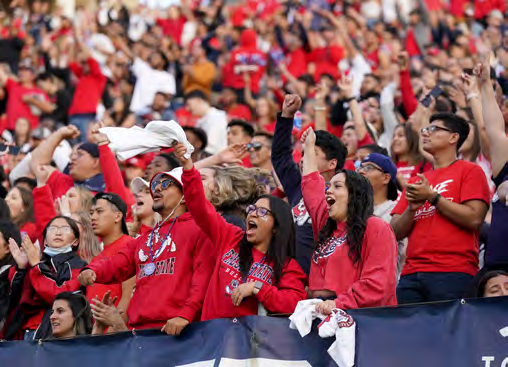
The Central Valley does not have professional sports teams; hence Fresno State serves as a critical sports entity--we have eighteen Division I athletic teams, and the Bulldogs attract a significant following among its fans, known as the Red Wave. Fresno State leads in national rankings for football attendance for non-Power 5 schools (online source: College Football Attendance Statistics); averaging nearly 40,000 fans per game in 2023 (online source: Fresno State Football Attendance). This remarkable attendance was more than 15 Power 5 conference schools and was our highest attendance since 2001. On July 1, 2026, Fresno State will join the Pac-12 Conference. The Fresno State brand ranks #1 in the CSU system for gross royalties and is among the top 5 in California alongside USC, UCLA, Cal, and Stanford.1
1. Based on the 2022-23 publication from Collegiate Licensing Company (CLC). Fresno State ranks #4 among all of CLC’s California client institutions. CLC is the largest Licensing Agency in the Collegiate Licensing Industry, representing over 90% of the market share with close to 800 Universities, Colleges and Athletic Conferences, including most of the universities in California with Division 1 Athletics.
The Fresno State Library plays an essential role in engagement and collaboration with Central Valley communities. Through unique collections, exhibitions and events that reflect and celebrate the diverse cultures and histories of the region, the library fosters a sense of community and inclusivity, making it a trusted space for historically marginalized communities.
The Fresno State community takes an active role in leadership in the Central Valley and preparing our students to be the next generation of leaders is an important part of our vision. Fresno State’s commitment to leadership was recognized by the Carnegie Foundation, which included the university in their inaugural Leadership for Public Purpose classification (online source: Carnegie Foundation Classifications). This recognition is based on a commitment to campus-wide efforts to advance leadership in pursuit of public purpose.
Our alumni are leaders in every sector of the community, including agriculture, business, education, government, health care, and social justice. For example, six out of 10 of the most recent mayors of Fresno earned their degrees at Fresno State and 60% of school administrators in the region, including the current Fresno County Superintendent of Education, are alumni. Our mission and core values emphasize the importance of providing servant leadership, rather than simply exercising authority. Our goals are to teach our students about the importance of collaboration , problem-solving, ethics, and a commitment to social and community well-being.
Fresno State’s curriculum seeks to develop both discipline-specific competencies and leadership skills. In the academic year 2022-23, 12% of our courses contained leadership in the title and these classes are available across the curriculum. We also have 12 degree programs and two certificate programs in leadership. They cover diverse fields, including agriculture, business, education, humanics (leadership for community benefit organizations), and public administration.
Maintaining Excellence in Teaching and Research.
In the early decades of Fresno State’s history, the faculty was primarily focused
on teaching. In the 1980s, the university began to transition from a faculty of teachers
to one of teacher/scholars, with excellence in both teaching and research/creative
activities required for retention, tenure, and promotion. Goal 3 of Fresno State’s
2023-29 strategic plan is to cultivate regional progress by enhancing both instruction
and research (online source: Fresno State Strategic Plan 2023-29).
Fresno State faculty members have an active record of research and creative activities. The Carnegie Foundation reclassified Fresno State as a Doctoral University (R3) in 2016, and as a Doctoral University High Research Activity (R2) in 2022. In February 2025, the university’s R2 designation was renewed, now classified by Carnegie as High Spending and Doctorate Production (online source: Carnegie Foundation Classifications). Indeed, we have been intentional about increasing our grants and funding–every tenured faculty is supported and required to apply for a grant. We have seen a steady increase in the number of PIs (220 in FY 2018-19 up to 348 in FY 2021-22), and the total research award dollars has increased dramatically–from $45M (FY 2018-19) to $78M (FY 2023-24). 2023-24 was the sixth consecutive year that the total research award dollars increased.
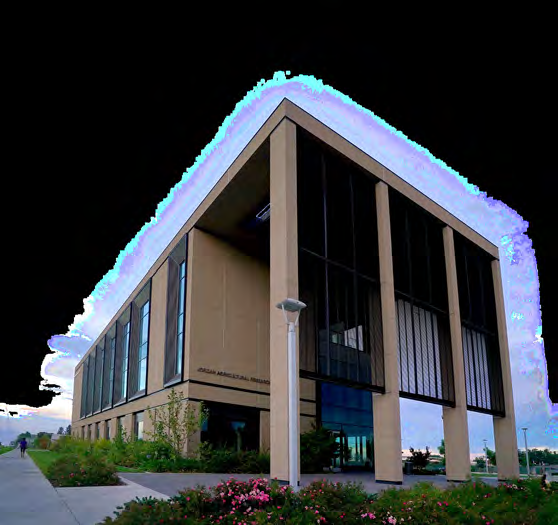
Fresno State centers and institutes are housed in each of the university’s colleges and many of these organizations conduct applied research that addresses regional needs. For example, the Jordan Agricultural Research Center conducts cutting edge research that is critical to maintaining the production of 25% of our nation’s food –their main areas of research are in agricultural, food, and natural resources. Furthermore, Fresno State is a leader in water research. Through the California Water Institute, we focus on sustainable water resource management. The Central Valley Health Policy Institute focuses on the special health challenges of our region.

R2 Research University
While Fresno State has expanded research activity, teaching remains the most important responsibility of the faculty. To earn tenure and to be promoted to either associate or full professor, faculty members are required to maintain a record of strong peer and student ratings of instruction and continually increase their teaching skills (Exhibits 1.2 and 1.3, Academic Policy Manual Sections 325 and 327) and promotion to full professor requires evidence that the faculty member’s teaching has matured over the course of their career (Exhibit 1.3, Academic Policy Manual Section 327). The Office of IDEAS provides high level professional development opportunities in many effective teaching practices, including affordable learning solutions, equity in the classroom, universal design for learning, and digital learning (including appropriate uses of artificial intelligence). Student ratings of instruction for Fresno State faculty have consistently been high, with a mean of 4.5 (5.0 scale) for overall teaching in each semester from fall 2022 to spring 2024. Ratings on instructional design, instructional delivery, and assessment have ranged from 4.4 to 4.6.2
2. Fresno State Student Ratings of Instruction, University Wide Report, Fall 2022 through Spring 2024. The student ratings instrument was developed by university faculty, providing for anonymous feedback. The instrument was specifically designed to identify only directly observable instructor behaviors and behaviors that have been demonstrated to produce learning.
Fresno State faculty also need to demonstrate an active record of student advising. Between 2016 to 2024, one hundred thirty-five faculty members have been nominated for the Campus Advisors Network Outstanding Advisor Award.3
3. Kathy Dunbar, Assistant Director, University Advising Center
California State University, Fresno | 6
Meeting Challenges
Budget Challenges.
Though the CSU has faced and still faces significant budgetary challenges, Fresno
State has managed to balance the budget while maintaining our educational mission.
In FY 2024-25, the CSU system experienced a gap of $218 million between anticipated
revenue and expenditures. Fresno State’s share of this deficit was close to $10 million.
The university achieved a balanced budget in 2024-25, implementing a 5% budget reduction
across all divisions. Each division developed their own plan for balancing their budget
reduction while prioritizing essential services and minimizing the impact on student
success.
For FY 2025-26, the Governor is proposing a $143.8 million cut for the CSU system and Fresno State’s share is anticipated to be $7.2 million. Each cabinet member is analyzing strategic reductions of Management Personnel Plan (MPP) positions as a first step to further reduce the deficit. The university will also draw from its benefit and compensation one-time reserves to cover the shortfall for this coming year.
Benefits of Fee Increase for Students
• Paid internships
• Almost 50% of students receive Supplemental Instruction
• Peer tutoring
• Food and financial security resources
To ensure funding for important student success priorities, the university increased the annual Instructionally Related Activities fee by $495 per student, effective in fall 2025. The allocations from this increase will be used to support programs that are linked to student success, such as paid internships, expanded supplemental instruction, peer tutoring, and food and financial security resources for students (online source: Student Fee Increase Proposal Spring 2025). Additionally, the fee will also support Athletics, which will free up current university support for Athletics and will allow the university to reallocate resources for the academic and student affairs budgets. The increase was instituted after a widespread campus consultation process and after the increase, the university remains in the lower half of total student fees for the CSU system for 2025-26 (Exhibit 1.4, CSU System Student Fees).
Enrollment Trends.
One concern has been declining higher education enrollment trends, exacerbated by
decreased enrollment during the COVID pandemic. Nationally, undergraduate enrollment
at the college level was 18.1 million in 2010, but the totals have decreased at a
rate of approximately 1.5% per year.4
4. College Transitions, “U/S. College Enrollment Decline – 2024 Facts and Figures,” April 22, 2024, online source: https://www.collegetransitions.com/blog/college-enrollment-decline/
In addition to the impacts of the pandemic, demographic trends are expected to cause an “enrollment cliff,” with the college age population in the U.S. declining over the next five to ten years, perhaps by as much as 15%.5
5. D. Bayman, “Colleges Were Already Bracing for an ‘Enrollment Cliff.’ Now There Might be a Second One.” Chronicle of Higher Education, February 7, 2024.
On our own campus, enrollment (headcount) had declined from 25,341 in fall 2020 to 23,832 in fall 2023.
Fresno State has taken an innovative, intentional, and proactive approach to building student enrollment. The Division of Student Affairs and Enrollment Management (DOSAEM) 2023-29 Strategic Plan (online source: DOSAEM) prioritizes expanded recruitment and outreach, promoting Fresno State as the brand of choice in the Central Valley. The Bulldog Bound Program is an innovative approach to recruitment—it’s a guaranteed admission to Fresno State through a contract that is signed by the student, parents, district and our university; it incorporates workshops on all the most important elements of college, including financial aid, tutoring, and student resources; the workshops are provided in English, Spanish, Hmong, and Punjabi. Bulldog Bound constructs a bridge of understanding to college, for both students and their parents.
California State University, Fresno | 7
The university took other steps to encourage and facilitate enrollment. When the government’s new FAFSA form caused logistical hurdles in 2024, the Better FAFSA program was launched, providing students with more time to submit their documents. Fresno State also implemented the Tuition Advantage Program, providing additional funding to close financial gaps caused by FAFSA processing delays and ensure that students who meet eligibility criteria received enough aid to cover their tuition and campus fees. The Bulldog Connect Program was established, under which the advising center identifies students who have not registered for an upcoming semester and offers them proactive outreach, support, and guidance. The university also created a support team for “stop out” students who had left the university for more than one year without a degree.
The result of these efforts was a significant increase in student enrollment for fall 2024. The university had the second largest-ever cohort of new students, with 3,526 first-time freshmen and 2,840 transfer students. They were joined by 354 returning students and 175 international students. This represented a 5% increase compared to fall 2023.
Mishandling of Sexual Harassment Case.
During the latter part of the pandemic, Fresno State suffered through a deep emotional
crisis –the previous president had become the chancellor of the CSU system and resigned
after allegations of having mishandled a sexual harassment case involving one of his
vice presidents. During this difficult time, Fresno State was ground zero for the
issue, and trust across campus and in the community eroded dramatically. After much
communication and planning, Fresno State is proud to lead in its response to Title
IX, discrimination, harrassment, retaliation, and other behaviors of concern, after
having created the Office of Compliance and Civil Rights; this has furthered Fresno
State’s vision of transparency, accountability, and trust.
Future Challenges.
As the university looks to the future, there are several challenges to higher education
as society continues to devalue a college degree, as well as the waning confidence
in higher education to deliver on the promise of social mobility.6
6. Courtney Brown, “We can’t ignore a crisis of confidence in American higher education,” Lumina Foundation, October 4, 2024, online source: https://www.luminafoundation.org/news-and-views/crisis-of-confidence-in-u-s-higher-education-a-call-for-renewed-focus-and-reform/
Many no longer see the return on their investment in earning a college degree, which is decreasing college enrollment and moving students into earning industry badges or micro-credentials as less expensive alternatives.7
7. Hanna Aronovich, “5 things to know about implementing digital badges,” April 26, 2022, online source: https://www.credentialinginsights.org/Article/5-things-to-know-about-implementing-digital-badges-1
This, coupled with shifting demographics resulting in fewer prospective students in the K-16 pipeline, will contribute to declining enrollment.
Additional concerns faced by the California State University System stem from competition for resources from the two other systems of higher education within the state—the California Community Colleges (CCCs) and the University of California (UCs). Both receive considerably more state funding than the CSU and, by comparison, attending a CCC is most cost effective for students at $46 per unit not including nominal fees (Fresno State’s tuition for full-time resident students is $3,225 in fall 2025). In addition, there are 32 CCCs with at least one bachelor’s degree program and that number is expected to grow in the coming years.8
8. Michael Burke, “California Community Colleges approves 6 new bachelor’s degree programs, March 26, 2024, online source: https://edsource.org/2024/california-community-colleges-approve-6-new-bachelors-degree-programs/708463
In an effort to increase enrollment, several UC universities are working closely with the CCC to streamline pathways, making it easier for students to transfer into a UC campus.
As Fresno State is pivotal to the economy and society of the region, we will continue to address these challenges through strategic enrollment management, ongoing legislative advocacy, and outreach to the community to ensure that the public understands the impact of Fresno State, and the degrees we offer to the region.
California State University, Fresno | 8
https://www. luminafoundation.org/news-and-views/crisis-of-confidence-in-u-s-higher-education-a-call-for-renewed-focus-and-reform/
https://www.credentialinginsights.org/Article/5-things-to-know-about-implementing-digital-badges-1
https://edsource.org/2024/california-community-colleges-approve-6-new-bachelors-degree-programs/708463
Response to 2015 WSCUC Reaccreditation Report
WSCUC conducted a site visit on October 20-22, 2015, and issued a letter reaffirming Fresno State’s reaccreditation for 10 years on March 2, 2016. The commission commended the university for its focus on its mission as a community-engaged university, dedicated to providing degree opportunities for all students, its open and inclusive planning process, improvement in graduation rates and closing the achievement gap for subgroups of non-traditional students, and sound financial management.
The commission identified four areas for further development: implementation of core competencies, development of a five-year business plan, setting deadlines for activities such as scheduling program reviews and assessments, and moving forward with the implementation of ePortfolios for assessment. WSCUC asked for an interim report to address three issues:
- Implementation of a five-year plan for the assessment of the five core competencies with evidence of outcomes
- Update on implementation of ePortfolios with results
- Development of a five-year business plan to accompany the strategic plan
The university submitted the interim report on schedule and participated in a virtual WSCUC Interim Report Committee (IRC) review on January 12, 2021. In the interim report, the university provided evidence of actions taken to address each of the three issues identified by WSCUC. No further reports were requested by the commission after this meeting.
Core Competency Assessment.
Fresno State created a plan to assess the five WSCUC core competencies on a rotating
basis. The College Assessment Coordinators Team is responsible for conducting each
assessment. This team includes one faculty member from each college (with a course
release for serving in this role), the Library Assessment Coordinator, and the University
Director of Assessment. Two coordinators serve as co-chairs each year and they recruit
a committee of faculty members from diverse disciplines to conduct the assessment.
Depending on the competency being assessed, the committee collects a representative sample of student coursework, administers a test, or (in the case of oral communication) observes student classroom speeches. They then apply a rubric to evaluate the student work and issue a report at the end of the evaluation. At the time the Interim Report was written, the university had assessed oral communication and quantitative reasoning. The core competencies continue to be assessed on a rotating basis, with written communication assessed in academic-year 2024-25. Consequently, the reports inform changes that ensure a continuous reassessment of student success.
California State University, Fresno | 9
... [content continues through remaining pages, preserving original wording and image placement] ...
This HTML version was generated with AI assistance and may contain errors or omissions. The original approved PDF remains the official document of record. An alternative accessible format is available upon request from the document creator in accordance with Title II of the ADA.