Education: College- or Institutional-Level Applications: Research Sources and External Evaluators

Office of University Initiatives
Gil Harootunian, PhD, Executive Director
Angelica Lopez, Administrative Analyst Specialist
Table of Contents
Section 1: Department of Education “Model”
Section 2: Successful Awards
Section 3: Proven Competitive Strategy: Vetted Sources
Section 4: Proven Competitive Strategy: Vetted External Evaluators
Section 5: Federal Agency Priorities
Department of Education “Model”
Why Is USDE Still A Good Model?
1. Dedicated to supporting educational success across disciplines.
2. Currently being dismantled, but components will exist elsewhere (e.g., other federal
agencies, state educational agencies).
3. Transfer knowledge gained from model … to wherever grant funds end up being house.
4. Source of vetted research and evaluators: Institute for Education Sciences (IES)
will likely remain as core component of Department of Education. IES provides vetted
research sources and certified external evaluators.
Successful Awards
Shepherded by University Initiatives
Shepherded by University Initiatives
Note: The range of support provided by University Initiatives varies as much as the projects
and the teams. The support ranges from developing a project from scratch to editing,
consulting, and/or budgeting. University Initiatives is responsive to the needs of
the project and of the team.
Developing Hispanic-Serving Institutions (undergraduate level)
➢ Enseñamos en el Valle Central - Kremen, w/ two Fresno City College and Reedley College - ~$3.75M
➢ “STEAM: Enriched Pathways” - CSM, LCOE, JCAST - ~$3M
➢ West Hills Community College District: subaward for Satellite Campus - ~$1M
PPOHA = Promoting Postbaccalaureate Opportunities for Hispanic Americans (graduate level)
➢ Blue Ribbon Online Graduate Campus (aka Grad Net) - ~$2.8M
➢ Finish in Five (4+1 accelerated degrees) - ~$2M
Each was for multiple disciplines.
➢ Asian American, Native American Pacific Islander-Serving Institutions (AANAPISI) award to increase AAPI representation in Criminology Department majors - ~$1.25M
➢ Office of Special Education Personnel award to provide scholarships and professional development to Special Education majors - ~$1.25M.

Successful Award from USDE Developed by University Initiatives
Postsecondary Student Success Grant Program - Educational Research Study: Strengthening Advising, Strengthening Results (“START”) - ~$8M

Proven Competitive Strategy: Vetted Sources
Proven Competitive Strategy: Consult Sources and Evaluators Who Have Been Vetted by USDE
Institute of Education Sciences’ - “What Works Clearinghouse (WWC)” @ https://ies.ed.gov/ncee/wwc/
Practice Guides, Intervention Reports, and Individual Studies to enable applicants
to make “evidence-based decisions” about what works.
WWC sources meet three tiers of evidence:
https://ies.ed.gov/ncee/wwc/essa
Tier 1: Strong Evidence of Effectiveness. Meets WWC standards “without reservations.” Well designed and implemented Randomized
Controlled Trial (RCT).
Tier 2: Moderate Evidence. Quasi-experimental study (no random selection or assignment w/ comparison groups).
Tier 3: Promising Evidence. Well designed and implemented correlational study w/ statistical controls for selection
bias.
Tier 4: Demonstrates a Rationale. Well designed Logic Model, supported by research, and study underway.
$8M “START” award
Study Designed To Meet Tier 1: Strong Evidence.
The START advising project will use a randomized control trial designed to meet What
Works Clearinghouse standards without reservations. Students who enter as freshmen
in fall 2024, and students who enter as transfer students in fall 2024 and fall 2026,
will be randomly assigned to a START advisor or regular advisor. Approximately 8,500
students will participate in the study, and half will be assigned to an advisor who
received enhanced advising training and the other half will be assigned to a business-as-usual
advisor. Students will be randomly assigned within their specific college at CSU,
Fresno. We will use a multilevel regression model to estimate the impact of the advising
intervention, accounting for the blocked natured of the random assignment, and determine
how START effects vary for specific student groups (i.e. URM, low-income, first-generation,
and part-time students) compared to their peers who received business-as-usual advising.

Evidence Justification form (good model to adapt for other proposals)
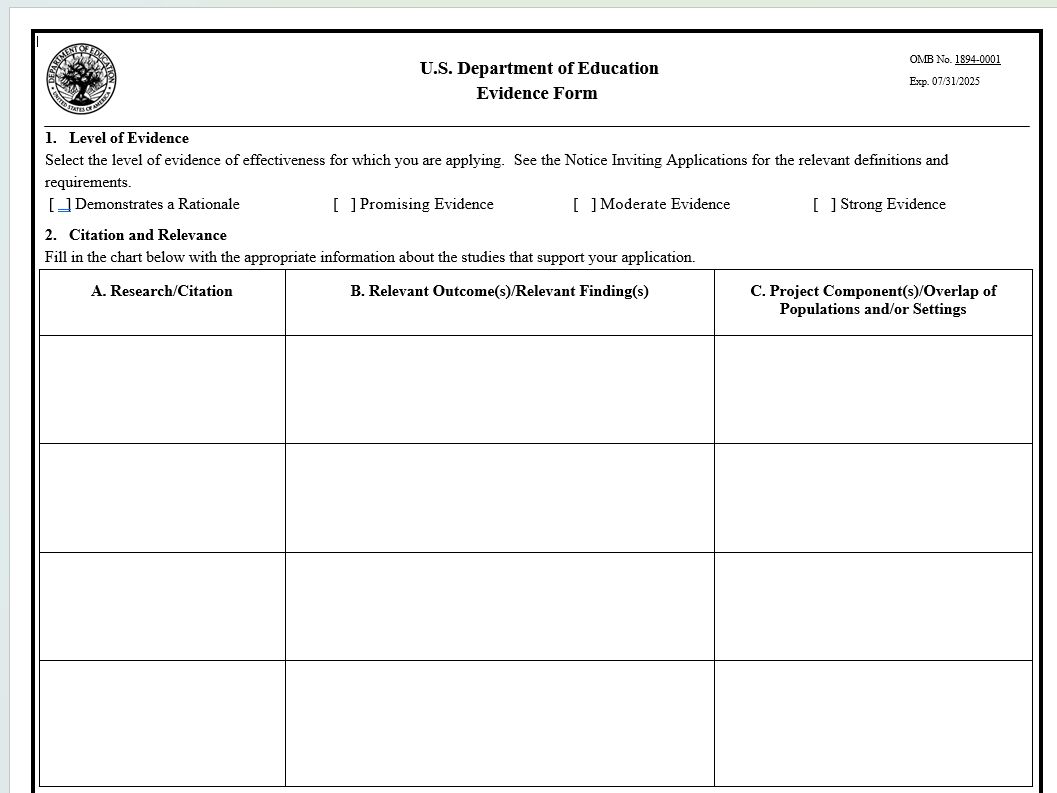
Evidence Justification form
1. Cite all the sources you think best.
2. Include WWC sources in “Evidence Justification” form (or re-create similar table).
3. Federal reviewers know that WWC sources have been vetted. You are giving reviewers
something they have no reason to question.

Conceptual Background
Six studies meeting What Works Clearinghouse Tier 1: Strong Evidence standards have confirmed the effectiveness of transformed and transformative advising in achieving postsecondary education academic outcomes, especially retention and timely graduation. The “START”project will provide additional insight regarding the impact of enhanced advising at four-year institutions since the majority of the existing literature has focused on community college settings.

Proven Competitive Strategy: Vetted External Evaluators
Independent Evaluators: More Value Added
➢ In demand and highest credibility
➢ An independent evaluator can pay more attention to your award, his or her expertise
can align best with your work, and his or her services cost less.
➢ A ‘big center’ evaluation often charges more for its services, provides more general
expertise (such as STEM education vs. Math education), and has contracted evaluators
with a bunch of awards.
$8M START Award
Recruited a WWC certified evaluator from list:
Search engine: https://ies.ed.gov/ncee/wwc/reviewer
To become one:
https://ies.ed.gov/ncee/wwc/Document/237#/Document_237_Becoming
Federal Agency Priorities
Annual Competition “Priorities” That Respond To National Need
➢ Absolute Priority - you are required to meet this.
➢ Competitive Preference Priorities - You can earn additional points if you meet these.
➢ Invitational - You are not required to meet these nor do you earn additional points,
but meeting an Invitational Priority creates a “halo” around your application
Priorities: Developing Hispanic Serving-Institution Program (DHSI): 2023
Absolute Preference [standard]: Excellent quality of the comprehensive development plan, project design, activity
objectives, rationale, and promising evidence. See “Genre: The Major Funding Application” resource.
Competitive Preference Priority 1: Meeting Student Social, Emotional, and Academic Needs (up to 5 points).
Competitive Preference Priority 2: Increasing Postsecondary Education Access, Affordability, Completion, and Post-Enrollment
Success (up to 5 points).
Invitational Priority: Addressing the Impact of COVID-19 on Students, Educators, and Faculty
Priorities: What to do about them?
➢ If you can meet all Priorities in any given competition, go for it.
➢ If you cannot meet all Priorities in any given competition, wait until another competition
or apply to another program. Awards are won by fractions of a point.
➢ Three reviewers will read and score your proposal, so you could earn 96.3 points,
and the cut off for awards was 96.6 points.
Contact anytime:
Dr. Gil Harootunian, Executive Director, University Initiatives
gharootunian@csufresno.edu
278-4850
This PDF is provided as a print-only reference document and may not be fully accessible to users of assistive technology. For more information, please visit Title II Rule on Digital Accessibility page.