The Role of Institutional Data A Focus on Hmong American Student Success
The Role of Institutional Data:
A Focus on Hmong American
Student Success
Dr. Yoshiko Takahashi
Associate Professor, Department of Criminology; OIE Faculty Fellow
Alex Nottbohm
Research Analyst, Office of Institutional Effectiveness
January 2019
Principal Investigators and Authors
Dr. Yoshiko Takahashi
Associate Professor, Department of Criminology; OIE Faculty Fellow
Alex Nottbohm
Research Analyst, Office of Institutional Effectiveness
Contributors
Marie Tongson-Fernandez
Administrative Analyst/Specialist, Office of Institutional Effectiveness
Dr. Soua Xiong
Assistant Professor, Counselor Education and Rehabilitation (CER) Department
Acknowledgments
Dr. Rudy Sanchez
Interim Associate Vice President of Academic and Institutional Effectiveness
Dr. Xuanning Fu
Dean of Undergraduate Studies
Dr. Matthew Zivot
Associate Director, Office of Institutional Effectiveness
Dr. Bryan Berrett
Director, Center for Faculty Excellence
Bethany Theuret
Student Research Assistant, Department of Criminology
Foreword—A Message From President Joseph I. Castro
Fresno has one of the largest Hmong American communities in the United States, and Fresno State is an Asian American /Native American/Pacific Islander-Serving Institution (AANAPISI). Six percent (6%) of Fresno State students are Hmong Americans, the highest proportion among all CSU campuses. Hmong American students’ educational success is important to students themselves, to their families and community, to the university, and to the nation.
Hmong are not specifically classified as an underrepresented minority group by federal education codes, but their unique immigration history and experiences present barriers to success that are no less challenging than those facing underrepresented minority student groups. Hmong students need institutional and community support for their educational success, and their experiences and life stories are invaluable to faculty, staff, administrators and other students.
This report provides a comprehensive analysis and narrative of Hmong students’ successes, challenges and needs. It informs all campus community members and calls for strategies and actions to better assist Hmong students in their pursuit of a college degree, and a better future for themselves and their families. The report also helps us to understand other Southeast Asian students who share similar cultural and immigration histories with Hmong.
Key Findings
Section 1—Institutional Data Findings
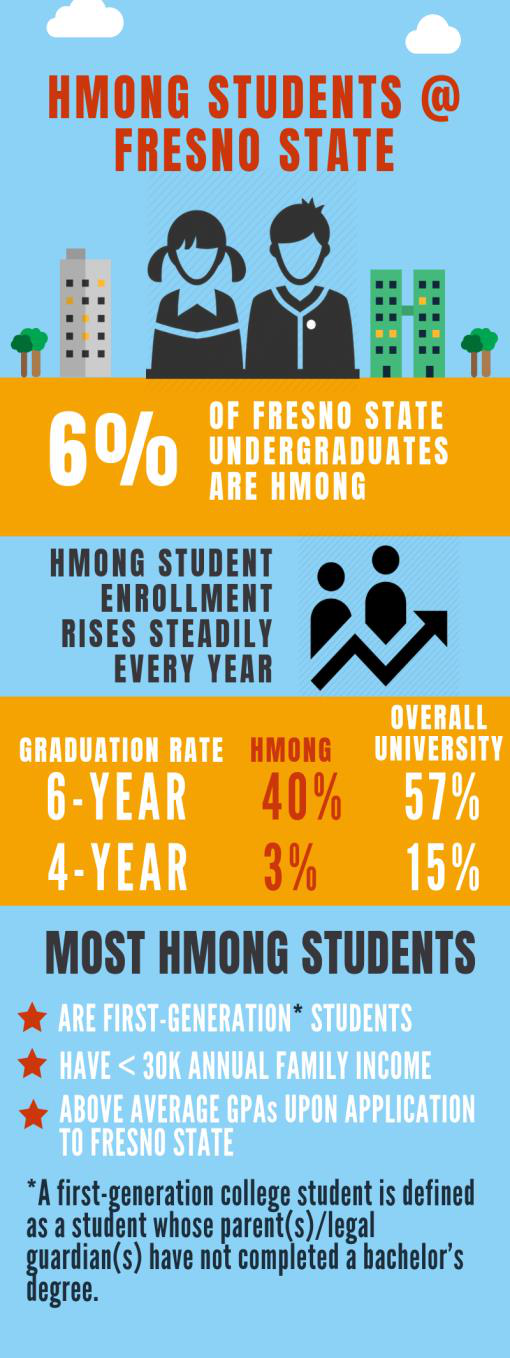
Hmong students make up about 6% of the Fresno State undergraduate student population, with enrollment steadily increasing. Most Hmong students are first-generation students, come from families that make less than $30,000 annually, and attend school full time.
Hmong students apply to Fresno State with higher-than-average high school GPAs and are more likely to be admitted than other applicants. Hmong students are more likely to enroll at Fresno State than other admitted students.
Only 3% of Hmong first-time full-time freshman (FTFTF) graduate within 4-years (compared to Fresno State’s FTFTF 4-year graduation rate of 15%, Fall 2009 – Fall 2012), and 40% of Hmong first-time full-time freshmen (FTFTF) graduate within 6 years (compared to Fresno State’s FTFTF 6-year graduation rate of 57%, Fall 2009 – Fall 2012).
The Student Success Survey was developed to fully highlight the nuances of Hmong students’ distinct experiences that are not captured in institutional data alone. The survey was sent to two groups of students: one group of Hmong students and one group of students of other ethnicities.
Section 2—Findings from the Student Success Survey
Finding 1: Hmong Students Experience Distinct Academic Challenges
Finding 2: Hmong Students Are Less Certain About Their Academic Readiness, Progress,
and Success
Finding 3: Hmong Students Find Some Campus Connections Challenging
Finding 4: Hmong Men and Women Students Share Similar Academic Progress but Experience
Distinct Challenges
Finding 5: Students’ Life Stories Revealed Differences Between Hmong Students and
Other Students
About the Report
In the following report, we present institutional data aimed at starting a conversation around how we can work together to promote Hmong educational success at Fresno State. In an analysis of the latest U.S. Census Bureau statistics, Xiong (2012) found that Hmong Americans have experienced an increase in college enrollment. Specifically, he noted that college enrollment among Hmong Americans more than doubled from 11.8% to 23.7% from 2001 to 2010. Although this trend suggests that more Hmong Americans are pursuing a college degree, institutions of higher education have struggled to support their success. As noted by Pak, Maramba, and Hernandez (2014), almost half of Hmong Americans nationwide who attended college did not obtain a degree. In addition, the number of Hmong Americans who completed a degree (14%) was disproportionately lower than the national population (28%) and all other racial/ethnic groups (Museus, 2013). These disparate outcomes are alarming and suggest that systematic challenges that Hmong Americans face have not been adequately addressed. As such, scholars, researchers, and practitioners have underscored the critical need to focus on advancing success outcomes for Hmong Americans in higher education (e.g., Iannarelli, 2014; Lee, 1997; Lor, 2008; Xiong & Lam, 2013; Xiong & Lee, 2011).
In light of the nationwide trends, we believe it is critical to further investigate Fresno State Hmong students’ experiences. The intent of this report is to demonstrate the capacity of institutional research by providing a detailed assessment of Hmong students at Fresno State from two data sources. After highlighting campus events celebrating the Asian & Pacific Islander (API) community, the institutional data in Section 1 describes the demographics and academic progress such as retention and graduation rates for Hmong students who have been admitted or transferred to Fresno State. The survey data, outlined in Section 2, discuss Hmong students’ distinct academic and personal challenges and the areas where further institutional supports are needed. The case-control matching process was used to create groups with similar socioeconomic status and academic backgrounds, isolating ethnicity as the main difference between the groups.
This range of institutional and empirical research sets the stage for posing a critical question: How can educational institutions use these findings to build an evidence-based collaborative system to support student success? This report should serve as a guide for facilitating conversations around best practices for using institutional data with an equity-minded perspective, as well as for developing and advocating for culturally sensitive programs tailored to the needs of students on campus and in the community.
Lastly, the report demonstrates that research on disaggregated data for racial/ethnic subgroups adds significant value to institutional knowledge and further analysis of other historically underrepresented ethnic subgroups would help present a more comprehensive picture of both educational successes and ongoing challenges of students at Fresno State.
This report was made possible by the Office of Institutional Effectiveness (OIE) Faculty and Student Fellow programs at Fresno State. Dr. Yoshiko Takahashi, OIE faculty fellow, and Alexandra Nottbohm, an OIE research analyst, collaboratively worked on the project over the past year. We are delighted to share the findings here and would like to thank the OIE and the Center for Faculty Excellence for their mentoring and support of the project. Special thanks go to Dr. Soua Xiong, who is an alumni and now an assistant professor in the Counselor Education and Rehabilitation (CER) Department at Fresno State, for his help in contributing a summary paragraph on the Hmong American experience in higher education, reviewing the report, and providing meaningful suggestions.
Yoshiko Takahashi, Ph.D. Alex Nottbohm
Associate Professor Research Analyst
Department of Criminology Office of Institutional Effectiveness
ytakahashi@csufreno.edu anottbohm@mail.fresnostate.edu
California State University, Fresno California State University, Fresno
Campus Recognizes & Celebrates the API Community
Over the past few years, Fresno State has been dedicated to celebrating the Asian & Pacific Islander (API) community, as well as increasing its focus on supporting the Southeast Asian community. Although these events and initiatives are not specific to Hmong students, many of these events encompass Hmong students’ experiences, and promote Hmong student success. The following events showcased API progress and success in the academic year 2017–2018.
SEA Young Men’s Educational Summit
In May 2018, Fresno State hosted the first ever Southeast Asian Young Men’s Education Summit. This event provided high school and college aged Southeast Asian men with the opportunity to meet with mentors and engage in seminars focused on leadership and cultural identity. The seminar also was open to parents and family members, who participated in workshops centered on parental support and involvement.
Asia in Fresno Symposium
Fresno State’s College of Social Sciences sponsored “A Symposium on Campus and Community Partnerships,” to facilitate a conversation between the API community and Fresno State faculty, staff, and students on shared experiences and campus initiatives. In addition, the symposium helped to establish and strengthen ongoing partnerships between Fresno State and the API community. The event was a great opportunity for students to hear from inspirational Asian leaders in Fresno, as well as a place to network and hear about career opportunities.
Raising the Bar Student Symposium
Hosted by Fresno State’s Asian Faculty and Staff Association, the symposium “Asian American and Pacific Islander (AAPI): Raising the Bar through Research, Reflections, and Resources” disseminated research focused on AAPI student success conducted at Fresno State to Fresno State students and the campus community. In addition, the seminar showcased a panel of AAPI community leaders who shared their experiences, both challenges and successes, as first-generation college students. Students also had the chance to learn about on-campus resources to support them through their college careers.
New Hmong Faculty & Staff
Fresno State has slowly increased the number of Hmong faculty and staff, from entry-level positions to administrative leaders on campus. For example, there are now a handful of Hmong tenure-track faculty teaching at Fresno State. There are also Hmong staff working to support Fresno State’s Southeast Asian students. The Cross-Cultural and Gender Center recently hired a coordinator for Asian Pacific Islander and American Indian programs and services.
Section 1: Institutional Data Findings
Background Characteristics of Hmong Students at Fresno State
In an examination of all Hmong students at Fresno State, including undergraduates and graduate students, a majority of Hmong students (85%) are first-generation students, meaning that neither of the student’s parents has earned a college degree. Most (92%) Hmong students are attending school full-time.
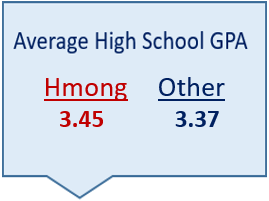
Hmong undergraduate students have shown competitive application readiness. A majority of Hmong applicants come from local high schools, including Sunnyside, Clovis East, and McLane (see Figure 1.2). Hmong students apply to Fresno State with high school GPAs that are higher than the average Fresno State applicant (see Figure 1.1). In addition, Hmong students are accepted into Fresno State at higher rates than other students. Approximately three of every four Hmong applicants are accepted into Fresno State. Hmong students are also more likely to enroll at Fresno State once they are admitted. Sixty-five percent of Hmong student admits chose to enroll at Fresno State, with 81% enrolling as first-time, full-time freshmen (FTFTF), meaning they are enrolling at Fresno State directly after finishing high school- and are choosing to attend school full-time.
As Figure 1.3 shows, Fresno State has seen a substantial increase in enrollment of Hmong students. In 2012, there were 1,097 Hmong students enrolled at Fresno State, and in 2018, there were 1,444, marking a 32% increase in enrollment of Hmong students.
Hmong Student Major Enrollment
Hmong undergraduate students choose majors similar to other Fresno State undergraduate students. As shown in Table 1.1, Hmong students are more likely to have an undeclared major than other students. When a student is undeclared, she/he is not currently working toward a specific degree. Often times, undeclared students are left to decide which courses to take on their own, and may take extra courses that are not required for their degree. This can lead to students having to take more courses than required, and delay students from graduating.
Hmong Transfer Student Success
In an examination of graduation rates, Hmong transfer students, or students who first attend a community college and later transfer to Fresno State as juniors, have achieved good success at Fresno State. Typically, the university uses four-year graduation rates as an indicator of on-time graduation for transfer students. As shown in Figure 1.4, 74% of Hmong transfer students graduate with a bachelor’s degree in 4 years compared to 76% of other transfer students.
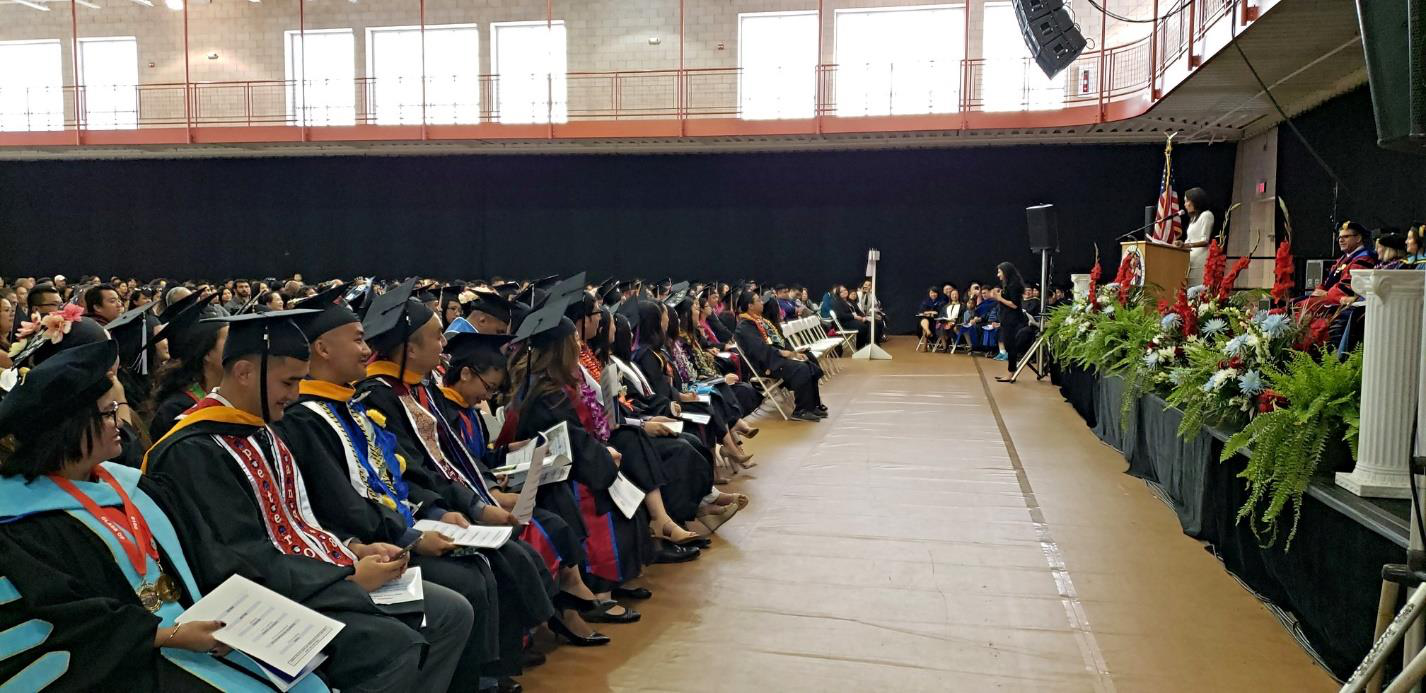
Fresno State Asian American & Pacific Islander Commencement Celebration, 2018
Table 1.1. Top five majors of currently enrolled Hmong undergraduates and other undergraduates
for Fall 2018.
Note: Psychology includes both Pre-Psychology and Psychology students.
Hmong Transfer Other Transfer
Promoting Hmong American Educational Success
Hmong Americans have made significant progress in higher education. However, we also want to explore what more we can do at Fresno State to enhance Hmong students’ success. As seen in Figure 1.5, Hmong students are retained at slightly lower rates than other students, meaning that more Hmong students leave the university without earning a degree than other students.
In addition, Hmong first-time, full-time freshmen (FTFTF) are graduating at lower rates than other students. The university typically considers graduating within 6 years of starting college as an important indicator of success. Primarily, graduating quicker means that students can enter higher-paying jobs sooner and avoid taking additional student loans. It is important to understand how we can continue to improve Hmong students’ education at Fresno State.
As shown in Figure 1.6, only 3% of Hmong FTFTF are graduating with their bachelor’s degree within 4 years of starting college, compared to 15% of other students. Moreover, 40% of Hmong FTFTF are graduating within 6 years of starting college, compared to 57% of other students. As shown in Figure 1.7, this disproportionate graduation rate occurs for Hmong students across all high school GPA groups. This indicates that the disparate graduation rates are not solely due to preparedness for college, but that Hmong students may be facing systematic challenges not currently addressed by institutions of higher education.
To investigate this, a follow-up study was conducted to further understand what challenges Hmong FTFTF might be facing, what challenges are distinct to Hmong students, and how experiencing challenges affects student success. Specifically, a survey named the Student Success Survey was developed to collect Hmong students’ opinions and perceptions.
Development of the Student Success Survey
The survey asked students questions about the academic and non-academic challenges they have experienced while being a Fresno State student and helped highlight the nuances of Hmong students’ distinct experiences that are not captured in institutional data alone. The survey was sent to two groups of students: one group of Hmong students and one group of students of other ethnicities. These two groups were created using a process of case control matching, which creates groups that are similar in selected demographic characteristics; 179 Hmong students and 137 other students completed the survey. For a detailed description of the survey’s development and methodology, see Appendix 1.
Section 2: Findings From the Student Success Survey
Finding 1: Hmong Students Experience Distinct Academic Challenges
Academic Progress
Figure 2.1 shows the academic progress of Hmong students and the control group (i.e., the other students who share a similar background with the Hmong sample) has no statistically significant difference. The average cumulative GPA for the Hmong sample is 3.02, whereas that of other students is 3.12. The total number of units taken for the Hmong sample is 100, whereas for other students it was 97.i
Figure 2.1. Academic progress by group (the left shows the mean cumulative GPA and the right shows the mean cumulative units earned as of Fall 2017)
Top Five Self-Identified Barriers to Success
In the survey, the students were asked to rate 8 academic and 11 personal barriers to success on a Likert-type scale ranging from 1 to 4 (a higher score indicates a greater perceived barrier).
Table 2.1 displays the five highest mean scores of self-identified barriers to success by group, as well as the percent of respondents who said each item was either a moderate or extreme barrier. Both Hmong and other students agreed that study behaviors and course access were some of the significant challenges.
Table 2.1. Top five self-identified academic or personal barriers to academic success by group
Students also had the opportunity to describe why each item may or may not have been a barrier for them, and provided insights into their life stories. Many Hmong students reported having difficulties with studying and avoiding procrastination.
Hmong students also expressed that household responsibilities can often be a barrier to their academic success. Many Hmong students reported feeling stressed by having to juggle school and the responsibilities that come with maintaining a household.
Hmong Students - % (Mean) Other Students - % (Mean)
1. Study behaviors – 76% (3.03)
2. Course access – 63% (2.81)
3. Taking care of family – 58% (2.69)
4. Household responsibilities – 56% (2.65)
5. Asking for help – 56% (2.62)
1. Study behaviors – 63% (2.82)
2. Job responsibilities – 58% (2.66)
3. Course access – 56% (2.64)
4. Course materials – 40% (2.27)
5. Household responsibilities – 36% (2.25)
“Sometimes the older generation doesn’t understand how important school work is compared to house chores. They still believe that as a daughter, being more knowledgeable with house chores and cooking is more important than an education.”
“Procrastinating is a big study behavior that I have. It is difficult for me to get motivated in doing my work.”
Unique Self-Identified Barriers to Success
Hmong students identified certain challenges as barriers to academic success that other students did not. For instance, 56% of Hmong students said asking for help was a moderate or extreme barrier. Many Hmong students expressed reservations about reaching out to faculty or on-campus resources for support.
Additionally, 36% of Hmong students reported language as a moderate or extreme barrier to academic success. Hmong students were more likely than other students in the survey to say that English was their second language, with 78% of Hmong students reporting English as their second language, compared to 51% of other students who reported English as their second language. Hmong students expressed how having English as their second language could often be a barrier to their academic success.
Consistent with a prior study (Gong, Kubo, & Takahashi, 2015), Hmong students identified balancing family responsibilities with study as a challenge. Fifty-eight percent (58%) reported taking care of family as a moderate or extreme barrier.
“I have used many resources on campus and most of the time I have trouble using them because of comfort. For example, [when using these resources], I’m always asking myself do they know what I’m going through as a Hmong student? Do they know my Hmong background? Do they really understand me?”
“English is my second language and I do considered it has a barrier because I struggle when it comes to reading and writing. I feel as if I don’t sound “smart” on my writing papers and because of that I don’t ever received an A. Plus when it comes to readings it almost feels as if I’m trying to understand another language and hoping I know what the reading is about.”
“I have 3 younger siblings so sometimes those responsibilities to help with homework or drive them to activities can be a barrier.”
Cumulative Self-Identified Barriers to Academic Success
Figure 2.2 illustrates a mean composite score of self-identified barriers to academic success. The composite academic barriers sums 8 items, ranging from a score of 8 to 32 (a higher score indicates a greater number of perceived barriers). The composite personal barriers sums 11 items ranging from 11 to 44. Together, there are 19 items, ranging from 19 to 76. Shown in Figure 2.2, there is a statistically significant difference between the two groups. Hmong students identified more academic and personal barriers than other students who share a similar background and academic progress.
Cumulative Effects of Self-Identified Barriers to Success
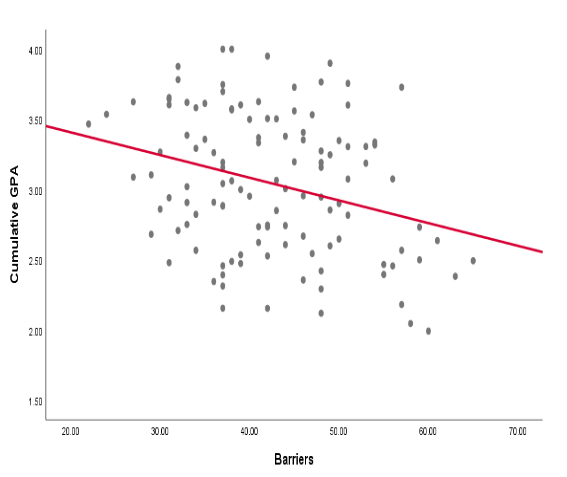
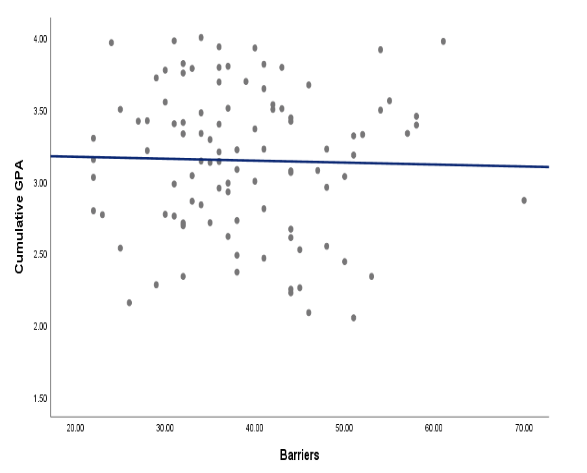
Figure 2.3 illustrates the relationship between the composite barriers score and cumulative GPA. For Hmong students, the more barriers identified, the more difficulty experienced in maintaining a higher GPA. However, such a statistical relationship is not observed for the other students.iii
Figure 2.3. Correlation between cumulative GPA and composite self-identified barriers
Finding 2: Hmong Students Are Less Certain About Their Academic Readiness, Progress, and Success
Academic Readiness
Figure 2.4 compares the percentage of self-rated academic readiness between the two groups. Even though there is no difference in the academic progress of the two groups as shown in Finding 1, Hmong students are less certain about their academic readiness than other students. Sixty-eight percent (68%) (adding the three “agree” categories) of other students indicated readiness for academic challenges, but only 54% of Hmong students indicated so. iv
Academic Progress
Figure 2.4. Students’ self-rated academic readiness at Fresno State by group
Figure 2.5 shows students’ perceptions of graduating in 4 years, and Figure 2.6 shows their perceptions of 6-year graduation. As shown in the figures, Hmong students are less confident about graduating in 4 years or 6 years compared to other students who have similar academic progress and GPA.v
Figure 2.5. Students’ perception about graduating in 4 years by group
Figure 2.6. Students’ perception about graduating in 6 years by group
“The Hmong survey respondents’ academic progress (in terms of cumulative GPA and cumulative units earned) is identical to the other students who shared the same background. However, the survey found that Hmong students are less certain about their readiness for academic challenges, success for graduating, and for identifying clear goals after graduation.”
Finding 3: Hmong Students Find Some Campus Connections Challenging
Connection to Professors
The survey found that a higher percentage of the Hmong sample had changed majors than the control group (61.2% for the Hmong sample and 51.5% for the control group, including switching from undeclared to another major program), but the difference was not statistically significant. However, when the students were asked to whom they talked to before changing a major, Hmong students were 2.4 times less likely to consult professors than other students. Instead, more Hmong students visited academic advisers more often than other students. While this finding does not mean that Hmong students do not have any connections to faculty, it may imply that they do not think of faculty members in the context of academic advising.
Figure 2.7. Percentage of parties from whom advice was sought when changing a major
Academic Support
A lack of sufficient academic support was also found in another survey question. Hmong students agreed less than other students to the statement that they felt they received adequate academic support from the school. Summing the three “agree” categories, only 76% of Hmong students agreed that they receive academic support from the university, whereas 86% of other students indicated so.vi
Figure 2.8. Comparison of students’ opinions about receipt of academic support from the school
Connection to Other Students
When students were asked if a study group helps them better understand the class materials, more Hmong students agreed than other students. Summing the three “agree” categories, 84.1% of Hmong students agreed a study group is helpful, whereas 74% of other students indicated so.vii
Figure 2.9. Comparison of the students’ opinion about whether a study group helped them understand the class materials
Connection to Campus
A majority Hmong students and other students agreed that they felt a sense of belonging to Fresno State in some capacity, with 79% of Hmong students agreeing they felt a sense of belonging to Fresno State compared to 81% of other students. However, other students showed a much stronger sense of belonging than Hmong students. More specifically, 19% of other students indicated a strong sense of belonging, whereas only 8% of Hmong students indicated so.viii
Figure 2.10. Comparison of students who feel a sense of belonging to the campus
Finding 4: Hmong Men and Women Share Similar Academic Progress but Some Distinct Challenges Revealed
Major Enrollment
There were 1,366 Hmong undergraduate students at Fresno State in Fall 2018. Among those, 589 were men and 777 were women. Those students’ major enrollment did differ by gender. Hmong women were mostly liberal studies, pre-nursing, pre-business, undeclared, and biology. Hmong men were mostly undeclared, criminology- law enforcement option, pre-business, biology, and computer science majors. The proportion of undeclared male students is higher than that of female students.
Men (Number of students) Women (Number of students)
Criminology/Law Enforcement
Undeclared
Pre-Business
Computer Sciences
Biology
8% (49)
8% (44)
7% (38)
6% (33)
5% (30)
Liberal Studies (99)
Pre-Nursing (73)
Pre-Business (66)
Undeclared (62)
Biology (51)
13% (104)
9% (73)
7% (55)
7% (53)
7% (51)
Table 2.2. Common majors for all Hmong undergraduate students (not only survey respondents) by gender, Fall 2018
Academic Progress and Challenges
Overall, there were no significant gender differences in the total number of barriers Hmong students experienced, number of cumulative units earned, or average number of units taken per semester. Hmong women had slightly higher semester GPAs (3.08) than Hmong men (2.98) and higher cumulative GPAs (3.07) than Hmong men (2.86). However, women tend to have a higher GPA than men at Fresno State: All undergraduate women’s cumulative GPA was 3.02 and men’s cumulative GPA was 2.90 as of Fall 2017.*
Hmong women reported that they spent more time caring for family, doing homework, and doing chores than Hmong men, and Hmong men reported that they spent more time working than Hmong women. Hmong men also experienced differences in their perceptions of the university. They were more likely than Hmong women to say that knowing someone in their class makes them more likely to attend, and that they feel more comfortable discussing questions and concerns with a faculty or staff member from the same background as their own. In addition, Hmong men were more likely to report that they have academic difficulties because they have to work to pay for school, and that they have had difficulty adjusting to the social and cultural climate of the university.
*Note – Fall 2017 was the most recent semester with data for cumulative GPA at the time of publication.
Finding 5: Students’ Life Stories Revealed Differences Between Hmong Students and Other Students.
In addition to rating the barriers described on the survey, students were able to describe in writing other barriers that significantly affected their academic success. Both Hmong students and students of other ethnicities agreed that mental and physical health were at times significant barriers to their academic success. Hmong students were unique however, with approximately 4% of Hmong survey respondents reporting romantic relationship issues as barriers to their success.
Students were also able to define what the term “academic success” meant to them. Both Hmong students and students of other ethnicities agreed that part of academic success meant getting good grades, graduating, and having better opportunities. However, students differed in their definitions of “better opportunities.” Students of other ethnicities were more likely to describe better opportunities as one day working their dream job, while Hmong students described it as having financial stability for themselves and their families.
“For me personally mental health has been a struggle that has significantly affected my student success.”
“Being in a relationship can affect your overall performance, especially if you’re going through rough times such as a breakup or if you’re just trying to cope with certain issues between you and your partner.”
Figure 2.11. Common definitions of academic success by group
Summary of Findings
Hmong students are competitive applicants to the university. They apply with higher-than-average high school GPAs and are admitted into the university at higher rates than other students. They are also more likely to enroll at Fresno State as first-time full-time freshmen (FTFTF) than other applicants. However, Hmong FTFTF graduate at disproportionately lower rates than other students across all high school GPA groups,which indicates that Hmong students may be facing systematic challenges not currently addressed by institutions of higher education.
The Student Success Survey Revealed:
Hmong students experience more barriers
Hmong students experience certain challenges at higher rates
Hmong students experience unique challenges
Experiencing more barriers had negative impacts on Hmong students’ cumulative GPA
Hmong Students Reported:
Lower perceived capacity to graduate
Lower perceived sense of institutional support
Lower sense of belonging
More likely to rely on advisors for information
However, despite reporting experiencing more challenges than other students, Hmong students had similar academic progress to other students. Hmong students had comparable cumulative GPAs, and number of cumulative units earned to other students. This suggests that Hmong students are working hard toward their degrees, and the institution should do more to better support our Hmong students.
Moving Forward: Future Direction of Institutional Research
1. Operate from an equity-minded perspective
When examining student success outcomes, it is essential to utilize an equity lens throughout data analysis. Often, Asian American students are not classified as underrepresented minority students, even though certain ethnic subgroups under the Asian American umbrella share many social and economic similarities with other racial and ethnic groups that are classified as such. This means that underrepresented subgroups such as Hmong and others in the Asian American umbrella might not have opportunities or access to the resources that they need. However, more research is needed on the distinct experiences of those underrepresented students in higher education to not only dispel the model minority myth but also determine what best practice interventions can be implemented. In addition to keeping equity at the forefront, it is essential to go beyond examining discrete ethnic groups but investigating how intersectionality also plays a crucial role in the experiences of students on campus. Further research can examine what extra support Hmong students may need to promote their success, such as major exploration, opportunities to connect with faculty, and support in family responsibilities.
2. Expand disaggregated data analysis
While aggregate data can be described as summary information, disaggregated data is information that can be analyzed at more detailed levels. Disaggregated data can uncover trends and patterns that otherwise might be hidden in aggregated data sets; for Asian Americans, in particular, it is essential to use disaggregated data to expose differences between ethnic subgroups, such as achievement gaps and inequities in academic outcomes. Institutions should continue to disaggregate racial and ethnic data to allow researchers to examine differences between ethnic and racial groups such as Hmong in order to implement culturally appropriate student support services. Disaggregation benefits all student groups campus-wide by providing detailed data that allows services to be specifically tailored to meet student needs.
3. Expand collection of qualitative data
Much of the data collected by offices of Institutional Research is quantitative, or in other words, numeric data. While this is an important aspect to understanding student success and outcomes, qualitative data plays a critical role in providing in-depth insights. Qualitative data is non-numeric information, for example, open-ended responses in surveys, or transcripts from interviews. Qualitative data can help researchers understand why students hold certain opinions, act in certain ways, and show certain outcomes. It is essential to expand the collection of quality qualitative data within institutional research to better inform insights to student behavior and student success.
4. Move towards proactive analytics
Institutions should work to move away from solely conducting reactive analytics and include proactive analysis. Currently, much of the analysis conducted to measure student success occurs after students leave the university or graduate. By moving to proactive analytics, institutions can work to identify key factors that indicate a student’s likelihood to leave the university or not graduate on time, and allow advisers to reach out to these students for in-depth advising. This way, institutions can provide support in real time to the students who may need it most. In addition, it is important to build culturally responsive models that recognize and respect the diverse experiences of different subgroups.
Appendix 1: Development of Survey and Methodology
First, we started by conducting qualitative coding of a survey sent out by our campus’s Asian Faculty and Staff Association. This survey contained two open-ended questions that asked students what academic and non-academic challenges they thought students within their ethnic group were facing. These responses were coded for recurring themes. Students commonly mentioned many themes, including a lack of motivation to study, financial difficulties, navigating language barriers, and asking for help. However, because these questions did not ask students directly about their own challenges, we could not make inferences about how experiencing these challenges might affect student success. Therefore, these themes were then used to develop the Student Success Survey. This survey asked students about the academic and non-academic barriers they have experienced at Fresno State. Students responded to questions about 8 academic barriers and 11 non-academic barriers on a 4-point Likert-type scale, from “not a barrier” to “extreme barrier,” and had the opportunity to explain their answers.
There also were 12 questions assessing students’ habits and graduation intention, as well as 20 questions assessing students’ opinions and perceptions. These questions were answered on a 7-point Likert-type scale from “strongly disagree” to “strongly agree.”
Currently enrolled juniors and seniors who entered the university as FTFTF were selected as potential participants of the survey, resulting in 6,722 students. Using case control matching, two groups of students were created: one group of Hmong students, and one group of students of other ethnicities. The two groups were matched on the following variables: average total units at entry, high school GPA, Pell eligibility, first-generation status, and gender. This matching process created groups of students who had similar socioeconomic status and academic backgrounds at the time of their entry into the university, isolating ethnicity as the main difference between the two groups. The case control matching process resulted in 576 Hmong students and 576 control students who were invited to participate in the study. There were 179 Hmong students and 137 control students who completed the survey.
Endnote
i Independent samples t-test revealed there are no significant differences between
groups. The cumulative GPA for Hmong students (M = 3.02, SD = .499) and that of other
students (M = 3.12, SD = .51), t(308) = 1.648, p < .05. The cumulative units for Hmong
students (M = 97.17, SD = 24.73) and that of other students (M = 100.77, SD = 24.31),
t(308) = 1.284, p > .05.
ii Independent samples t-test revealed there are significant differences between groups.
Overall, Hmong students report experiencing more barriers (M = 42.27, SD = 9.03) than
other students (M = 38.68, SD = 9.49), t(223) = 2.90, p < .05; Cronbach’s alpha =
.84. Hmong students generally report experiencing more academic barriers (M = 19.35,
SD = 4.22) than other students (M = 17.31, SD = 4.47), t(223) = 3.51, p <.05; Cronbach’s
alpha = .71 and Hmong students also report experiencing more personal barriers (M
= 22.93, SD = 5.98) than other students (M = 21.37, SD = 6.07) with marginal significance
t(223) = 1.92, p = .056; Cronbach’s alpha = .78.
iii Hmong students who experience more barriers have significantly lower cumulative
GPA (r = -.29, p < .01), especially if they are experiencing more personal barriers
(r = -.30, p < .001). Experiencing more academic barriers was also significantly negatively
associated with cumulative GPA for Hmong students, r = -.20, p < .05.
iv Well prepared for the academic challenges: χ2 (3, N = 220) = 13.78, p <.05.
v Perceived ability to graduate within 4 years: χ2 (2, N = 208) =1 1.91, p < .01;
Perceived ability to graduate within 6 years: χ2 (2, N = 202) = 11.22, p < .01.
vi Have received academic support from Fresno State: χ2 (6, N = 221) = 21.23, p <
.01.
vii Study group helped understand the class materials: χ2 (6, N = 221) = 14.35, p
<. 05.
viii Sense of belonging at Fresno State: χ2 (6, N = 221) = 19.72, p < .01.
References
Gong, G., Kubo, H. & Takahashi, Y. (2014, October). The Academic Challenges of Southeast
Asians at Fresno State, [Research brief]. Office of Institutional Effectiveness, California
State University, Fresno, CA
Iannarelli, C. M. (2015). Stressing success: Examining Hmong student success in career
and technical education. Hmong Studies Journal, 14(1), 1–22.
Lee, S. J. (1997). The road to college: Hmong American women’s pursuit of higher education.
Harvard Educational Review, 67(4), 803–827.
Lor, P. (2008). Key life experiences contributing to Hmong students’ matriculation.
Multicultural Education, 16(1), 39–47.
Museus, S. D. (2013). Asian Americans and Pacific Islanders: A national portrait of
growth, diversity, and inequality. In S. D. Museus, D. C. Maramba, & R. T. Teranishi
(Eds.), The misrepresented minority: New insights on Asian Americans and Pacific Islanders,
and the implications for higher education (pp. 11–41). Sterling, VA: Stylus.
Pak, Y. K., Maramba, D. C., & Hernandez, X. J. (2014). Asian Americans in higher education:
Charting new realities. ASHE Higher Education Report, 40(1). San Francisco: Jossey-Bass.
Xiong, S., & Lam, S. K. Y. (2013). Factors impacting the success of Hmong college
students in America. British Journal of Guidance and Counselling, 41(2), 132–144.
Xiong, S., & Lee, S. E. (2011). Hmong students in higher education and academic support
programs. Hmong Studies Journal, 12, 1–20.
Xiong, Y. S. (2012). Hmong American’s educational attainment: Recent changes and remaining
challenges. Hmong Studies Journal, 13(2), 1–18.
This PDF is provided as a print-only reference document and may not be fully accessible to users of assistive technology. For more information, please visit Title II Rule on Digital Accessibility page.