Armenian Studies Program
MEMORANDUM
DATE: November 21, 2011
TO: Faculty
Armenian Studies Program
M/S PB 4
FROM: William A. Covino [signed]
Provost and Vice President for Academic Affairs
SUBJECT: Approval of your Department Policy on Peer Evaluations and Student Course Evaluations (RE: APM 322)
I have received and reviewed your departmental documents, and they are tentatively
approved for implementation during the remainder of AY11-12.
I am, however, concerned about your department's use of a relatively low statistical standard for student ratings—a standard that may render data used to support AY12-13 RTP recommendations less than persuasive. Thus, it is my hope that, once AY11-12 data becomes widely available, you may wish to adjust the departmental standard upward to a more meaningful measure of relative teaching performance.
In the meantime, I want to reiterate my commitment to our Academic Senate's stated beliefs that student feedback is best viewed from a multi-year perspective, and considered within the larger context of all evidence presented in support of a colleague's teaching effectiveness.
WAC:kyp
cc: Jose Diaz, Acting Dean, College of Arts & Humanities
Ted Wendt, AVP for Academic Personnel
POLICY ON ASSESSMENT OF TEACHING EFFECTIVENESS
APM 322 is the official policy on the Assessment of Teaching Effectiveness. This Departmental policy is designed to further define requirements at the Departmental level as specified in APM 322.
STUDENT RATINGS OF INSTRUCTION
Each faculty member shall have a minimum of two sections rated by students annually.
While the IDEA Short Form will be the standard paper instrument for the campus, faculty may elect to use either the Diagnostic Form or Online version.
Student ratings of instruction shall be assessed to identify patterns and trends of teaching performance and effectiveness. It is expected that the faculty member shall meet or exceed the department standard 3 out of 5.0 using adjusted or unadjusted scores, whichever are higher, on a regular basis; however, it is more important to evaluate on the basis of multi-year trends rather than focusing on a single course or narrow time frame.
PEER EVALUATIONS
1. Frequency
a. For part-time temporary faculty, the first time a course is taught by the instructor and, thereafter, at least one section every other year of employment regardless of a break in service.
b. For full-time temporary faculty, two sections each semester for the first year and two sections each academic year thereafter.
c. For probationary faculty, two sections (to include as many different courses as possible) every semester.
d. For tenured faculty, one section each academic year on a rotating basis such that during a five year period the maximum number of different courses is evaluated.
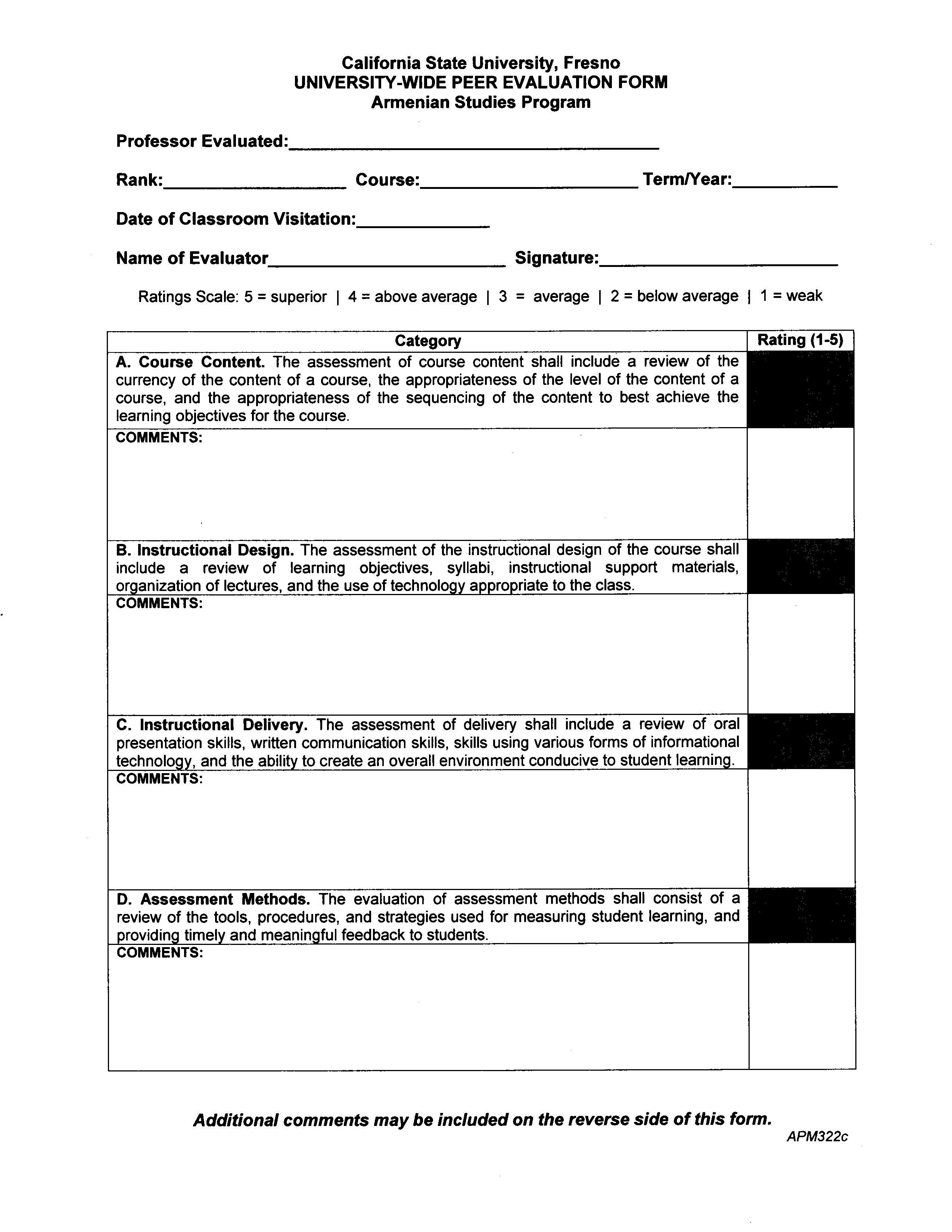
2. Faculty will use the attached Departmentally approved form to evaluate Course Content, Instructional Design, Instructional Delivery and Assessment methods.
OVERALL
The Department will follow the guidelines in APM 325, APM 327 and APM 328 when electing committees selected to prepare the overall evaluation of teaching.
APPROVAL PROCESS
Departmental policies will be submitted to the appropriate School/College Dean and to the Provost for review and approval.
Last Updated: October 3, 2011
This PDF is provided as a print-only reference document and may not be fully accessible to users of assistive technology. For more information, please visit Title II Rule on Digital Accessibility page.