322JCASTPolicies
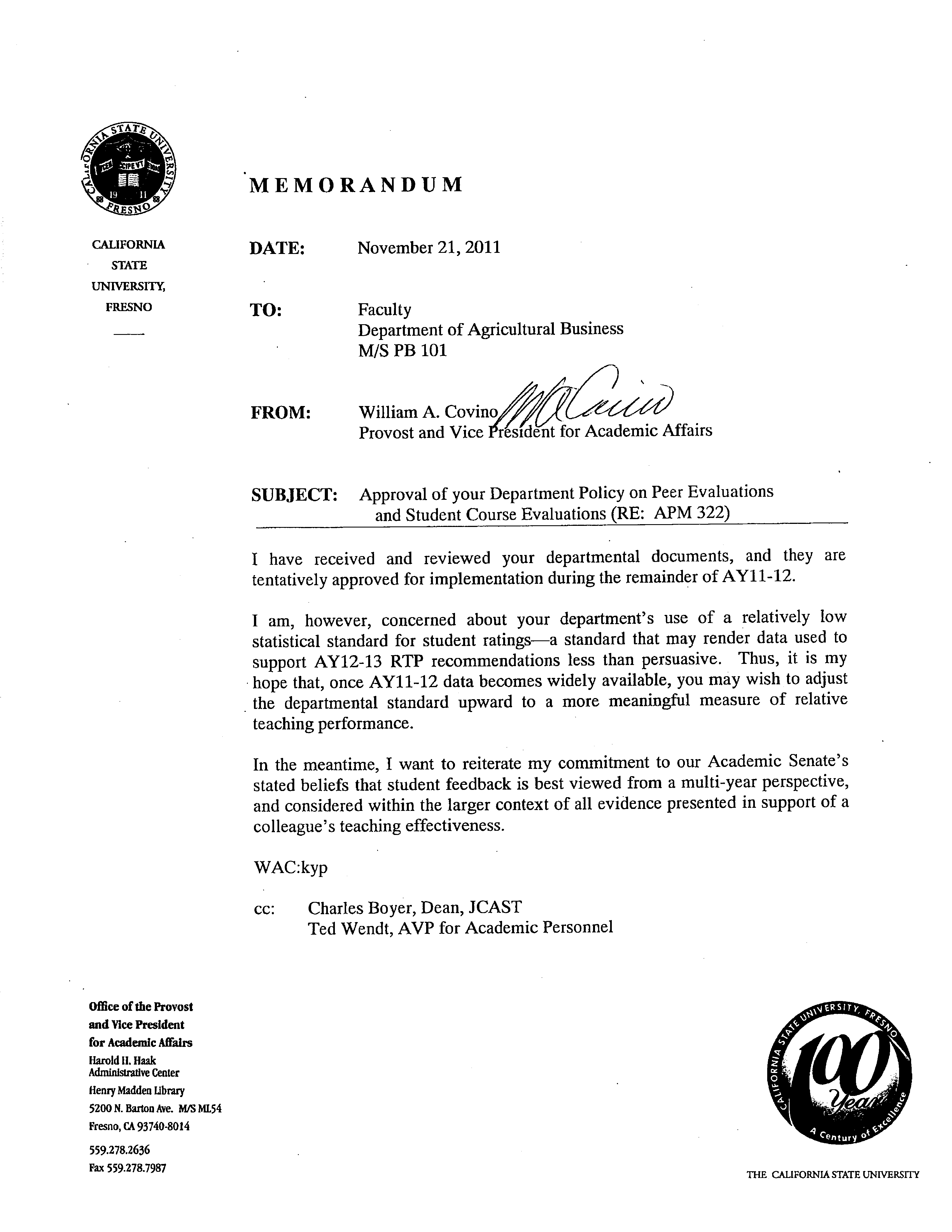
DEPARTMENT OF AGRICULTURAL BUSINESS
POLICY ON ASSESSMENT OF TEACHING EFFECTIVENESS
APM 322 is the official policy on the Assessment of Teaching Effectiveness. This
Departmental policy is designed to further define requirements at the departmental
level as
specified in APM 322.
STUDENT RATINGS OF INSTRUCTION
Each faculty member shall have all sections rated by students annually.
While the IDEA Short Form will be the standard paper instrument for the campus, faculty
may elect to use either the Diagnostic Form or Online version.
Student ratings of instruction shall be assessed to identify patterns and trends of
teaching
performance and effectiveness. It is expected that the faculty member shall meet or
exceed
the department standard (3 out of 5.0) using adjusted or unadjusted scores, whichever
are
higher, on a regular basis; however, it is more important to evaluate on the basis
of multi–
year trends rather than focusing on a single course or narrow time frame.
PEER EVALUATIONS
1. Frequency
a. For part-time temporary faculty, the first time a course is taught by the instructor
and, thereafter, at least one section every other year of employment regardless of
a
break in service.
b. For full-time temporary faculty, two sections each semester for the first year
and
two sections each academic year thereafter.
c. For probationary faculty, two sections every semester.
d. For tenured faculty, one section each academic year on a rotating basis such that
during a five year period the maximum number of different courses is evaluated.
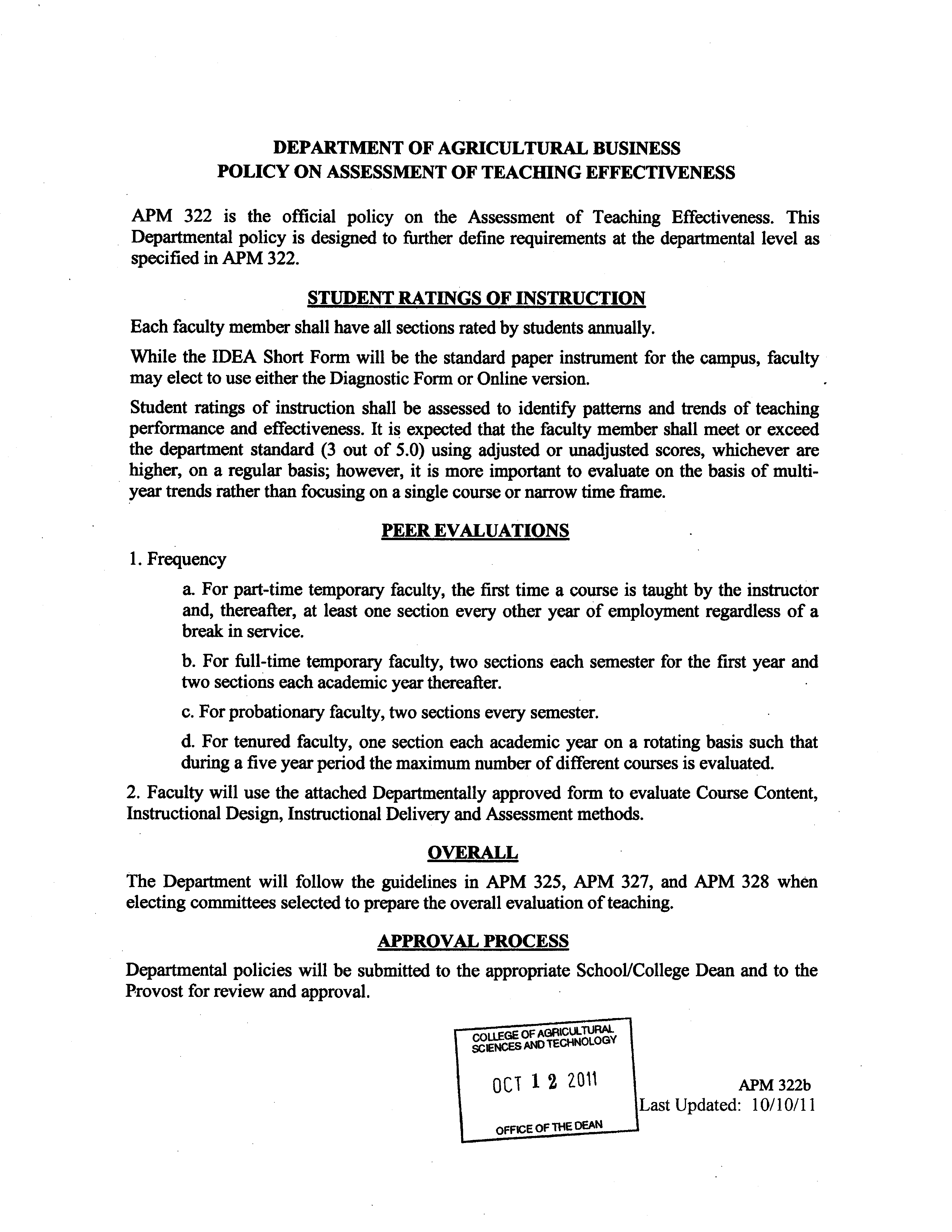
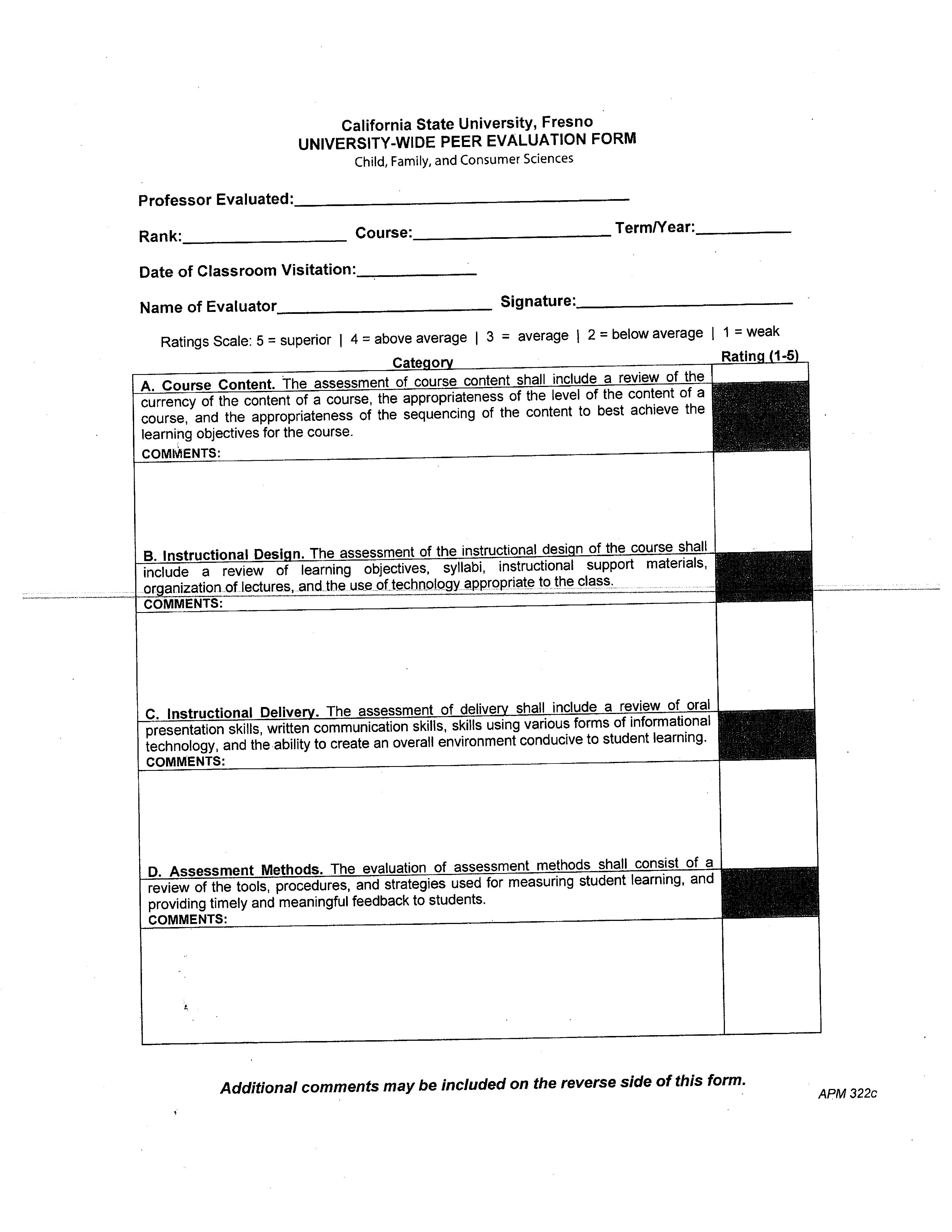
2. Faculty will use the attached Departmentally approved form to evaluate Course Content,
Instructional Design, Instructional Delivery and Assessment methods.
OVERALL
The Department will follow the guidelines in APM 325, APM 327, and APM 328 when
electing committees selected to prepare the overall evaluation of teaching.
APPROVAL PROCESS
Departmental policies will be submitted to the appropriate School/College Dean and
to the
Provost for review and approval.
THE CALIFORNIA STATE UNIVERSITY
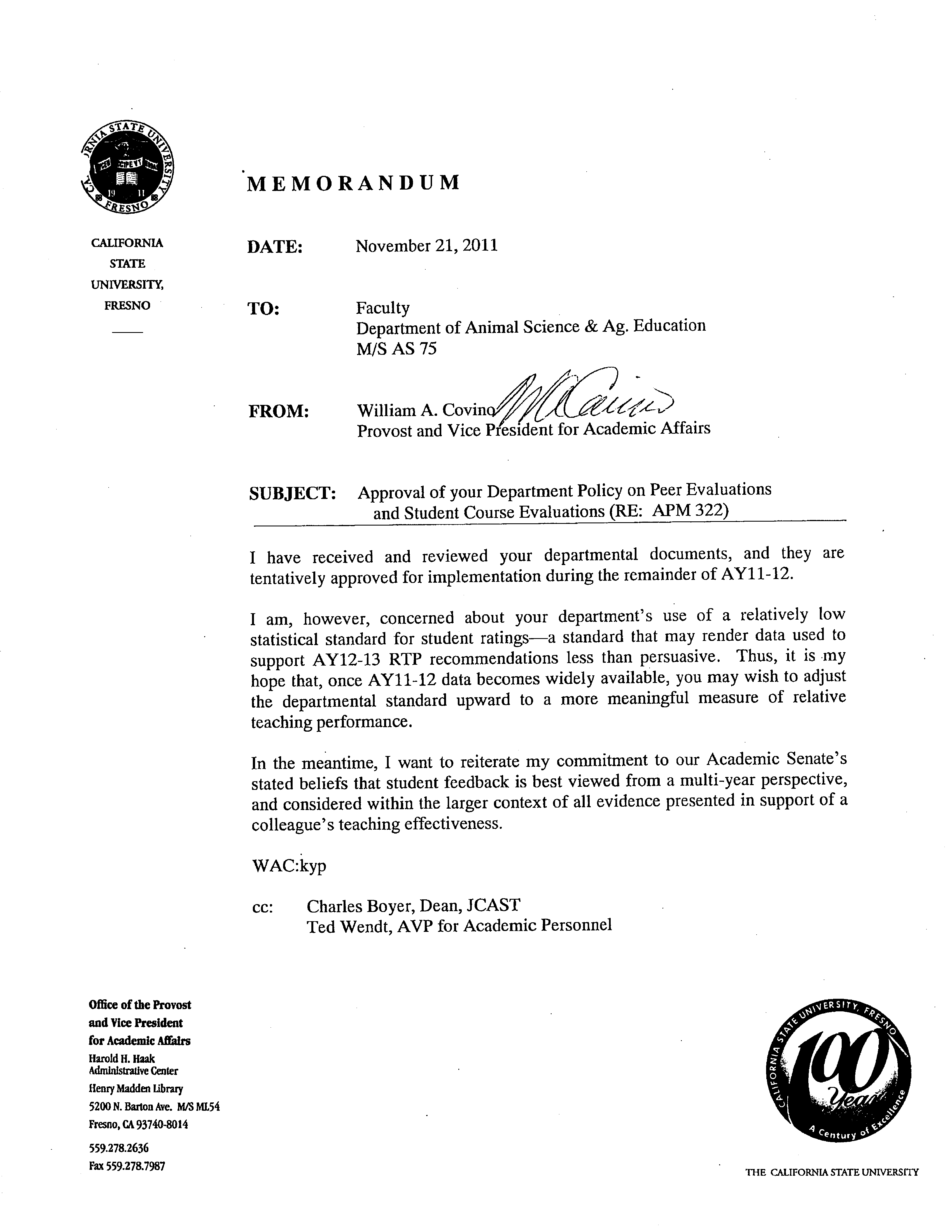
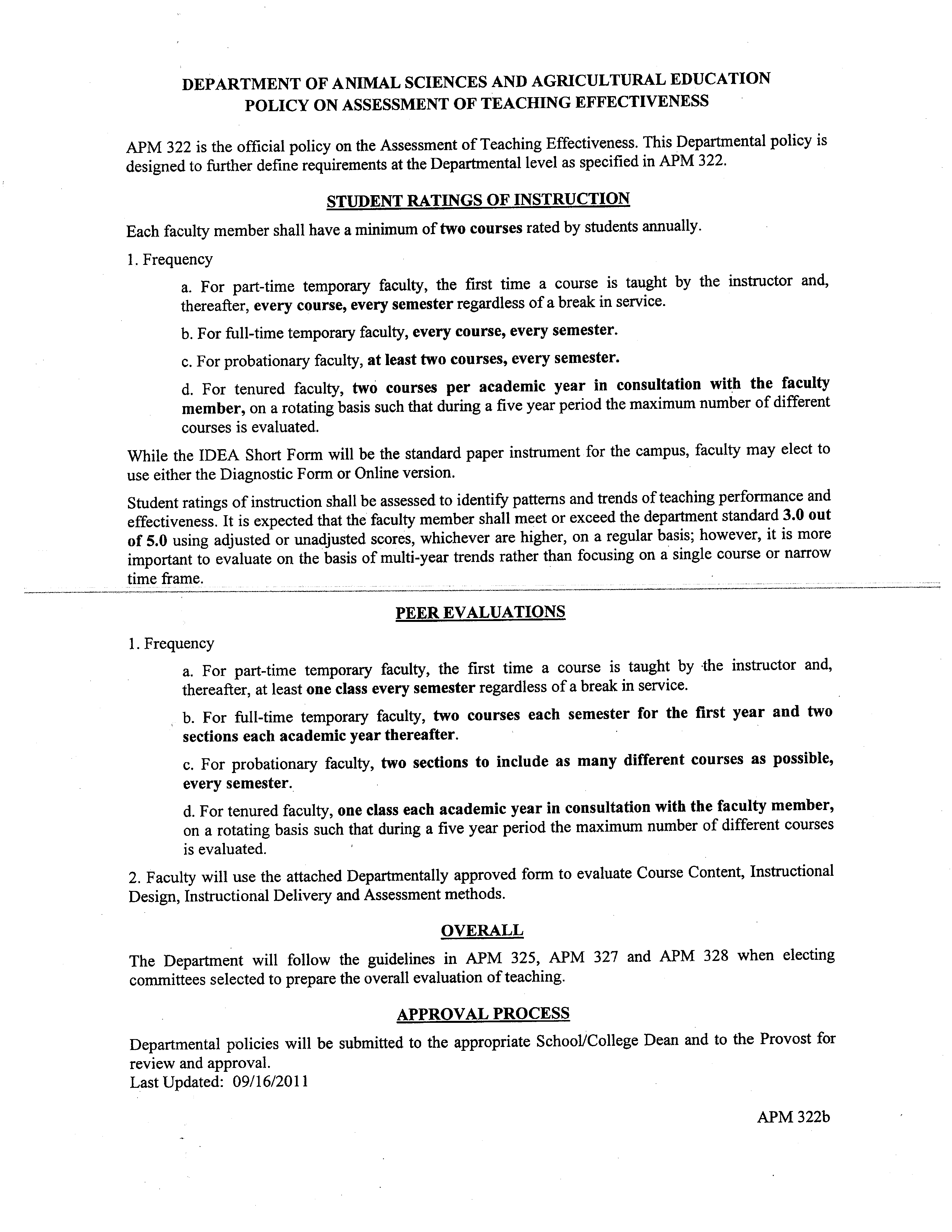
DEPARTMENT OF ANIMAL SCIENCES AND AGRICULTURAL EDUCATION
POLICY ON ASSESSMENT OF TEACHING EFFECTIVENESS
APM 322 is the official policy on the Assessment of Teaching Effectiveness. This Departmental
policy is
designed to further define requirements at the Departmental level as specified in
APM 322.
STUDENT RATINGS OF INSTRUCTION
Each faculty member shall have a minimum of two courses rated by students annually.
1. Frequency
a. For part-time temporary faculty, the first time a course is taught by the instructor
and,
thereafter, every course, every semester regardless of a break in service.
b. For full-time temporary faculty, every course, every semester.
c. For probationary faculty, at least two courses, every semester.
d. For tenured faculty, two courses per academic year in consultation with the faculty
member, on a rotating basis such that during a five year period the maximum number
of different
courses is evaluated.
While the IDEA Short Form will be the standard paper instrument for the campus, faculty
may elect to
use either the Diagnostic Form or Online version.
Student ratings of instruction shall be assessed to identify patterns and trends of
teaching performance and
effectiveness. It is expected that the faculty member shall meet or exceed the department
standard 3.0 out
of 5.0 using adjusted or unadjusted scores, whichever are higher, on a regular basis;
however, it is more
important to evaluate on the basis of multi-year trends rather than focusing on a
single course or narrow
time frame.
PEER EVALUATIONS
1. Frequency
a. For part-time temporary faculty, the first time a course is taught by The instructor
and,
thereafter, at least one class every semester regardless of a break in service.
b. For full-time temporary faculty, two courses each semester for the first year and
two
sections each academic year thereafter.
c. For probationary faculty, two sections to include as many different courses as
possible,
every semester.
d. For tenured faculty, one class each academic year in consultation with the faculty
member,
on a rotating basis such that during a five year period the maximum number of different
courses
is evaluated.
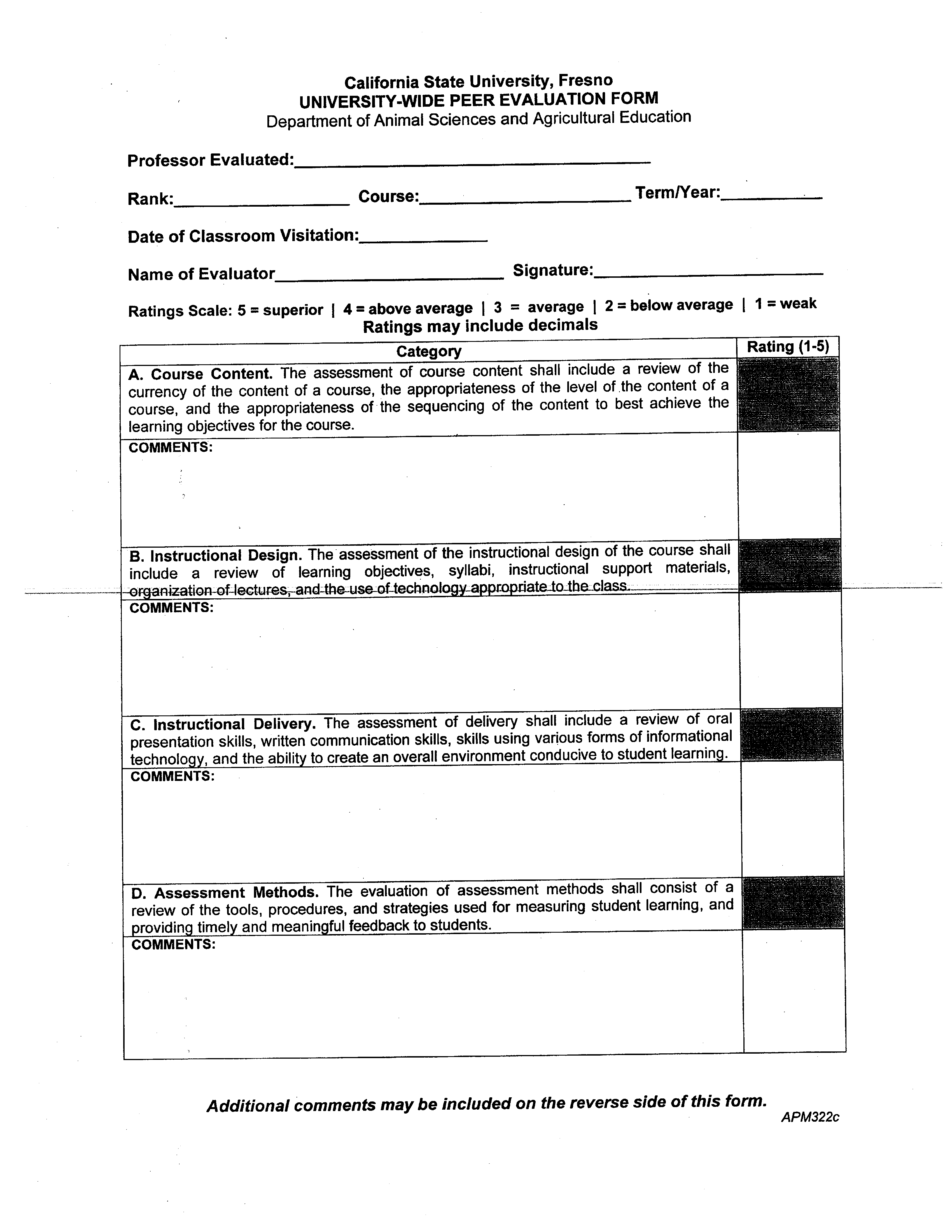
2. Faculty will use the attached Departmentally approved form to evaluate Course Content,
Instructional
Design, Instructional Delivery and Assessment methods.
OVERALL
The Department will follow the guidelines in APM 325, APM 327 and APM 328 when electing
committees selected to prepare the overall evaluation of teaching.
APPROVAL PROCESS
Departmental policies will be submitted to the appropriate School/College Dean and
to the Provost for
review and approval.
Last Updated: 09/16/2011
APM 322b
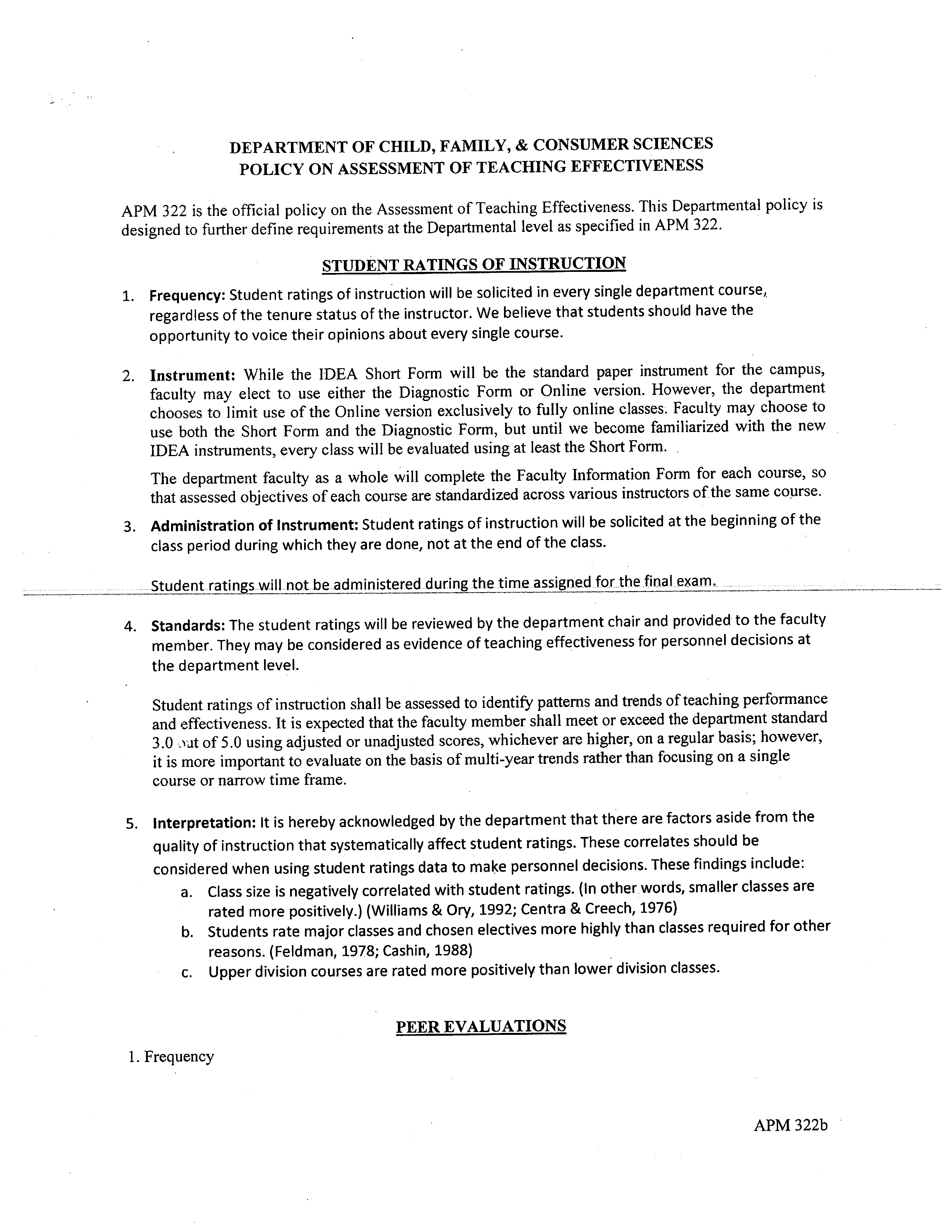
DEPARTMENT OF CHILD, FAMILY, & CONSUMER SCIENCES
POLICY ON ASSESSMENT OF TEACHING EFFECTIVENESS
APM 322 is the official policy on the Assessment of Teaching Effectiveness. This Departmental
policy is
designed to further define requirements at the Departmental level as specified in
APM 322.
STUDENT RATINGS OF INSTRUCTION
1. Frequency: Student ratings of instruction will be solicited in every single department
course,
regardless of the tenure status of the instructor. We believe that students should
have the
opportunity to voice their opinions about every single course.
2. Instrument: While the IDEA Short Form will be the standard paper instrument for
the campus,
faculty may elect to use either the Diagnostic Form or Online version. However, the
department
chooses to limit use of the Online version exclusively to fully online classes. Faculty
may choose to
use both the Short Form and the Diagnostic Form, but until we become familiarized
with the new
IDEA instruments, every class will be evaluated using at least the Short Form.
The department faculty as a whole will complete the Faculty Information Form for each
course, so
that assessed objectives of each course are standardized across various instructors
of the same course.
3. Administration of Instrument: Student ratings of instruction will be solicited
at the beginning of the
class period during which they are done, not at the end of the class.
Student ratings will not be administered during the time assigned for the final exam.
4. Standards: The student ratings will be reviewed by the department chair and provided
to the faculty
member. They may be considered as evidence of teaching effectiveness for personnel
decisions at
the department level.
Student ratings of instruction shall be assessed to identify patterns and trends of
teaching performance
and effectiveness. It is expected that the faculty member shall meet or exceed the
department standard
3.0 it of 5.0 using adjusted or unadjusted scores, whichever are higher, on a regular
basis; however,
it is more important to evaluate on the basis of multi-year trends rather than focusing
on a single
course or narrow time frame.
5. Interpretation: It is hereby acknowledged by the department that there are factors
aside from the
quality of instruction that systematically affect student ratings. These correlates
should be
considered when using student ratings data to make personnel decisions. These findings
include:
a. Class size is negatively correlated with student ratings. (In other words, smaller
classes are
rated more positively.) (Williams & Ory, 1992; Centra & Creech, 1976)
b. Students rate major classes and chosen electives more highly than classes required
for other
reasons. (Feldman, 1978; Cashin, 1988)
c. Upper division courses are rated more positively than lower division classes.
PEER EVALUATIONS
1. Frequency
THE CALIFORNIA STATE UNIVERSITY
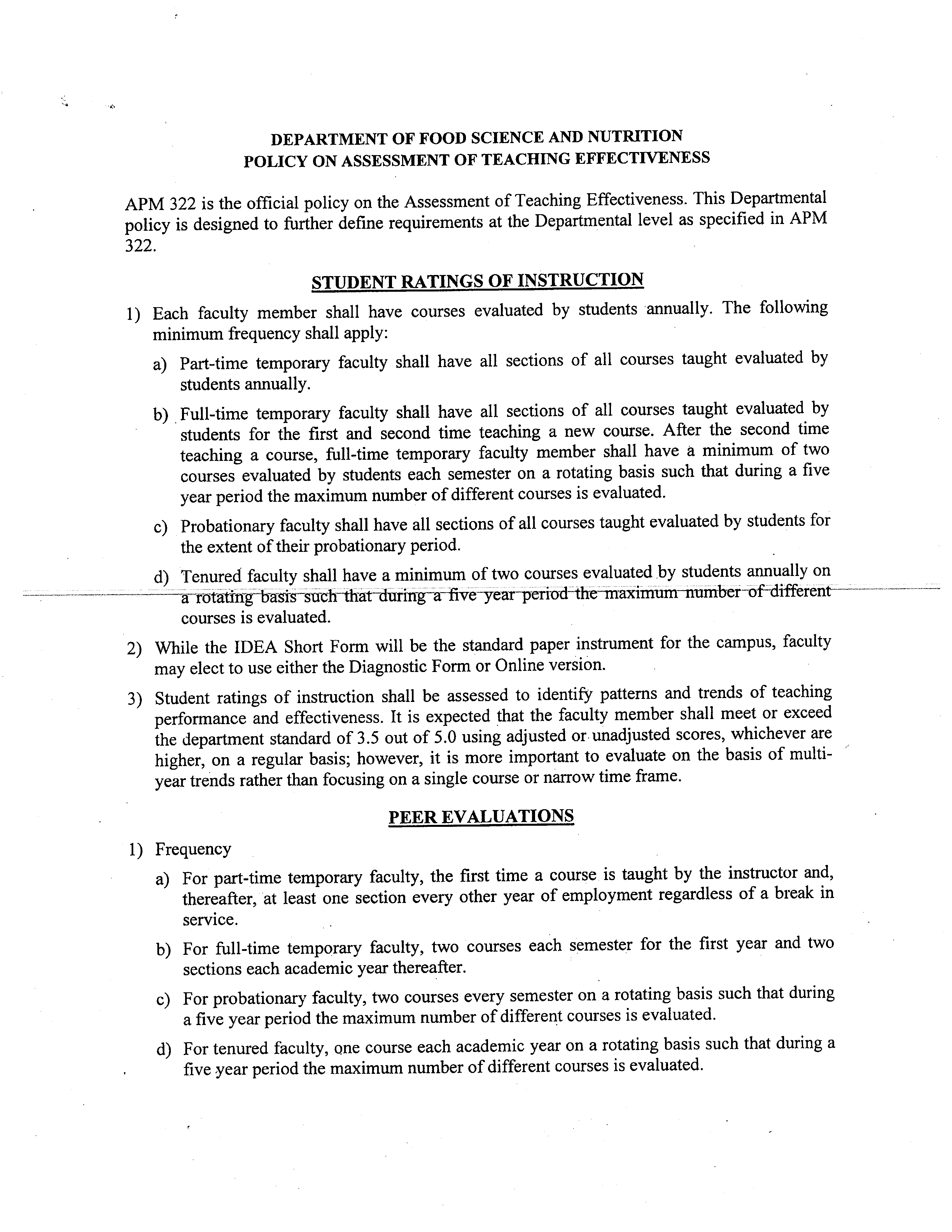
DEPARTMENT OF FOOD SCIENCE AND NUTRITION
POLICY ON ASSESSMENT OF TEACHING EFFECTIVENESS
APM 322 is the official policy on the Assessment of Teaching Effectiveness. This Departmental
policy is designed to further define requirements at the Departmental level as specified
in APM
322.
STUDENT RATINGS OF INSTRUCTION
1) Each faculty member shall have courses evaluated by students annually. The following
minimum frequency shall apply:
a) Part-time temporary faculty shall have all sections of all courses taught evaluated
by
students annually.
b) Full-time temporary faculty shall have all sections of all courses taught evaluated
by
students for the first and second time teaching a new course. After the second time
teaching a course, full-time temporary faculty member shall have a minimum of two
courses evaluated by students each semester on a rotating basis such that during a
five
year period the maximum number of different courses is evaluated.
c) Probationary faculty shall have all sections of all courses taught evaluated by
students for
the extent of their probationary period.
d) Tenured faculty shall have a minimum of two courses evaluated by students annually
on
a Totating-b-asis- such that-during-a-five-year-period-the-ma y
dmum-number of-different
courses is evaluated.
2) While the IDEA Short Form will be the standard paper instrument for the campus,
faculty
may elect to use either the Diagnostic Form or Online version.
3) Student ratings of instruction shall be assessed to identify patterns and trends
of teaching
performance and effectiveness. It is expected that the faculty member shall meet or
exceed
the department standard of 3.5 out of 5.0 using adjusted or unadjusted scores, whichever
are
higher, on a regular basis; however, it is more important to evaluate on the basis
of multi–
year trends rather than focusing on a single course or narrow time frame.
PEER EVALUATIONS
1) Frequency
a) For part-time temporary faculty, the first time a course is taught by the instructor
and,
thereafter, at least one section every other year of employment regardless of a break
in
service.
b) For full-time temporary faculty, two courses each semester for the first year and
two
sections each academic year thereafter.
c) For probationary faculty, two courses every semester on a rotating basis such that
during
a five year period the maximum number of different courses is evaluated.
d) For tenured faculty, one course each academic year on a rotating basis such that
during a
five year period the maximum number of different courses is evaluated.
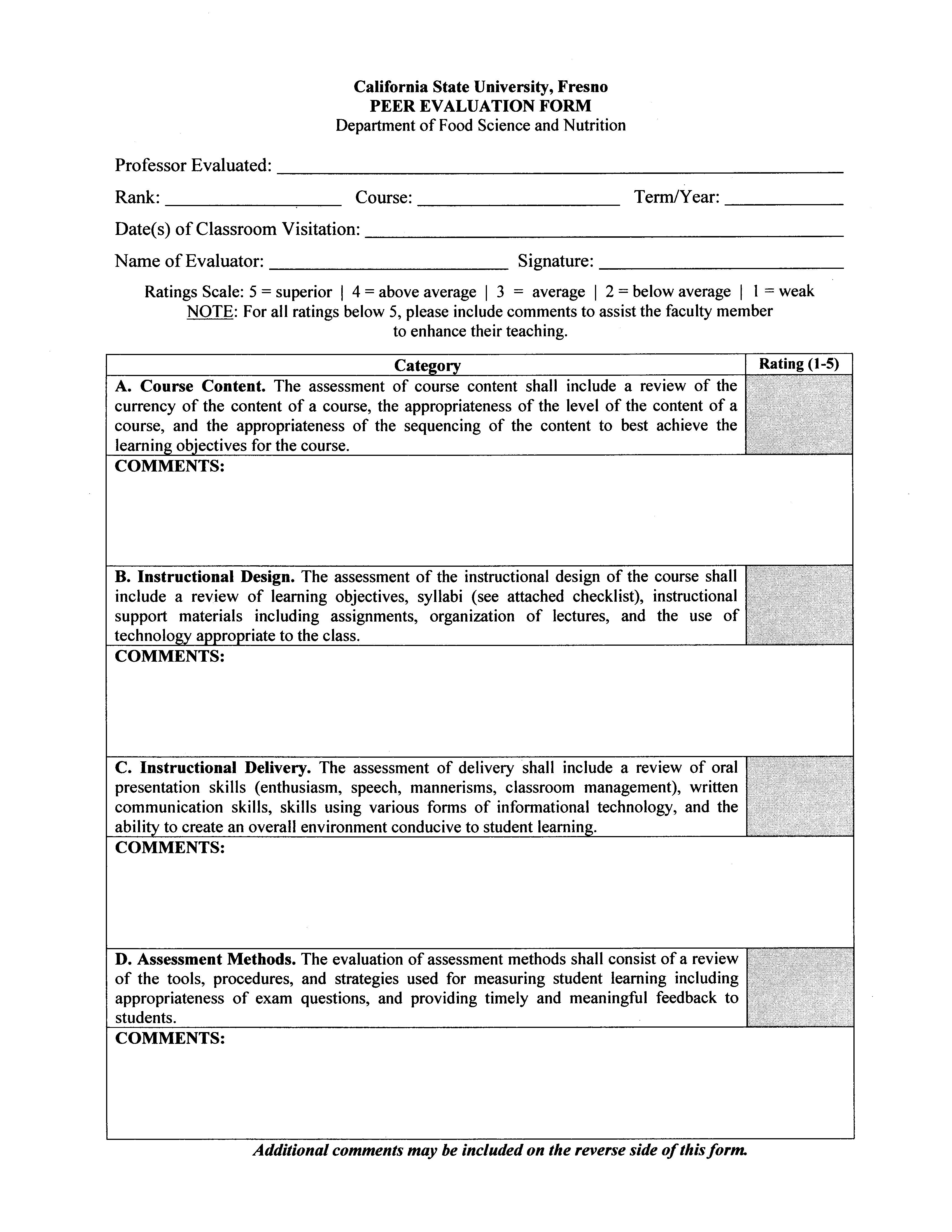
2) Faculty will use the attached departmentally-approved form to evaluate Course Content,
Instructional Design, Instructional Delivery and Assessment methods.
OVERALL
The Department will follow the guidelines in APM 325, APM 327 and APM 328 when electing
committees selected to prepare the overall evaluation of teaching.
APPROVAL PROCESS
Departmental policies will be submitted to the Dean, Jordan College of Agricultural
Sciences
and Technology, and to the Provost for review and approval.
Approved: October 3, 2011
Last Updated:
DEPARTMENT OF INDUSTRIAL TECHNOLOGY
POLICY ON ASSESSMENT OF TEACHING EFFECTIVENESS
APM 322 is the official policy on the Assessment of Teaching Effectiveness. This Departmental
policy is
designed to further define requirements at the Departmental level as specified in
APM 322.
STUDENT RATINGS OF INSTRUCTION
1. Frequency
a. For part-time temporary faculty, the first time a course is taught by the instructor
and, thereafter,
at least one section every semester regardless of a break in service.
b. For full-time temporary faculty, two sections each semester for the first year
and two sections
each academic year thereafter.
c. For probationary faculty, minimum of two sections (to include as many different
courses as
possible) every semester.
d. For tenured faculty, minimum of two sections each academic year on a rotating basis
such that
during a five year period the maximum number of different courses is evaluated.
2. While the IDEA Short Form will be the standard paper instrument for the campus,
faculty may elect
to use either the Diagnostic Form or Online version.
3. Student ratings of instruction shall be assessed to identify patterns and trends
of teaching performance
and effectiveness. It is expected that the faculty member shall meet or exceed the
department standard
of 3.5 out of 5.0 using adjusted or unadjusted scores, whichever are higher, on a
regular basis;
'however, it is more important to evaluate on the basis of multi-year trends rather
than focusing on a
single course or narrow time frame.
PEER EVALUATIONS
1. Frequency
a. For part-time temporary faculty, the first time a course is taught by the instructor
and, thereafter,
at least one section every other year of employment regardless of a break in service.
b. For full-time temporary faculty, two sections each semester for the first year
and two sections
each academic year thereafter.
c. For probationary faculty, two sections (to include as many different courses as
possible) every
semester.
d. For tenured faculty, one section each academic year on a rotating basis such that
during a five
year period the maximum number of different courses is evaluated.
2. Faculty will use the attached Departmentally approved form to evaluate Course Content,
Instructional
Design, Instructional Delivery and Assessment methods.
OVERALL
The Department will follow the guidelines in APM 325, APM 327 and APM 328 when electing
committees selected to prepare the overall evaluation of teaching.
APPROVAL PROCESS
Departmental policies will be submitted to the appropriate School/College Dean and
to the Provost for
review and approval.
Last Updated: October 10, 2011
DEPARTMENT OF PLANT SCIENCE
POLICY ON ASSESSMENT OF TEACHING EFFECTIVENESS
APM 322 is the official policy on the Assessment of Teaching Effectiveness. This Departmental
policy is
designed to further define requirements at the Departmental level as specified in
APM 322.
STUDENT RATINGS OF INSTRUCTION
1. Frequency
a. For part-time temporary faculty, the first two times a course is taught by the
instructor and,
thereafter, at least two courses a year.
b. For full-time temporary faculty, two sections each semester for the first year
and two sections
each academic year thereafter.
c. For probationary faculty, two sections (to include as many different courses as
possible) every
semester on a rotating basis such that during a five year period the maximum number
of different
courses is evaluated.
d. For tenured faculty, two sections each academic year on a rotating basis such that
during a five
year period the maximum number of different courses is evaluated.
2. Additional student ratings of instruction may be requested by the instructor or
required by the
College/School Personnel Committee, Dean or Provost on a case by case basis
3. While the IDEA Short Form will be the standard paper instrument for the campus,
faculty may elect to
use either the Diagnostic Form or Online version.
4. Student ratings of instruction shall be assessed to identify patterns and trends
of teaching performance
and effectiveness. It is expected that the faculty member shall meet or exceed the
department standard of
4.5 out of 5.0 using adjusted or unadjusted scores, whichever are higher, on a regular
basis. In addition,
the department will pay particular attention to the adjusted converted average scores.
The faculty member
should achieve a 45 or greater on the adjusted converted average scores when compared
to all classes in
the IDEA database (this corresponds to the lower end of the “similar area” on the
short form report);
however, it is more important to evaluate on the basis of multi-year trends rather
than focusing on a single
course or narrow time frame.
PEER EVALUATIONS
1. Frequency
a. For part-time temporary faculty, the first two times a course is taught by the
instructor and,
thereafter, at least one section every other year of employment regardless of a break
in service.
b. For full-time temporary faculty, two sections each semester for the first year
and two sections
each academic year thereafter.
c. For probationary faculty, two sections (to include as many different courses as
possible) every
semester on a rotating basis such that during a five year period the maximum number
of different
courses is evaluated.
d. For tenured faculty, one section each academic year on a rotating basis such that
during a five
year period the maximum number of different courses is evaluated.
2. Faculty will use the attached Departmentally approved form to evaluate Course Content,
Instructional
Design, Instructional Delivery and Assessment methods.
3. Additional peer evaluation reports may be requested by the instructor or required
by the College/School
Personnel Committee, Dean or Provost on a case by case basis.
OVERALL
The Department will follow the guidelines in APM 325, APM 327 and APM 328 when electing
committees selected to prepare the overall evaluation of teaching.
APPROVAL PROCESS
Departmental policies will be submitted to the appropriate School/College Dean and
to the Provost for
review and approval.
Approved Oct 14, 2011
DEPARTMENT OF VITICULTURE AND ENOLOGY
POLICY ON ASSESSMENT OF TEACHING EFFECTIVENESS
APM 322 is the official policy on the Assessment of Teaching Effectiveness. This Departmental
policy is
designed to further define requirements at the Departmental level as specified in
APM 322.
STUDENT RATINGS OF INSTRUCTION
Each faculty member shall have a minimum of two (2) sections rated by students annually.
While the IDEA Short Form will be the standard paper instrument for the campus, faculty
may elect to
use either the Diagnostic Form or Online version.
Student ratings of instruction shall be assessed to identify patterns and trends of
teaching performance and
effectiveness. It is expected that the faculty member shall meet or exceed the department
standard 3.0 out
of 5.0 using adjusted or unadjusted scores, whichever are higher, on a regular basis;
however, it is more
important to evaluate on the basis of multi-year trends rather than focusing on a
single course or narrow
time frame.
PEER EVALUATIONS
1. Frequency
a. For part-time temporary faculty, the first time a course is taught by the instructor
and,
thereafter, at least one section every other year of employment regardless of a break
in service.
b. For full-time temporary faculty, two sections each semester for the first year
and two sections
—eaeh-aeaderni-e-yeaT-thertafter:---
c. For probationary faculty, two sections (to include as many different courses as
possible) every
semester.
d. For tenured faculty, one section each academic year on a rotating basis such that
during a five
year period the maximum number of different courses is evaluated.
2. Faculty will use the attached Departmentally approved form to evaluate Course Content,
Instructional
Design, Instructional Delivery and Assessment methods.
OVERALL
The Department will follow the guidelines in APM 325, APM 327 and APM 328 when electing
committees selected to prepare the overall evaluation of teaching.
APPROVAL PROCESS
Departmental policies will be submitted to the appropriate School/College Dean and
to the Provost for
review and approval.
Last Updated: 10/03/2011
APM 322b
This HTML version was generated with AI assistance and may contain errors or omissions. The original approved PDF remains the official document of record. An alternative accessible format is available upon request from the document creator in accordance with Title II of the ADA.