Impacts of Service-Learning on Students: Persistence, Graduation, Personal & Professional Development
California State University, Fresno was founded as Fresno State Normal School in 1911, became a teacher’s college in 1921, and has offered advanced degrees since 1949. The university’s popular nickname is “Fresno State“ and its mascot is the Bulldog. Fresno State is one of the 23 campuses of the California State University, one of the largest systems of higher education in the world, and has 26 nationally accredited departmental programs with more than 21,500 students enrolled (2009).
Matthew Ari Jendian was born and raised in Fresno and received his B.A. in sociology and minor degrees in psychology and Armenian Studies from Fresno State (1991) and his Ph.D. from USC (2001). He received his baccalaureate degree in sociology from California State University, Fresno in 1991 along with minor degrees in psychology and Armenian Studies. Dr. Jendian is founding director of the American Humanics Nonprofit Administration Program at Fresno State and serves as a tenured Associate Professor and chair of sociology. He authored Becoming American, Remaining Ethnic (LFB Scholarly Publishing, 2008) and was honored in Menk, an encyclopedia of biographies of prominent Armenian scholars. Dr. Jendian is the recipient of several honors, including the 2007 Social Action Award from Temple Beth Israel, the 2007 “Amigo Award” presented by Vida en El Valle to “a non-Latino individual or organization that has worked tirelessly on behalf of the Latino community,” and the 2008 “Provost Award for Faculty Service.” He was nominated for the 2009 California Campus Compact Cone Award for Excellence & Leadership in Cultivating Community Partnerships and has written and received national and federal grants to develop curricula that engage university students in capacity-building work with Community Benefit Organizations (CBOs) in Central California. Dr. Jendian has served as a board member for several CBOs, including American Humanics, Inc., Fresno Nonprofit Advancement Council, Fresno Housing Alliance, and Relational Culture Institute and as an external evaluator with local and multinational CBOs, including Porterville College and Armenian General Benevolent Union. He and his wife, Pamela, reside in Clovis with their two sons, Joshua and Nicholas.
FYI: Humanics defined: Traditionally defined as the “science of humanity,” Dr. Laurence L. Dogget, President of Springfield College (MA), and Hanford Burr, Professor of Sociology, used the term “Humanics” in 1905 as the name of an undergraduate degree that involved “the education of the whole person in spirit, mind, and body for leadership in service to humanity.” (http://www.csufresno.edu/ah)
At Fresno State, “ engaging with the region ” is one of our strategic goals. Adopting effective teaching methods is a goal in our Academic Plan. SL is one of the means by which engagement and active, experiential learning are achieved. Since 2005-06, the number of SL classes has grown from 124 to 160 in 2007-08. The number of students participating increased from 3,660 to 3,774. Approximately 10% of 2007-08 Fresno State graduates completed a SL course. The university has supported SL since the early 1990s. In 2007, Fresno State received a $3.5 million donation to launch the Jan and Bud Richter Center for Community Engagement and Service Learning to continue and expand those activities.
So, more faculty members are using SL. More students are participating. And the university and Fresno community are supporting this method of teaching and learning. But does SL show positive effects for Fresno State students?
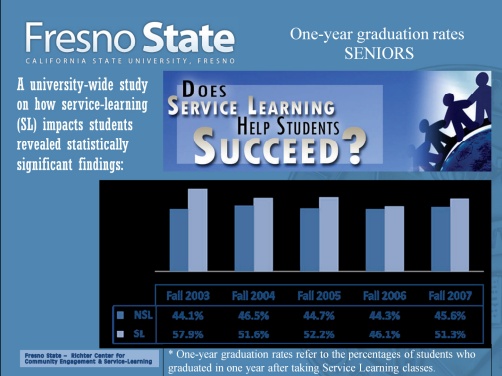
Students who took SL as seniors were more likely than seniors who did not take SL to graduate within one year after taking the class ( even when controlling for cumulative units earned and other factors ) ( Chart 1 ) .
This was true for seniors who entered as first-time freshmen or as transfers.
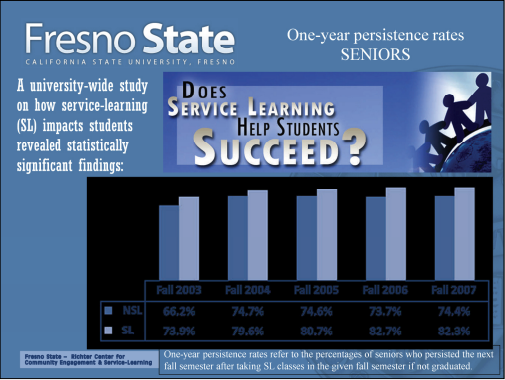
Seniors who did not graduate within one year after taking an SL class persisted into the next year at higher rates than comparable non-SL students (again, even when controlling for cumulative units earned and other factors) (Chart 2).
The difference between SL and non-SL seniors on time to degree is very small and not consistently different across the 5 cohorts included in this analysis.
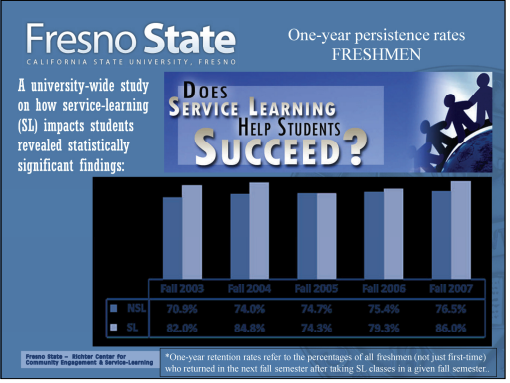
Freshmen who took an SL class had a higher 4-year graduation rate than non-SL freshmen until controlling for High School GPA and SAT scores. Being prepared for college outweighs the effect of SL for these students. The 5-year graduation rate though continues to show SL as influential. SL freshmen’s one-year persistence rates after taking the class are higher than for non-SL freshmen (Chart 3).
Comparing SL and non-SL course sections, there is no difference in the average grade earned. SL sections show a slightly higher passing rate overall, but not consistently across semesters and in some semesters it is even lower than non-SL on average. Overall, the withdrawal rate is slightly lower for SL than non-SL classes, but again, this pattern is not consistent across semesters.
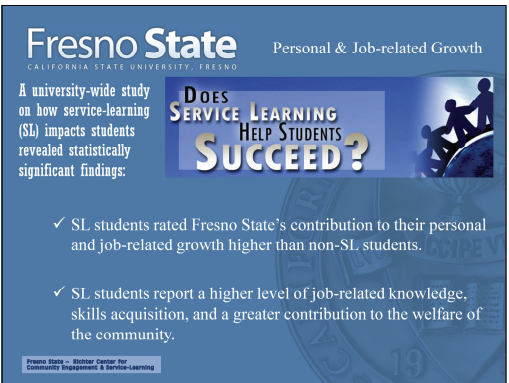
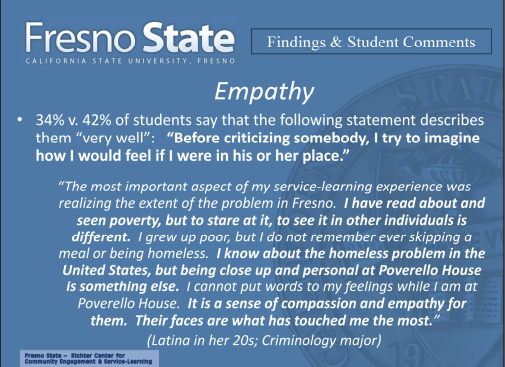
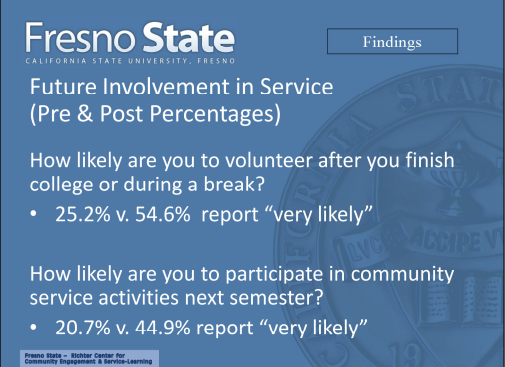
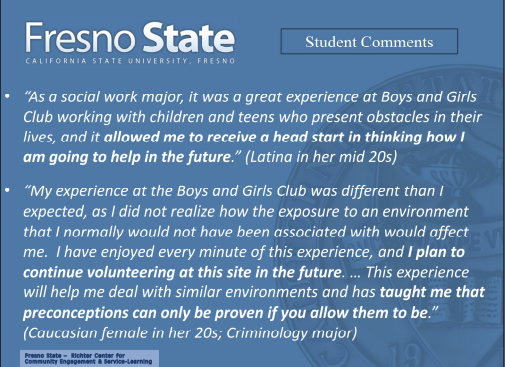
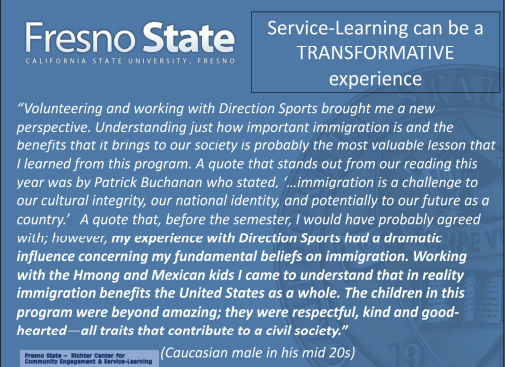
Linking the 2007 National Survey of Student Engagement ( N SSE ) data to IRAP databases, we examined the survey’s personal growth and job-related items to determine whether differences exist between students who had taken a SL class and those who had not. Although differences are small, SL students rated Fresno State’s contribution to their personal and job-related growth higher than did non-SL students. For example, SL students report higher quality relationships with people, including those from other racial and ethnic backgrounds, and they work more effectively with others. They report a higher level of job-related knowledge and skills acquisition.
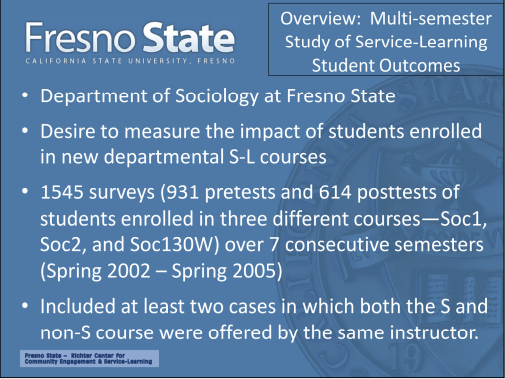
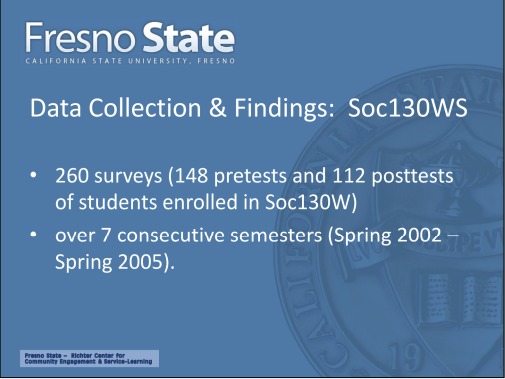
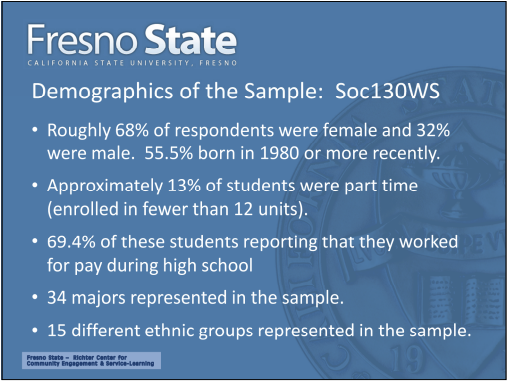
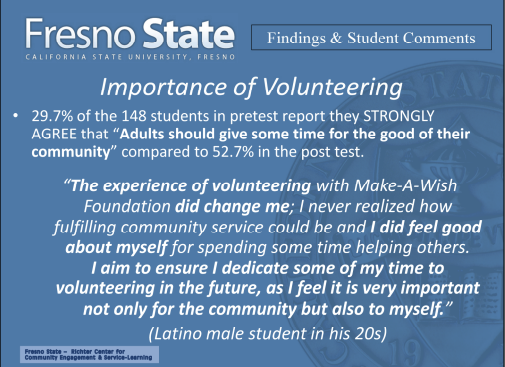
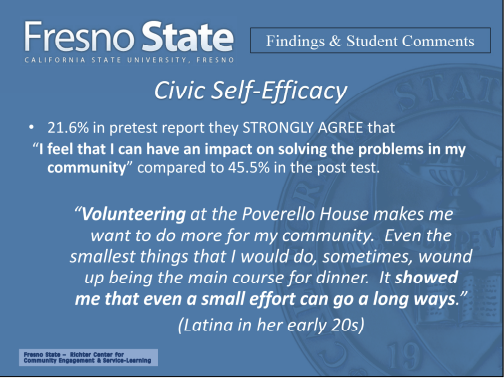
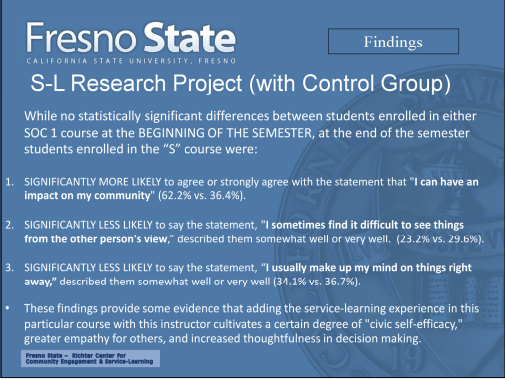
PRE – POST Comparison with our data
RE: the statement, “I usually make up my mind on things right away,” none of the students in Soc1 service-learning courses said the statement described them very well while 4.2% of Non-S students said the statement described them very well.
This PDF is provided as a print-only reference document and may not be fully accessible to users of assistive technology. For more information, please visit Title II Rule on Digital Accessibility page.