Student Outcomes Assessment Plan (SOAP)
I. Mission Statement
It is the mission of the Department of Kinesiology to create, foster and perpetuate an academic environment and community which transcends social and economic disparity, and focuses upon improving the human condition through education, research, and practical applications related to physical activity, fitness, and wellness, and through the biological, psychological, philosophical, social, economic and personal benefits intimately associated with physical learning, development and achievement. Related to this mission, it is the philosophy of the Department that positive and formative development of individuals and society, promotion of health, vitality and wellness, and achievement of self-actualization are derived from a foundational understanding of underlying biological, physical, psychological, sociological and philosophical principles of physical activity, and from the regular practice of physical activities which promote such understanding. We believe that our students are profoundly influenced by positive working relationships with individual faculty members, who are actively involved in teaching, research, and community outreach. The Department of Kinesiology is therefore committed to continuous improvement of our curriculum and the process by which we educate our students and conduct research, and to expansion of our interactions with the local and global community.
II. Goals and Student Learning Outcomes
A. Student will demonstrate knowledge, skill, and practice in physical activity, health, wellness, and quality of life.
1. Demonstrate knowledge of the relationship between the physical activity participation, health, and well being across the lifespan.
2. Demonstrate skill in evaluating physical activity programs that promote health and improve quality of life.
3. Demonstrate knowledge of lifestyle factors and choices that increase risk for chronic disease or which prevent chronic disease, and promote optimal health and wellness.
4. Demonstrate knowledge of nutritional patterns and practices that increase risk for chronic disease or which prevent chronic disease, and promote optimal health and wellness.
B. Students will demonstrate knowledge of and skill in scientific foundations of physical activity.
1. Apply scientific theory of human movement in the design and implementation of appropriate physical activities.
2. Critically evaluate information about physical activity from a scientific basis.
C. Students will identify issues related to kinesiology for diverse populations.
1. Identify factors that influence physical activity choices for diverse populations.
2. Demonstrate skills or abilities necessary to implement appropriate physical activity programs for diverse populations.
D. Students will develop critical thinking, problem solving, and professional communication skills.
1. Identify problems and develop solutions based upon issues in kinesiology.
2. Demonstrate skills to communicate kinesiological principles to diverse groups.
III. Curriculum Map (Matrix of Courses x Learning Outcomes)
I =Introduced, E = Emphasized, A = Applied, R = Reinforced, M = Mastered
| Course | Outcome A1 | Outcome A2 | Outcome A3 | Outcome A4 | Outcome B1 | Outcome B2 | Outcome C1 | Outcome C2 | Outcome D1 | Outcome D2 |
|---|---|---|---|---|---|---|---|---|---|---|
| KINES 1. Introductory Principles and Techniques for Physical Fitness Development | I | I | I | I | I | I | I | I | I | I |
| KINES 31. Historical and Professional Foundations of Physical Education | I | I | I | I | I | I | I | I | E | |
| KINES 32. Lifetime Fitness and Wellness | A | A | A | A | E | E | I | I | E | I |
| KINES 33. Foundation of Sport Exercise Psychology | I | I | A | A | R | I | R | R | ||
| KINES 35. Human Structure and Function: Applications to Kinesiology | E | I | I | R | I | E | R | I | ||
| KINES 38. Introduction to Athletic Training | I | A | E | A | E | |||||
| KINES 45. Introduction to Sport Administration | E | I | E | I | ||||||
| KINES 109. Motor Learning | E, A, R, M | E, A, R | E, A, R | E, A, R | ||||||
| KINES 110. Motor Development | E, A, R | E, A, R | E, A, R | E, A, R, M | E, A, R | E, A | E, A | E, A, R | E, A, R, M | |
| KINES 111. The Olympics Games | R | R | R | R | R | R | R | R | R | |
| KINES 116. Fundamentals of Biomechanics | R | A | R | R | M | E | E | E | E | E |
| KINES 118. Fundamentals of Exercise Physiology | M | E | R | R | E | E | E | E | E | E |
| KINES 119. ECG and Clinical Exercise Physiology | M | E | M | A | E | M | M | M | M | E |
| KINES 120. Planning Strategies for Physical Education | R | I | R | E, A, R | E, A, R | E, R | I, A | E, R | A, R | |
| KINES 121. Body Composition: Theory, Principles and Management | E | E | E | R | I | M | ||||
| KINES 122. Nontraditional Games and Outdoor Education | R | R | R | R | A | R | A | R | ||
| KINES 123. Analysis and Application: Fitness Nutrition, and Elementary Physical Education | A | A | A | E | A | E | E | A | I | A |
| KINES 125A. Coaching Football | I | I | I | |||||||
| KINES 125B. Coaching Basketball | I | I | I | |||||||
| KINES 125D. Coaching Baseball | A | I | I | |||||||
| KINES 126. Analysis and Application: Aquatics | R | A | A, R, M | E | M | R | ||||
| KINES 131. Analysis and Application: Rhythm, Tumbling, Individual, and Team Activities | A | A | R | A | E | A | I | A | ||
| KINES 137. Structural Biomechanics | R | R | R | R | M | E | E | E | M | E |
| KINES 144. Field Experience in Teaching | A | R | A | A | A | R | A | A | M | M |
| KINES 146. Risk Management of Sport and Exercise | A | I | ||||||||
| KINES 147. New Ventures in Sport | R | I | ||||||||
| KINES 148. Biophysical Aspects of Aging | M | M | M | E | R | R | R | E | R | M |
| KINES 150. Internship in Sport Administration | I | I | ||||||||
| KINES 152. Physical Education for Children | E | E | I | I | I | A | I | A | ||
| KINES 159. Measurement and Evaluation | E | A | E | A | A | I | I | A | A | |
| KINES 162. Coaching Concepts | I | A | I | I | E | I | I | I | A | I |
| KINES 163. Fitness and Wellness | A | A | M | A | E | M | E | M | M | E |
| KINES 165. Performance Related Fitness | A | A | M | A | E | M | E | M | M | E |
| KINES 167. Integrative Exercise Science | E | E | E | M | E | E | E | E | E | M |
IV. Assessment Methods
A. Direct Measures
1. Percentage of exercise science majors who score 70% or above on embedded exam questions in KINES 119.
a. This measurement provides information on how well exercise science majors understand the relationship between physical activity participation, health, and well being across the lifespan.
b. This measurement provides information on the exercise science majors’ skill in evaluating physical activity programs.
c. This measurement provides information on the exercise science majors’ ability to critically evaluate information about physical activity from a scientific basis.
d. This measurement provides information on the exercise science majors’ ability to identify factors that influence physical activity choices for diverse populations.
e. This measure provides information on the exercise science majors’ abilities in implementing appropriate physical activity programs for diverse populations.
2. Percentage of physical education majors who score 70% or above on the KINES 110 Fundamental Motor Skills exam.
a. This measurement provides information to determine the extent to which physical education majors can identify movement patterns associated with development across the lifespan and is evaluated using a rubric.
3. Percentage of physical education majors who score 70% or above on the KINES 110 Fundamental Motor Skills Stage Characteristic exam.
a. This measurement provides information on the physical education majors’ ability to evaluate physical activity programs through analysis of movement patterns associated with development across the lifespan and is evaluated using a rubric.
4. Percentage of Kinesiology majors who score 70% or above on the Cardiovascular Risk Assessment assignment in KINES 32.
a. This measurement provides information about how effectively students can interpret how wellness data collected impacts their risk of chronic disease and what prevention steps can be taken. It is evaluated using a rubric.
5. Percentage of Kinesiology majors in KINES 32 who score 70% or above on the 7-day Nutritional Analysis assignment.
a. This measurement provides information on the students’ understanding of nutritional practices and theories and how they impact health and disease prevention on a personal level. It is evaluated using a rubric.
6. Percentage of exercise science majors who score 70% or above on embedded questions on exam four in KINES 137.
a. This measurement provides information on exercise science majors’ ability to apply scientific theory to design and implement appropriate physical activities.
b. This measurement also provides information on the exercise science majors’ ability to identify problems and develop solutions based upon issues in Kinesiology.
7. Percentage of physical education majors who score 70% or above on the Hydrodynamics exam in KINES 126.
a. This measurement provides information on physical education majors’ ability to apply scientific theory to design and implement appropriate physical activities. It is evaluated using a rubric.
8. Percentage of physical education majors who score 70% or above on the Lab One assignment in KINES 159.
a. This measurement provides information on the physical education majors’ ability to critically evaluate information about physical activity from a scientific basis and is evaluated using a rubric.
9. Percentage of physical education majors who score 70% or above on the Diverse Populations Writing assignment in KINES 122.
a. This measurement provides information on the physical education majors’ ability to identify factors that influence physical activity choices for diverse populations. It is evaluated using a rubric.
10. Percentage of physical education majors who score 70% or above on the Cultural Activity Lesson Plan assignment in KINES 122.
a. This measure provides information on the physical education majors’ abilities in implementing appropriate physical activity programs for diverse populations. It is evaluated using a rubric.
11. Percentage of physical education majors who score 70% or above on the Teaching Video assignment in KINES 144.
a. This measurement provides information on the physical education majors’ ability to identify problems and develop solutions based upon issues in Kinesiology and is evaluated using a rubric.
12. Percentage of Kinesiology majors who score 70% or above on the Practical exam in KINES 1.
a. This measure provides information on the exercise science majors’ ability to communicate kinesiological principles to diverse groups and is evaluated using a rubric.
B. Indirect Measures
1. Results of the alumni survey.
a. The alumni survey is a comprehensive survey of graduate’s perceptions about content, quality, organization, relevance, and how prepared they feel for whatever they are currently doing. Thus, it allows the Department to better understand graduates’ perceived level of competence in each of our learning outcomes.
2. Results of the senior exit survey.
a. The senior exit survey is a comprehensive survey of the student’s perceptions about content, quality, organization, relevance, and how prepared they feel for the future. Thus, it allows the Department to better understand graduates’ perceived level of competence in each of our learning outcomes.
V. Student learning outcomes x Assessment Methods Matrix
ExSci = measurement of Learning Outcome for Exercise Science majors
PE = measurement of Learning Outcome for Physical Education majors
ALL = measurement of Learning Outcome for all Kinesiology majors
| Assessment Method | Outcome A1 | Outcome A2 | Outcome A3 | Outcome A4 | Outcome B1 | Outcome B2 | Outcome C1 | Outcome C2 | Outcome D1 | Outcome D2 |
|---|---|---|---|---|---|---|---|---|---|---|
| Percentage of exercise science majors who score 70% or above on embedded exam questions in KINES 119. | ExSci | ExSci | ExSci | ExSci | ExSci | |||||
| Percentage of physical education majors who score 70% or above on the KINES 110 Fundamental Motor Skills exam. | PE | |||||||||
| Percentage of physical education majors who score 70% or above on the KINES 110 Fundamental Motor Skills Stage Characteristic exam. | PE | |||||||||
| Percentage of Kinesiology majors who score 70% or above on the Cardiovascular Risk Assessment assignment in KINES 32. | ALL | |||||||||
| Percentage of Kinesiology majors in KINES 32 who score 70% or above on the 7-day Nutritional Analysis assignment. | ALL | |||||||||
| Percentage of exercise science majors who score 70% or above on embedded exam questions in KINES 137. | ExSci | ExSci | ||||||||
| Percentage of physical education majors who score 70% or above on the Hydrodynamics exam in KINES 126. | PE | |||||||||
| Percentage of physical education majors who score 70% or above on Lab One assignment in KINES 159. | PE | |||||||||
| Percentage of physical education majors who score 70% or above on the Diverse Populations Writing assignment in KINES 122. | PE | |||||||||
| Percentage of physical education majors who score 70% or above on the Cultural Activity Lesson Plan assignment in KINES 122. | PE | |||||||||
| Percentage of physical education majors who score 70% or above on the Teaching Video assignment in KINES 144. | PE | |||||||||
| Percentage of exercise science majors who score 70% or above on the Practical exam in KINES 1. | ALL | |||||||||
| *Results of Alumni survey. | ALL | ALL | ALL | ALL | ALL | ALL | ALL | ALL | ALL | ALL |
| *Results of senior exit survey. | ALL | ALL | ALL | ALL | ALL | ALL | ALL | ALL | ALL | ALL |
* Currently under revision.
VI. Timeline for Implementation of Assessment Methods and Summary Evaluations
Year 2014 to 2015
1. Percentage of exercise science majors who score 70% or above on embedded exam questions in KINES 119. (Outcome A1 and A2 – ExSci)
2. Percentage of physical education majors who score 70% or above on the KINES 110 Fundamental Motor Skills exam. (Outcome A1 – PE)
3. Percentage of physical education majors who score 70% or above on the KINES 110 Fundamental Motor Skills Stage Characteristic exam. (Outcome A2 – PE)
4. Percentage of Kinesiology majors who score 70% or above on the Cardiovascular Risk Assessment assignment in KINES 32. (Outcome A3 – All)
5. Percentage of Kinesiology majors in KINES 32 who score 70% or above on the 7-day Nutritional Analysis assignment. (Outcome A4 – All)
Year 2015 to 2016
1. Percentage of exercise science majors who score 70% or above on embedded exam questions in KINES 137. (Outcome D1 – ExSci)
2. Percentage of physical education majors who score 70% or above on the Teaching Video assignment in KINES 144. (Outcome D1 – PE)
3. Percentage of Kinesiology majors who score 70% or above on the Practical exam in KINES 1. (Outcome D2 – All)
4. Percentage of exercise science majors who score 70% or above on embedded exam questions in KINES 119. (Outcome C1 and C2 – ExSci)
5. Percentage of physical education majors who score 70% or above on the Diverse Populations Writing assignment in KINES 122. (Outcome C1 – PE)
6. Percentage of physical education majors who score 70% or above on the Cultural Activity Lesson Plan assignment in KINES 122. (Outcome C2 – PE)
Year 2016 to 2017
1. Percentage of exercise science majors who score 70% or above on embedded exam questions in KINES 137. (Outcome B1 – ExSci)
2. Percentage of physical education majors who score 70% or above on the Hydrodynamics exam in KINES 126. (Outcome B1 – PE)
3. Percentage of physical education majors who score 70% or above on Lab One assignment in KINES 159. (Outcome B2 – PE)
4. Percentage of exercise science majors who score 70% or above on embedded exam questions in KINES 119. (Outcome B2 – ExSci)
5. Results of Alumni survey.
Year 2017 to 2018
1. Percentage of exercise science majors who score 70% or above on embedded exam questions in KINES 119. (Outcome A1 and A2 – ExSci)
2. Percentage of physical education majors who score 70% or above on the KINES 110 Fundamental Motor Skills exam. (Outcome A1 – PE)
3. Percentage of physical education majors who score 70% or above on the KINES 110 Fundamental Motor Skills Stage Characteristic exam. (Outcome A2 – PE)
4. Percentage of Kinesiology majors who score 70% or above on the Cardiovascular Risk Assessment assignment in KINES 32. (Outcome A3 – All)
5. Percentage of Kinesiology majors in KINES 32 who score 70% or above on the 7-day Nutritional Analysis assignment. (Outcome A4 – All)
6. Results of Senior Exit Survey.
Year 2018 to 2019
1. Percentage of exercise science majors who score 70% or above on embedded exam questions in KINES 137. (Outcome D1 – ExSci)
2. Percentage of physical education majors who score 70% or above on the Teaching Video assignment in KINES 144. (Outcome D1 – PE)
3. Percentage of Kinesiology majors who score 70% or above on the Practical exam in KINES 1. (Outcome D2 – All)
4. Percentage of exercise science majors who score 70% or above on embedded exam questions in KINES 119. (Outcome C1 and C2 – ExSci)
5. Percentage of physical education majors who score 70% or above on the Diverse Populations Writing assignment in KINES 122. (Outcome C1 – PE)
6. Percentage of physical education majors who score 70% or above on the Cultural Activity Lesson Plan assignment in KINES 122. (Outcome C2 – PE)
Year 2019 to 2020
1. Percentage of exercise science majors who score 70% or above on embedded exam questions in KINES 137. (Outcome B1 – ExSci)
2. Percentage of physical education majors who score 70% or above on the Hydrodynamics exam in KINES 126. (Outcome B1 – PE)
3. Percentage of physical education majors who score 70% or above on Lab One assignment in KINES 159. (Outcome B2 – PE)
4. Percentage of exercise science majors who score 70% or above on embedded exam questions in KINES 119. (Outcome B2 – ExSci)
5. Results of Alumni survey.
VII. Process for Closing the Loop
Data is collected and analyzed according to the implementation schedule, above. This information is then used to write a report, “Summary of Outcome Assessment Results”, for the academic year in which the data is collected. Shortly after the report is compiled, it is presented to and reviewed by the departmental faculty. The findings are discussed and an action plan may be decided upon, as appropriate. If it is decided that an action needs to be taken or a change needs to be made, responsibilities are assigned. It is then up to the Assessment Coordinator to follow up on any actions or changes in terms of additional data collected in subsequent years. Examples of “Summary of Outcome Assessment Results” reports will clearly identify actions that have been taken and are available upon request.
Appendices
1. Appendix A: Embedded Exam Questions for KINES 119
a. Outcomes A1, A2, B2, C1, C2 (Ex Sci)
2. Appendix B: Fundamental Motor Skills Exam for KINES 110
a. Outcome A1 (PE)
3. Appendix C: Fundamental Motor Skills Stage Characteristic Exam for KINES 110
a. Outcome A2 (PE)
4. Appendix D: Cardiovascular Risk Assessment Assignment and Rubric for KINES 32
a. Outcome A3 (all)
5. Appendix E: Seven Day Nutritional Analysis Assignment for KINES 32
a. Outcome A4 (all)
6. Appendix F: Embedded Exam Questions for KINES 137
a. Outcomes B1 and D1 (Ex Sci)
7. Appendix G: Hydrodynamics Exam for KINES 126
a. Outcome B1 (PE)
8. Appendix H: Lab One Assignment and Rubric for KINES 159
a. Outcome B2 (PE)
9. Appendix I: Diverse Populations Writing Assignment for KINES 122
a. Outcome C1 (PE)
10. Appendix J: Cultural Activity Lesson Plan Assignment and Rubric for KINES 122
a. Outcome C2 (PE)
11. Appendix K: Teaching Video Assignment Rubric for KINES 144
a. Outcomes D1 and D2 (PE)
12. Appendix L: Practical Exam for KINES 1
a. Outcome D2 (Ex Sci)
13. Appendix M: Alumni Survey (under revision)
a. All outcomes
14. Appendix N: Senior Exit Survey (under revision)
a. All outcomes
Appendix A
Embedded Exam Questions for KINES 119
A1
KINES 119, Test #1
3) According to your K119 instructor, the best description of the primary job duty of any individual possessing an exercise science degree is to:
a) Ensure that the client is properly supervised during all exercise testing procedures.
b) Properly document all pertinent and relevant information during an exercise session
c) Promote lifelong adherence to a physically active lifestyle for all individuals
d) Screen at risk individuals for developing disease(s) and counsel them on safe alternatives
to exercise
For a “Wellness” way of life, a person needs to:
a) recognize components of lifestyle that are detrimental.
b) implement programs conducive to increase positive outcome in all the dimensions
of wellness.
c) become (and stay) physically fit .
d) manifest no signs of disease and avoid all risk factors for disease.
e) the combination of all of the above is ideal for a “Wellness” way of life.
A2
KINES 119, Test #3
15) Mrs. Fatty McButterpants wants to lose this initial 20 pounds in the most effective
manner possible, as supported by the scientific evidence. Because of your expertise
and knowledge about the effects of exercise, diet, and medications on weight loss,
your co-worker has asked your opinion about the best way for Mrs. McButterpants to
lose weight. Which of the following would be the best option (according to the scientific
evidence) in order to promote weight loss?
a) Weight train 3 days/week + 1000 calorie a day diet
b) 30 minutes of aerobic exercise daily
c) Weight train 2 days/week and 30 minutes of aerobic exercise daily while maintaining
her typical dietary intake/habits
d) Medically supervised use of weight loss medication combined with weight training
e) A balanced diet combined with physical activity that results in a deficit of 500
– 1000 calories a day.
KINES 119, Test #3
Mr. Methuselah Honeysuckle has come to you for an exercise prescription. He has undergone extensive screening and testing by his physician and is cleared to begin an exercise program. Mr. Honeysuckle is 73 years old, 5’11’ tall and 163 lbs. He has been diagnosed as hypertensive and with coronary artery disease (CAD). He currently is taking medication for these diseases, and these diseases are well controlled. He lives alone. His major complaint is that it is becoming more difficult
for him to get in and out of his car, stepping up & down curbs, climbing stairs, generally walking about, etc. He also has a hard time getting up and down from his recliner and the toilet. You notice he requires several tries to get up from the chair in your office. He also moves with a very “stiff” gait and has trouble turning his head. He still likes a good cigar every now and then, and drinks two glasses of wine with dinner every night. He also says he has trouble lifting a gallon of milk out of the refrigerator (about 8 lbs.)
58) For a warm–up, you will have Mr. Methuselah Honeysuckle walk slowly for 5-10 minutes,
gradually increasing his exercise intensity. After this he may commence the aerobic
exercise portion of his program. After the aerobic training session and a gradual
cool-down he will perform a series of stretches that address each major muscle group.
Based on class discussion, is this an optimal order for performing these components
of an exercise program?
a) Yes
b) No
What is the typical (traditional) aerobic exercise prescription for sedentary, overweight
persons wanting to lose weight?
a) 3-4x per week / 15-20 minute sessions / 75-85% intensity
b) 5-6x per week / 45-60 minute sessions / 50-65% intensity
c) 5-7x per week / 15-45 minute sessions / 50-65% intensity
d) 4-5x per week / 60-90 minute sessions / 60-70% intensity
B2
KINES 119, Test #1
32) Ms. Leeza Snerdley is a 20 year-old college student. She is a Kinesiology student
at CSU Fresno. Her mother developed breast cancer when Leeza was 16 and her father
was diagnosed with colon cancer last year. She had heard, and shared with her parents,
that regular physical activity may help slow the progression of their diseases. Her
parents discussed this with their physician, Dr. Dray. Dr. Dray informed them that
there is no scientific evidence to support Leeza’s claim. Is Dr. Dray correct?
a) Yes
b) No
C1
KINES 119, Test #1
28) Which of the following statements is incorrect?
a) Physical activity tends to increase with age
b) Physical activity tends to be less among low-income individuals
c) Physical activity tends to be less among lower educated individuals
d) Sedentary lifestyle tends to be greater among adult women v. adult men
C2
KINES 119, Test #1
45) Because of language and cultural barriers, when the client and EP come from different
cultural backgrounds, the health history obtained may not be accurate. This statement
is essentially:
a) True
b) False
Appendix B
Fundamental Motor Skills Exam for KINES 110
1. What is the proper sequence in the development of locomotion:
a. crawling, sliding, walking
b. scooting, crawling, walking
c. crawling, walking, running
d. crawling, toddling, walking
2. Initial prone locomotion begins with what movement:
a. walking
b. cruising
c. crawling
d. upright movement
3. Crawling is characterized by what movement pattern:
a. contralateral movement
b. ipsilateral movement
c. bilateral movement
d. unrhythmic movement
4. Girls develop the most mature stage of which Fundamental Motor Skills prior to
boys:
a. catching, hopping, skipping
b. leaping, sliding, punting
c. striking, throwing, kicking
d. hopping, galloping, skipping
5. Stage 1 of the FMS of throwing is identified by:
a. no spinal rotation, chop throw, vertical windup
b. high windup, ipsilateral step, no follow through
c. downward throw, contralateral step, follow through
d. ipsilateral step, diagonal swing, no follow through
6. An ipsilateral movement is defined as:
a. movement where limbs move in opposition
b. an awkward or uncoordinated movement
c. limbs on the same side of the body moving simultaneously
d. a smooth rhythmic movement
7. A contralateral movement is defined as:
a. movement where limbs move in opposition
b. an awkward or uncoordinated movement
c. limbs on the same side of the body moving simultaneously
d. a smooth rhythmic movement
8. Stage 3 of the FMS of catching is characterized by:
a. arms wrap around the ball, step to catch
b. arms scoop the ball, single step
c. catching with hands, steps to ball
d. catching with hands, no stepping to ball
9. Yoking is defined as:
a. the most mature stage of jumping
b. a bilateral hopping motion
c. winging or breaking motion
d. contralateral arm movement
10. Stage 1 of the FMS skipping is characterized by:
a. slow deliberate movement, irregular rhythm
b. easy rhythmic movement, reduced arm action
c. feet remain close to ground, hips oriented forward
d. pendular action, forward upper body lean
11. Stage 3 of the FMS striking is defined by:
a. contralateral step, wrist rollover
b. diagonal swing, ipsilateral step
c. contralateral step, chop strike
d. ipsilateral step, vertical wind up
12. Bilateral arm action is characteristic of which stages of hopping:
a. stage 1 and 5
b. stage 1 and 2
c. stage 2 and 3
d. bilateral arm action does not occur in hopping
13. Stage 4 of the FMS galloping is characterized by:
a. rhythmic uneven run, airborne phase
b. stiff trail leg, hips oriented sideways
c. galloping does not exhibit a forth stage
d. smooth rhythmic tempo, feet close to the ground
14. Stage 2 of the FMS kicking is characterized by:
a. rear leg wind up, stationary body
b. rapid approach, airborne phase
c. no wind up, push at ball
d. preparatory steps, rear leg wind up
15. Stage 3 of the FMS running is defined by:
a. pendular arm action, flat feet
b. arms low guard, heel-toe contact
c. complete arm/leg extension
d. legs fully extended, some heel-toe contact
16. Stage 2 of the FMS jumping is characterized by:
a. legs near full extension, great vertical component
b. knees flexed, contralateral arm action
c. preparatory steps, arm yoking
17. Stage 1 of the FMS of hopping is characterized by:
a. body erect, non support leg in front and parallel
b. arms middle guard, forceful movement
c. arms low guard, forceful movement
d. body erect, non support leg parallel, held in back
18. The early stages of catching are characterized by all of the following except
A. arms relaxed at sides while awaiting the ball
B. arms and hands attempt to secure the ball by holding it against the chest
C. ball is caught with hands, without making contact with the body
D. fingers are extended as hands attempt to grasp the ball
19. The most difficult motor patterns for children to attain is the
A. gallop
B. skip
C. hop
D. jump
20. The most advanced stage of arm action in the throw is
A. no preparatory backswing
B. a circular arm action in which the arm moves down and back
C. a circular overhand preparatory movement with the elbow extended
D. bringing the object up beside the head by upward humerus flexion
21. Which of these combination movement skills is characterized by an uneven rhythmical
pattern?
A. hop
B. gallop
C. slide
D. skip
22. The mature catcher
A. gives with the catch
B. adjusts the entire body to control the ball with only the hands
C. hugs or traps the ball against the body
D. both A and B
23. A child’s initial attempt at striking an object with either a bare hand or an
implement is very similar to the
A. catching pattern of young children
B. the Moro reflex in infants
C. overarm throwing pattern of young children
D. skipping pattern of young children
24. Factors that influence catching performance include all of the following except
A. ball size
B. leg length
C. vision and viewing time
D. ball and background color
25. Braking is defined as:
a. the most mature stage of jumping
b. a bilateral hopping motion
c. winging or yoking motion
d. contralateral arm movement
Appendix C
Fundamental Motor Skills Stage Characteristic Exam for KINES 110
Fundamental Motor Skill Stage 1 Stage 2 Stage 3 Stage 4 Stage 5
| Fundamental Motor Skill | Stage 1 | Stage 2 | Stage 3 | Stage 4 | Stage 5 |
|---|---|---|---|---|---|
| THROW | Vertical wind-up; “Chop” throw; Feet stationary; No spinal rotation | Horizontal wind-up; “Sling throw”; Block rotation; Follow-through across body | High wind-up; Ipsilateral step; Little spinal rotation; Follow-through across body | High wind-up; Contralateral step; Little spinal rotation; Follow-through across body | Downward arc wind-up; Contralateral step; Segmental body rotation; Arm-leg follow-through |
| CATCH | Delayed arm action; Arms straight in front until ball contact, then scooping action to chest; Feet stationary | Arms encircle ball as it approaches; Ball is “hugged” to chest; Feet stationary or many take one step | “To chest” catch; Arms “scoop” under ball to trap it to chest; Single step may be used to approach ball | Catch with hands only; Feet stationary or limited to one step | Catch with hands only; Whole body moves through space |
| KICK | Little/No leg wind-up; Stationary position; Foot “pushes” ball; Step backward after kick (usually) | Leg wind-up to the rear; Stationary position; Opposition of arms and legs | Moving approach; Foot travels in a low arc; Arm/Leg opposition; Forward or sideward step on follow-thru | Rapid approach; Backward trunk lean during wind-up; Leap before kick; Hop after kick | |
| PUNT | No leg wind-up; Ball toss erratic | Leg wind-up to the rear; Ball toss still erratic | Preparatory step(s); Some arm/leg yoking | Rapid approach; Controlled drop | |
| HOP | Non-supporting foot in front with thigh parallel to floor; Body erect; Hands shoulder height | Non-support knee flexed with knee in front and foot behind support leg; Slight body lean forward | Non-support thigh vertical with foot behind support leg-knee flexed; More body lean forward; Bilateral arm action | Pendular action on non-support leg; Forward body lean; Arm opposition with swing leg | |
| STRIKE | “Chop” strike; Feet stationary; Horizontal push/swing; Block rotation | Feet stationary/stepping; Ipsilateral step; diagonal downward swing | Contralateral step; Segmented body rotation; Wrist rollover on follow-through | ||
| LONG JUMP | Arms act as “brakers”; Large vertical component; Legs not extended | Arms act as “wings”; Vertical component still great; Legs near full extension | Arms move forward/elbows in front of trunk at take-off; Hands to head height; Take-off angle still above 45 degrees; Legs often fully extended | Complete arm and leg extension at take-off; Take-off near 45° angle; Thighs parallel to surface when feet contact for landing | |
| RUN | Arms – high guard; Flat-footed contact; short stride; Wide stride, shoulder width | Arms – middle guard; Vertical component still great; Legs near full extension | Arms – low guard; Arms opposition – elbows nearly extended; Heel-toe contact | Heel-toe contact (toe-heel when sprinting); Arm-leg opposition; High heel recovery; Elbow flexion | |
| GALLOP | Resembles rhythmically uneven run; Trail leg crosses in front of lead leg during airborne phase, remains in front at contact | Slow-moderate tempo, choppy rhythm; Trail leg stiff; Hips open, oriented sideways; Vertical component exaggerated | Smooth, rhythmical pattern, moderate tempo; Feet remain close to ground; Hips oriented forward | ||
| SKIP | Broken pattern or irregular rhythm; Slow, deliberate movement; Ineffective arm action | Rhythmical skip pattern; Arms provide body lift; Excessive vertical | Arm action reduced; hands below shoulders; Easy, rhythmical movement; Support foot near surface on hop |
Paper components Possible Earned
| Paper components | Possible | Earned |
|---|---|---|
| Have your resting blood pressure measured and record results. Compare your results with norms provided. | 5 | |
| Perform a thorough health history going back 3 generations (parents, grandparents, great-grandparents) and include as many aunts, uncles, cousins, etc. as possible. Create a chart to summarize findings and attach as an appendix. | 10 | |
| Fill out the “Self Evaluation for Cardiovascular Risk” form and calculate your score. Attach to this paper as appendix. | 5 | |
| Complete the “Stress Vulnerability Questionnaire” and “Stress Test” and calculate the two scores. Include scores in narrative of paper. | 10 | |
| Use all of these data to estimate your risk for cardiovascular disease. Rate yourself on a scale from 1 (lowest risk) to 10. | 10 | |
| Explain why you have given yourself that rating. Relate the rating to the number and severity of risk factors you have identified for yourself. | 10 | |
| Identify three (3) lifestyle modifications you could make that would have the greatest positive effect on your cardiovascular health. | 10 | |
| Develop and fully describe a practical, feasible behavior-based strategy for implementing the 3 lifestyle modifications you have identified above. Explain precisely how you would change your daily life to implement these modifications. | 30 | |
| Extra Credit: Take the blood lipid panel test and attach a copy of your results. Compare your results with the norms in the textbook or class handout. Discuss your blood lipid results as they compare to norm values. | (20) | |
| Present this information in a clear, well-developed paper. This paper should have an introduction, which provides the reader with some general info about the relationship between lifestyle and disease/longevity, and which clearly and concisely describes the purpose/objectives of the paper. Following this intro there should be a multi-paragraph body, which covers the points identified above. Finally, there should be a conclusion, which summarizes the info in the body in relation to the main points in the introduction. | 10 | |
| 100 |
Appendix D
Cardiovascular Risk Assessment Assignment for KINES 32
Scoring Rubric
Appendix E
Seven Day Nutritional Analysis Assignment for KINES 32
The purpose of this assignment is to take a close look at the foods and beverages you are eating, and determine if they are helping or hindering your ability to meet your daily caloric and nutritional goals (based upon determining your Daily Caloric Allowance). Additionally, you should be able to see if there are any inconsistencies in your diet that need addressing.
1. Go to www.choosemyplate.gov and then click on “SuperTracker”.
2. Click on “create profile” and answer the questions.
a. Profile name, age, gender
b. Activity level
c. Height and weight
d. Are you trying to lose weight or maintain weight?
3. Then “Register to save your profile” and “Submit to review your plan”.
a. Write down your log in info
4. Read the “My Plan” info provided which is specific to you and includes:
a. Your daily caloric allowance
b. Limit of empty calories per day allowed
c. Specific recommendations for each food group
i. Number of servings
ii. Food group amounts (serving sizes)
iii. What counts
iv. Tips
5. Return to the SuperTracker start page and click on “Food Tracker”
6. Enter ALL foods and beverages eaten each day for 7 consecutive days.
a. SUGGESTION: keep a food journal during the day and write everything down after each meal/snack so you don’t forget anything and be very specific
b. Log everything onto the Food Tracker by day (use calendar)
7. At the end of 7 days, go to the SuperTracker start page and click on “My Reports”
a. For this assignment you will need to print out and submit the following:
i. “Food Groups and Calories” report for the 7 days
ii. “Nutrients” report for the 7 days
8. Attach the following to the above reports to complete the assignment
a. Typed with the following headings
i. “Analysis of Food Groups and Calories report”
1. identify your strengths and weaknesses (up to 3 paragraphs)
ii. “Analysis of Nutrients report”
1. identify your strengths and weaknesses (up to 2 paragraphs)
i. “My Plan of Action”
2. briefly describe the changes you need to make to your diet based upon this project (up to 2 paragraphs)
Appendix F
Embedded Exam Questions for KINES 137
B1
KINES 137, Test #4
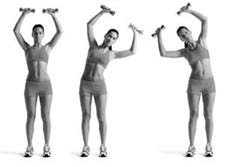
Please answer questions #6, 9, 10 using the pictures of the standing side bend exercise below. The picture on the far left is the starting position. The picture in the middle is end position of the first half of the movement. The picture on the far right is the end position of the second half of the movement.
Standing Side Bend
6. Which one of the following muscles functions to move the trunk from the starting
position to the end position of the first half of the movement?
a. Erector spinae
b. External oblique
c. Quadratus lumborum
d. All of the above
e. None of the above
9. When moving from the end position of the first half of the movement to the end
position of the second half of the movement, the muscle(s) causing this movement is(are)
contracting __________.
a. Concentrically
b. Eccentrically
c. Isometrically
d. None of the above; not actively participating in this movement
10. When moving from the end position of the first half of the movement to the end
position of the second half of the movement, the spine is moving in __________.
a. Flexion
b. Extension
c. Lateral flexion
d. Rotation
e. Hyperextension
D1
A 1500m runner wants to find out what is his/her optimal training running speed. What
variables must be simultaneously measured during an incremental exercise test attempting
to estimate this optimal intensity?
a) heart rate (HR), treadmill speed, and VO2.
b) HR, VO2, and blood lactate concentration.
c) HR, treadmill speed, and blood lactate concentration.
d) VO2, treadmill speed, and blood lactate concentration.
Appendix G
Hydrodynamics Exam for KINES 126
1. When manipulating one’s body position to be a horizontal back floater, the goal
is to:
a. move both your center of mass and center of buoyancy towards your head
b. move your center of mass towards your feet and your center of buoyancy towards
your head
c. move your center of mass towards your head and your center of buoyancy towards
your feet
d. move both your center of mass and center of buoyancy towards your feet
2. Lane lines are an example of one way to reduce _____________ drag, while shaving and wearing tight swimsuits are examples of ways to reduce _____________ drag.
3. A swimmer with a specific gravity less than 1 will ________________ (sink or float), while a swimmer with a specific gravity more than 1 will _______________ (sink or float).
4. “If a swimmer glides for too long, it will require more energy to resume stroking” is an example of the Law of _______________________.
5. The bent arm pull is an example of __________ the length of the resistance arm to reduce the amount of ________ needed to move you through the water.
6. In butterfly, the “sweep in and sweep out” motion of the arms creates _______ forces which are __________ to drag forces, and create most of the propulsion.
7. A swimmer’s hands and forearms should face __________ ____ ________ in order to create the greatest propulsive force from drag. This position allows the swimmer to push against the greatest amount of water.
8. “If forces are applied away from the swimmer’s intended direction, the body will be pushed off course and additional forces are necessary to readjust body motion and get back on track” is an example of the application of the Law of _____________________.
Appendix H
Lab One Assignment and rubric for KINES 159
Lab #1: NASPE Standards & Healthy People 2020
TOPIC: Tests for NASPE Standards and Healthy People 2020 Strategies
DESCRIPTION: This lab includes two parts. Students may complete this lab individually, in partners, or in groups of 3. Submit one electronic file per group.
PART 1: NASPE Standards
- Describe a valid test for assessing the ability of a physical education student (or exercise / health client) to achieve each of the five NASPE Standards. Type your description (100 words or less) directly into the NASPE Standards table that is included in this lab report.
PART 2: Healthy People 2020
- Select 3 Physical Activity Objectives
- Respond to the following items for each objective:
1. What is the objective?
2. What is the baseline?
a. How do we know this (what is the Data Source)?
3. What is the target?
4. Describe a strategy you would create in your community / school / business, etc. to achieve the target by 2020.
LAB 1 RUBRIC
| Lab Component | Excellent (3) | Good (2) | Unsatisfactory (1) |
|---|---|---|---|
| NASPE Test 1 | Test or strategy is valid and consistent with best practices and current research in physical activity and exercise science. Test or strategy is specific to the particular national standard or physical activity objective. Test or strategy description is vivid and detailed. | Test or strategy has face validity and is somewhat consistent with best practices and current research in physical activity and exercise science. Test or strategy is may be appropriate for, but is not specific to, the particular national standard or physical activity objective. Test or strategy description is lacking some detail. | Test or strategy validity is questionable or inconsistent with best practices and current research in physical activity and exercise science. Test or strategy is not specific to the particular national standard or physical activity objective. Test or strategy description is unclear or incomplete. |
| NASPE Test 2 | |||
| NASPE Test 3 | |||
| NASPE Test 4 | |||
| NASPE Test 5 | |||
| Healthy People 2020 Strategy 1 | |||
| Healthy People 2020 Strategy 1 | |||
| Healthy People 2020 Strategy 1 |
Appendix I
Diverse Populations Writing Assignment for KINES 122
Students enrolled in KINES 122 – Nontraditional Games and Outdoor Education will be given the prompt below and will be asked to engage in a think-pair-share activity. To start, students will individually think about the prompt and respond to it in writing. Then they will be asked to pair up with a class member and the two students will discuss their individual responses. The next step will involve a whole class discussion where the students will share their ideas. Students are encouraged and expected to participate in the whole class discussion. Students can earn up to five class points on selected days throughout the semester. Their participation in the class discussion, as well as their individual writing response will be included in each student’s point total for the day. The instructor will be looking for answers as suggested in the list below.
Writing Prompt: What are the factors that influence physical activity choices for diverse populations? How can the inclusion of nontraditional games and outdoor education experiences play a role in physical activity participation for diverse populations?
Key Answers:
• Physical activity tends to decrease with age
• Physical activity tends to be less among low-income individuals
• Physical activity tends to be less among lower educated individuals
• Sedentary lifestyle tends to be greater among adult women v. adult men
• Physical activity is greater in high-skilled individuals vs. lower-skilled individuals
• Nontraditional games and outdoor education experiences tends to level the playing
field and those who participate in these activities often feel enhanced competence
• Participation in nontraditional games and outdoor education experiences can lead
to increased confidence in the psychomotor domain
• Increased competence and confidence, which can occur as a result of participation
in nontraditional games and outdoor education experiences, can lead to further engagement
in physical activity for all populations
Appendix J
Cultural Activity Lesson Plan Assignment for KINES 122
Students enrolled in KINES 122 – Nontraditional Games and Outdoor Education are tasked with creating and implementing lesson plans to diverse groups of K-12 students. The information below is included in the grading rubric for the cultural activity lesson plan assignment.
| Lesson Plan Component | Poor – No SN or modifications identified (0) | Below Average (0.5) – Only one SN or modification identified | Average (1) – Only one SN and modification identified or two SN identified, but modifications are not consistent with the SN or are unclear | Good (1.5) – Two SN identified; modifications for one SN is consistent with the SN, but the other modifications are inconsistent or unclear | Great (2) – Two SN identified; modifications are consistent with the SN and relate to best practices within pedagogy |
|---|---|---|---|---|---|
| Special Needs (Identify two different special needs (SN) and explain how you will modify the game accordingly) | |||||
| Lesson Plan Component | Poor (0) – No inclusion of gender-specific information | Below Average (0.5) – Only one gender addressed (or both genders not addressed explicitly); modifications are weak or unclear | Average (1) – Only one gender addressed and modification identified or both genders addressed, but modifications are not consistent with best practices in pedagogy and/or don’t respect Title IX | Good (1.5) – Both genders addressed; modifications are consistent with best practices within pedagogy, but don’t respect Title IX | Great (2) – Both genders addressed; modifications are consistent with best practices within pedagogy and respect Title IX |
| Gender (assume that one or both genders will not want to participate and explain what you will do to achieve maximum participation of both genders) |
Appendix K
Teaching Video Assignment Rubric for KINES 144
| Description – | Comments |
|---|---|
| OPENING: Did you prepare the learners for the lesson? Did you connect this lesson with prior learning or previously learned skills? Is there a visual component to assist second language learners? Did you Q & A the students for understanding? | |
| LESSON PLAN/OBJECTIVES: Did the instructor have an appropriate lesson plan (sections, information, and structure)? Were the appropriate STATE objectives identified/coded (1, 2, 3, 4, 5 or 1, 2, 3) and were additional specific STATE objectives identified/coded? Does the lesson plan diagram take you from Bell to Bell in easy to follow outline form? | |
| DESCRIBE and DEMONSTRATE: Did you address the physical principles to be learned, and the action of the movement (UPF). Did you Q & A the students for understanding? | |
| INSTRUCTION: Do the students know what to do? Do they know if they performed correctly (UPF)? Did the teacher use cues to help students develop skills? Did you Q & A the students for understanding? | |
| MOTIVATION: Did you (positively, correctly, and specifically) encourage students to keep going, practice UPF, improve, and not give up? Was quality feedback (verbal and non-verbal) used throughout the class to motivate? | |
| ORGANIZATION: Was every student active (physical and/or education) 100% of the time? Were appropriate ASSESSMENT procedures administered for every student? Students were never left standing, waiting for their turn to practice, perform a skill, or complete an assignment. Did you move the students effectively between warm up, instruction and cool down areas? | |
| CLOSURE: Did you Q & A the students for understanding? Did the questions cover lesson content (STATE objectives / UPF)? Are the students able to perform skills (UPF) as a result of this lesson? | |
| INCLUSION: Were provisions made for low and high skilled students? | |
| Comments: | |
| PROFESSIONAL: Was the teacher dressed appropriately? Was the teacher’s voice and projection adequate for the area? Were all students supervised adequately? Did the teacher give feedback addressing UPF, motivation, improvement strategies, expectations, and educational principles? | |
| SAFETY PROVISIONS: Were safety issues covered in all aspects of this lesson (individual students, whole class, environment, equipment used)? Did the lesson design account for possible safety issues? |
Appendix L
Practical Exam for KINES 1
The Practical is worth a possible 20 points. The goal of the Practical is for you to show me how you can successfully coach a movement to others. You will be evaluated on your knowledge of the movement details, how well you can communicate the details to your students/athletes so that they can execute the movement with good technique, and your ability to recognize and correct faults. Your Practical should last a minimum of 4 minutes.
INTRO:
_____ Intro yourself
_____ Background/Description of movement
_____ Initial Demo
SETUP:
_____ Stance = shoulder width, toes turned out slightly
_____ Full extension at hips and knees
_____ Head position is neutral
_____ Bar “racked” on the shoulders (create a shelf with the shoulders for the bar
to sit on)
_____ Hands outside shoulders
_____ Loose, open fingertip grip
_____ Elbows high
_____ Upper arm parallel to the ground
EXECUTION:
_____ Weight on heels
_____ Natural curve of low back (lumbar curve) maintained
_____ Chest up
_____ Butt travels back and down to initiate movement
_____ Bottom of squat is hip crease below the top of the kneecap (below parallel)
_____ Knees track parallel to feet (no buckling)
_____ Return to full extension at the hips and knees to complete the movement
_____ Elbows high, arms stay parallel to ground throughout movement
PRIMARY POINTS OF PERFORMANCE:
_____ Bar racked properly: elbows high, hands just outside shoulders, bar re fingertip
grip
_____ Elbows high throughout the movement
_____ Natural curve of low back (lumbar curve) maintained
_____ Butt travels back and down to initiate movement
_____ Bottom of squat is hip crease below the top of the kneecap (below parallel)
DELIVERY:
_____ Volume
_____ Confidence/Calm
_____ Organized/Good Flow
_____ Reinforcing of Key Points
_____ DISCUSSED RELEVANCE OF POINTS
_____ Review/Conclusion/Tying up of any loose ends
_____ Time Management (4 minute minimum)
COMMAND OF ATHLETES:
_____ Cueing/Clarity of Cueing
_____ Adequate amount of reps
_____ Recognition/Correction of Faults
_____ Everyone constantly engaged
_____ Everyone kept on task
Appendix M
Alumni Survey
California State University, Fresno
Department of Kinesiology
B.S. in Kinesiology
ALUMNI SURVEY
The Department of Kinesiology at Fresno State is dedicated to providing quality educational and professional development experiences for our students now and in the future. As a graduate in a Kinesiology Option, we are interested in your satisfaction with our degree program. Your answers will help us assess how well we served your needs while you were a major in our department and will assist us in improving the training and experiences for future students.
Your responses on this questionnaire are for the Department of Kinesiology use only. You will remain anonymous in any and all reports related to this survey. Please first complete the background information by choosing the letter of the correct response.
1. Gender: A. Male B. Female
2. Age Group: A. 18-21 D. 31-35 G. 46-50
B. 22-25 E. 36-40 H. 51 or over
C. 26-30 F. 41-45
3. Race/Ethnicity: A. American Indian / Alaskan Native E. Native American /Indian
B. Asian / Pacific Islander F. White
C. Black / African American G. Other (specify)___
D. Hispanic / Latino
4. Kinesiology Option: A. Athletic Training C. General Kinesiology
B. Exercise Science D. Physical Education
5. Year of Graduation: A. 2014-15 D. 2018-19
B. 2015-16 E. 2019-20
C. 2017-18
Please read statements 6-15 and rate your agreement using the letter of most appropriate
response.
A. Strongly Agree
B. Agree
C. Undecided
D. Disagree
E. Strongly Disagree
Coursework/Instruction
6. Most of the required coursework prepared me for my future career plans.
7. The coursework blended course content and practical field experiences.
8. The coursework was intellectually challenging.
9. The overall quality of instruction in the required kinesiology (KINES) courses was high.
10. The overall quality of instruction in the required kinesiology activity (KAC) courses was high.
12. Instruction in the use of technology related to kinesiology was high.
Professional Preparation
12. The curriculum provided the discipline-specific skills needed to succeed in my chosen field.
13. The curriculum provided an understanding of the methods and practices of my chosen profession.
14. The program prepared me to succeed professionally after college.
Please read statements 15-20 and indicate the most accurate response.
Current Activities
15. Which of the following best describes your current primary activity?
A. Employed full time
B. Employed part time
C. Graduate/professional school full time
D. Graduate/professional school part time
E. Military service
F. Not employed, seeking employment, admission to graduate school, or other opportunity
G. Not employed by choice (homemaker, volunteer, traveling, etc.)
16. Which of the following best describes your career path since graduation? (check
all that apply)
A. Work in private sector
B. Work in not-for-profit sector
C. Work in public sector (local, state, or federal government)
D. Graduate school
E. Career training or other instruction (non-graduate school)
F. None of the above
17. How important is your undergraduate degree to your current employer?
A. Very important
B. Somewhat important
C. Only slightly important
D. Not important at all
E. Not applicable
18. My current job: (check all that apply)
A. Is related to my undergraduate major
B. Uses important skills I gained during college
C. Is related to my desired career path
D. Is work I find meaningful
E. Allows me to continue to grow and learn
F. Pays enough to support my desired lifestyle
G. Provides health insurance benefits
H. Is likely to continue until I wish to leave
G. Not applicable
20. I would recommend the Kinesiology Major at CSU Fresno to someone seeking a degree
in kinesiology.
A. Strongly Agree
B. Agree
C. Undecided
D. Disagree
E. Strongly Disagree
21. Please feel free to include any additional comments here:
Appendix N
Senior Exit Survey
California State University, Fresno
Department of Kinesiology
B.S. in Kinesiology
SENIOR EXIT SURVEY
The Department of Kinesiology at California State University, Fresno is “On the Move!” and dedicated to providing quality educational and professional development experiences for our students now and in the future. As a graduating senior in a Kinesiology Option, we are interested in your satisfaction with our degree program. Your answers will help us assess how well we have served your needs and will assist us in improving the training and experiences for future students.
Your responses on this questionnaire are for the Department of Kinesiology use only. You will remain anonymous in any and all reports related to this survey. Please first complete the background information by choosing the letter of the correct response. If “Other” is chosen in numbers 3 and 5, use the correct letter on the scantron then write the response directly on this sheet.
1. Gender: A. Male B. Female
2. Age Group: A. 18-21 D. 31-35 G. 46-50
B. 22-25 E. 36-40 H. 51 or over
C. 26-30 F. 41-45
3. Race/Ethnicity: A. American Indian / Alaskan Native E. Native American /Indian
B. Asian / Pacific Islander F. White
C. Black / African American G. Other (specify)____________
D. Hispanic / Latino
4. Kinesiology Option: A. Exercise Science
B. Physical Education
5. Career Goal (select one that best describes you now):
A. Teaching and/or Coaching at Elementary or Secondary level
B. Teaching and/or Coaching at Collegiate or Professional level
C. Athletic Administration at Elementary or Secondary level
D. Athletic Administration at Collegiate or Professional level
E. Athletic Training/Physical Therapy
F. Fitness Management/Personal Training/Recreation
G. Sport Marketing/Public Relations/Sport Agent
H. Post-Baccalaureate Training (Either Graduate or Professional Education)
I. Other (please specify) ____________________________________
Please read statements 6-39 and rate your agreement using the letter of correct response.
A. Strongly Agree
B. Agree
C. Undecided
D. Disagree
E. Strongly Disagree
Coursework/Instruction
6. The required coursework was relevant to my future career plans.
7. The coursework blended course content and practical field experiences.
8. The coursework has prepared me for future employment in the kinesiology profession.
9. The overall quality of instruction in the required kinesiology (KINES) courses was high.
10. The overall quality of instruction in the required kinesiology activity (KAC) courses was high.
11. Instruction in the use of technology related to kinesiology was high.
Timing of Instruction/Coursework
12. The kinesiology courses were offered when I needed to take them.
13. The kinesiology courses were available (open) when I needed to take them.
14. It would have benefited me if required kinesiology courses were offered at night between 6 to 9 pm.
15. It would have benefited me if required kinesiology courses were offered on Saturday.
16. It would have benefited me if required kinesiology courses were offered in the summer.
17. It would have benefited me if required kinesiology courses were offered on-line.
Academic & Career Advising
18. I received appropriate and timely academic advising.
19. I received relevant career advisement.
20. I received advising which directed me to take the appropriate classes for my option.
21. I received advising which directed me to take classes in the appropriate sequence for my option.
22. I received advising that helped me make good decisions about my future career directions.
23. The overall quality of advising which I received was high.
Kinesiology Faculty
24. The faculty has a strong commitment to student learning.
25. The faculty are professionally knowledgeable.
26. The faculty are organized and prepared for class.
27. The faculty presented current information.
28. My contact and interaction with faculty was sufficient enough to facilitate my learning and professional development.
29. The faculty displayed an interest in my professional development and growth.
30. Faculty were available for help outside of class.
31. Faculty were conscientious and enthusiastic.
32. The Kinesiology Department has outstanding faculty.
Staff
33. The department office staff was helpful in meeting my needs.
34. The equipment room staff was helpful in meeting my needs.
Overall Rating
35. I am satisfied with the overall education I received in kinesiology.
36. I received a sound education and training in kinesiology that taught me the principles, theories and application of my option.
37. The learning experiences I received met my expectations.
38. I believe I am well prepared for a career in kinesiology.
39. I would recommend the Kinesiology Major at CSU Fresno to someone seeking a degree in kinesiology.
Written Comments (Please write directly on this sheet.):
40. What have been the Kinesiology Department’s greatest assets for you
41. What have been the Kinesiology Department’s greatest drawbacks for you
This HTML version was generated with AI assistance and may contain errors or omissions. The original approved PDF remains the official document of record. An alternative accessible format is available upon request from the document creator in accordance with Title II of the ADA.